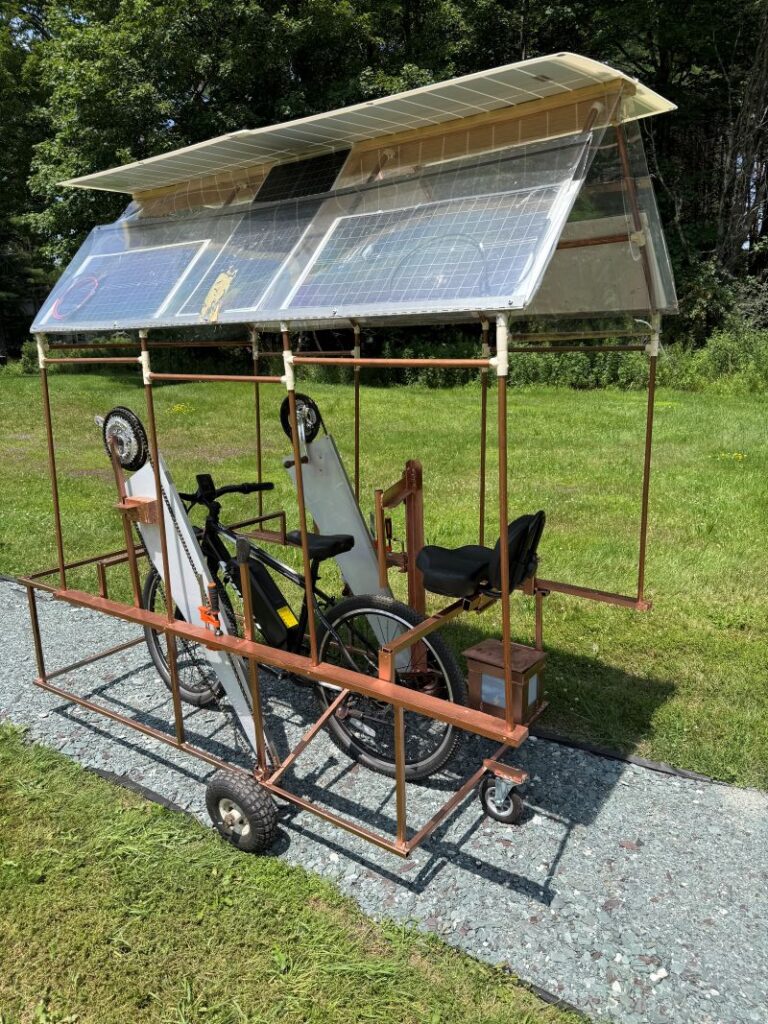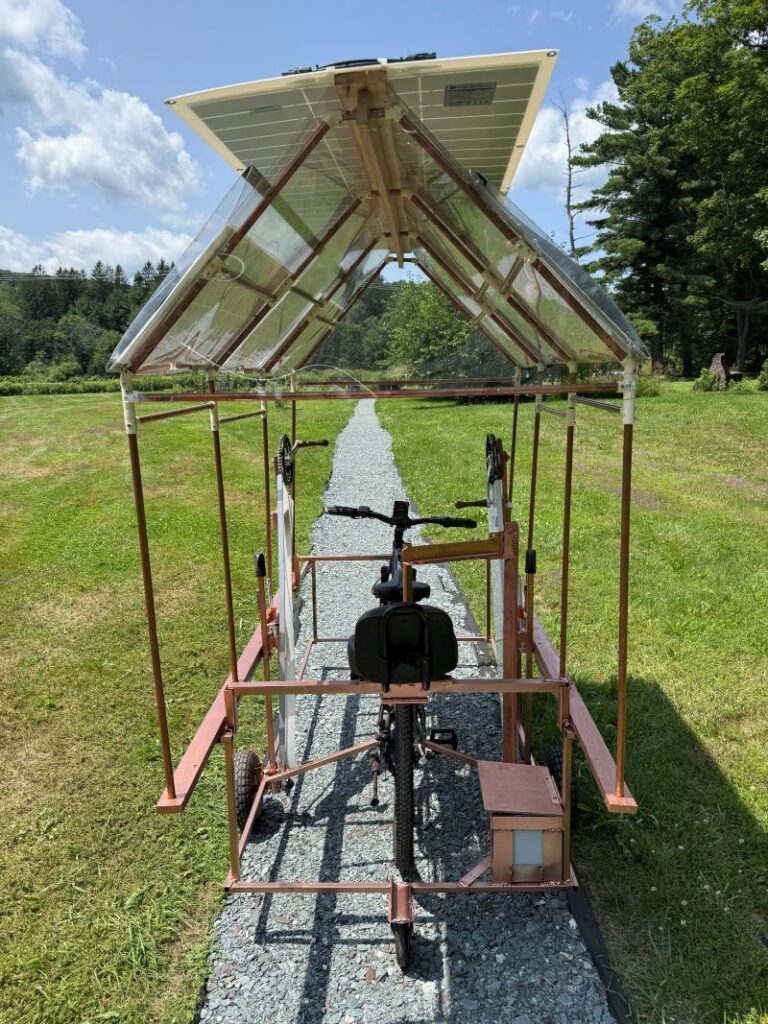
The Family

A 7-passenger human/solar electric-powered vehicle.

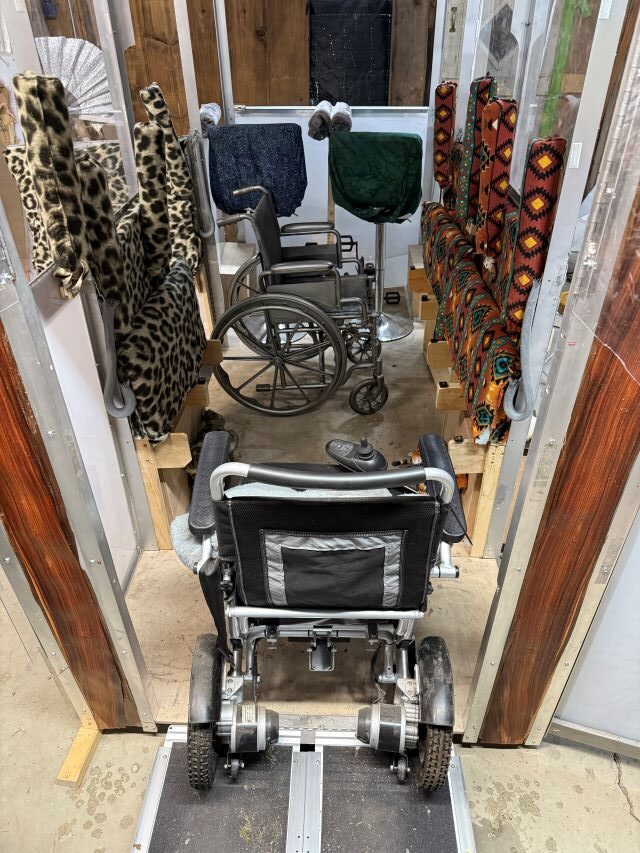
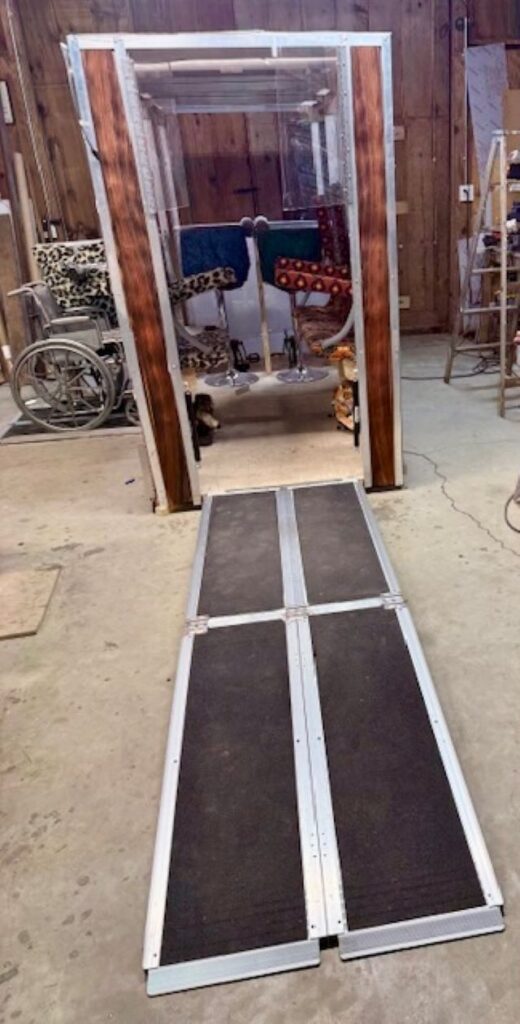
4’x10′. NYC legal pedicab. Wheelchair accessible.

Go, baby, go!
Pedicabs are finally being considered a subject worth discussing.

The Sociable

A Trike. 3’ x 6’ x 6’ tall.

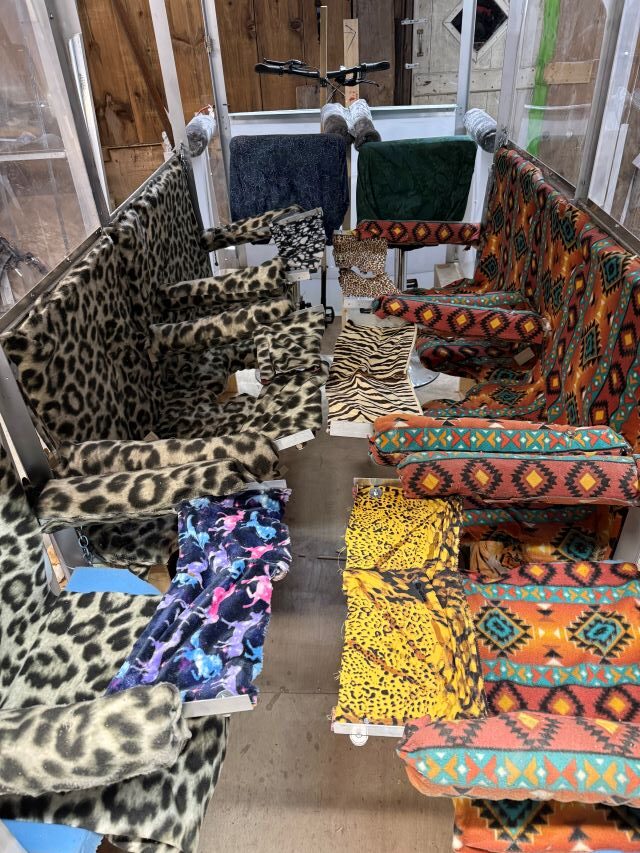
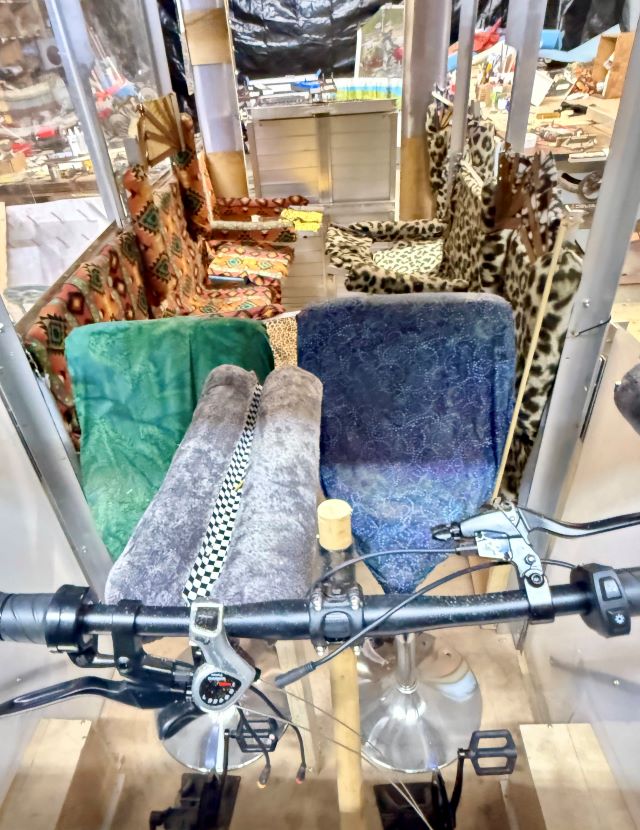
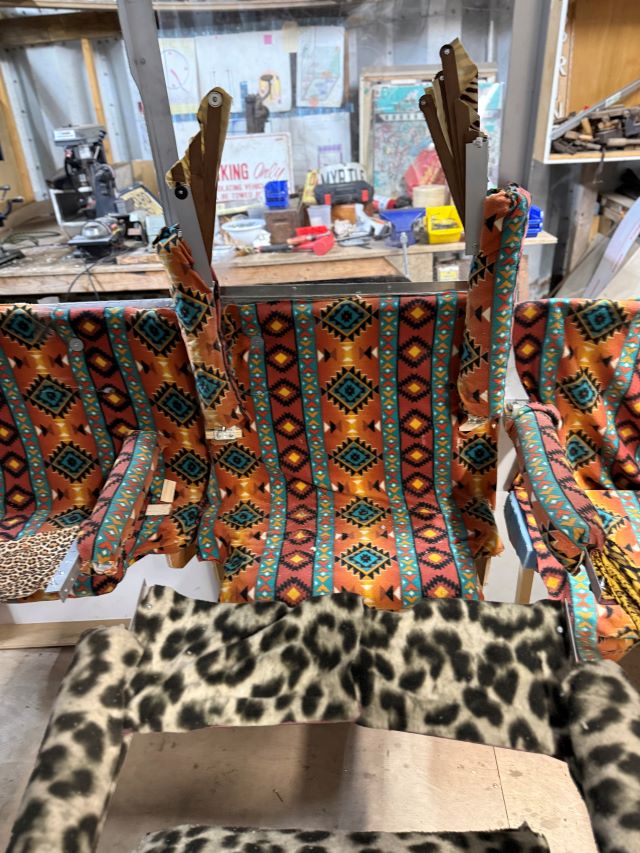
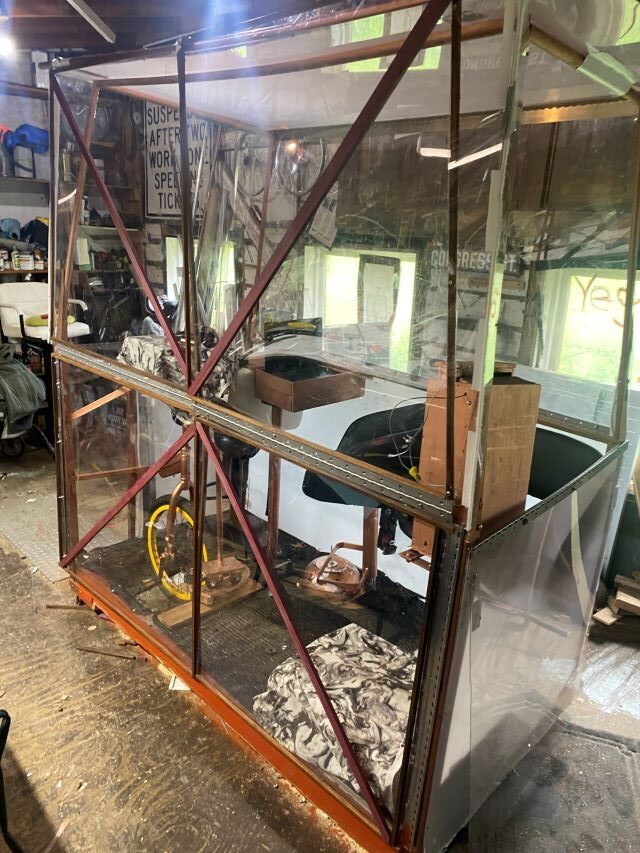
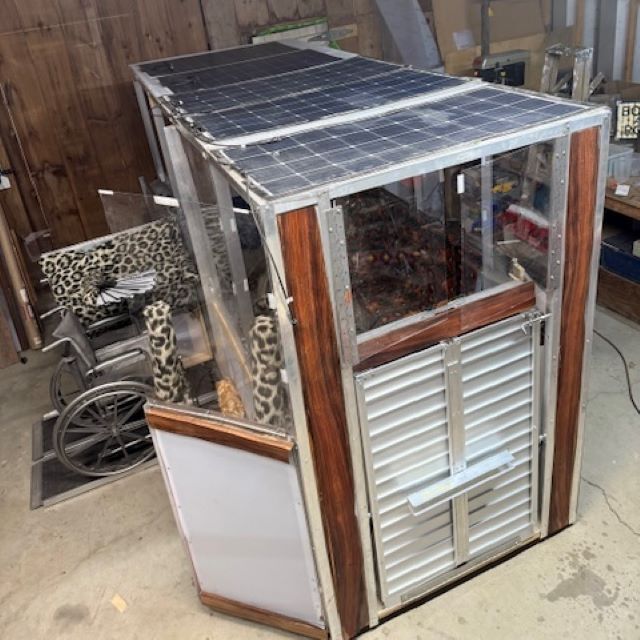
It can be wide open to the air or fully enclosed in a folding polycarbonate shell. It may carry one, two, or three people. One drive wheel is an anchored-in-place, pedal-able unicycle, the two others are hub-motor equipped, electric-powered wheels. The vehicle can travel, facing either the three or the six-foot side, either tandem-style or the more sociable side-by-side. The seats, and wheels, all pivot and move, easily, to enable this to happen. Use in dense urban spaces is what is expected here, and at a maximum speed of 15-20 mph to ensure safe operation.

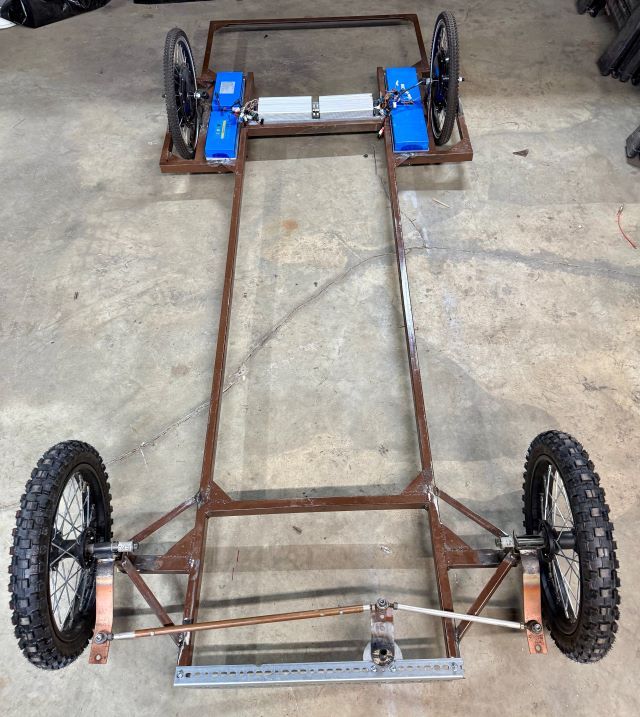
The wheels are all linked together so that when facing the six-foot side, with the pedaler steering, all the wheels turn together. When facing the 3’ side, the pedaler steers and the back wheels go straight, as in all trikes. Batteries are stored under the vehicle, which can be charged in place or slide out like a drawer and be rapidly replaced. A solar panel acts as a roof as well as a source of power. When an opening above is preferred it can be temporarily stored, with the rest of the body, alongside the wall. The hinges are aluminum, covered by colorful fabric. Closings are Velcro and magnets. Seats are well cushioned and sprung, mounted on tubes that are anchored to the floor. They can be adjusted for height and face any direction, as well as be tilted, to allow for the most comfortable, supported, standing/leaning posture, or made level. Drive wheels are under polycarbonate covers, both for passenger safety and comfort and to maximize weatherization when enclosed. These structures are part of the wheels’ “forks”, turn with them and help stabilize them.

Current regulations in New York State demand that electric bikes and trikes be no wider than 36”, thus this design. Careful study suggests a limit of 48” wide, or even up to 72”, with a corresponding stretching of the length to 8’ or so, will eventually be regarded, in crowded cities, as optimal for many purposes. For example, this would permit wheelchairs to be transported properly on such a vehicle, or several passengers or a healthy load of cargo to be accommodated safely and comfortably. The OH is meant to test the absolute minimum of space and materials that must be required to begin to accomplish these tasks. There are considerable benefits to exploring this, with the lowest level of consumption and simplicity of design, as one answer that offers a wide variety of rewards. It is not necessary to consider this as the only or best answer to this challenge, but it is, rather, a suggested first step in the right direction.

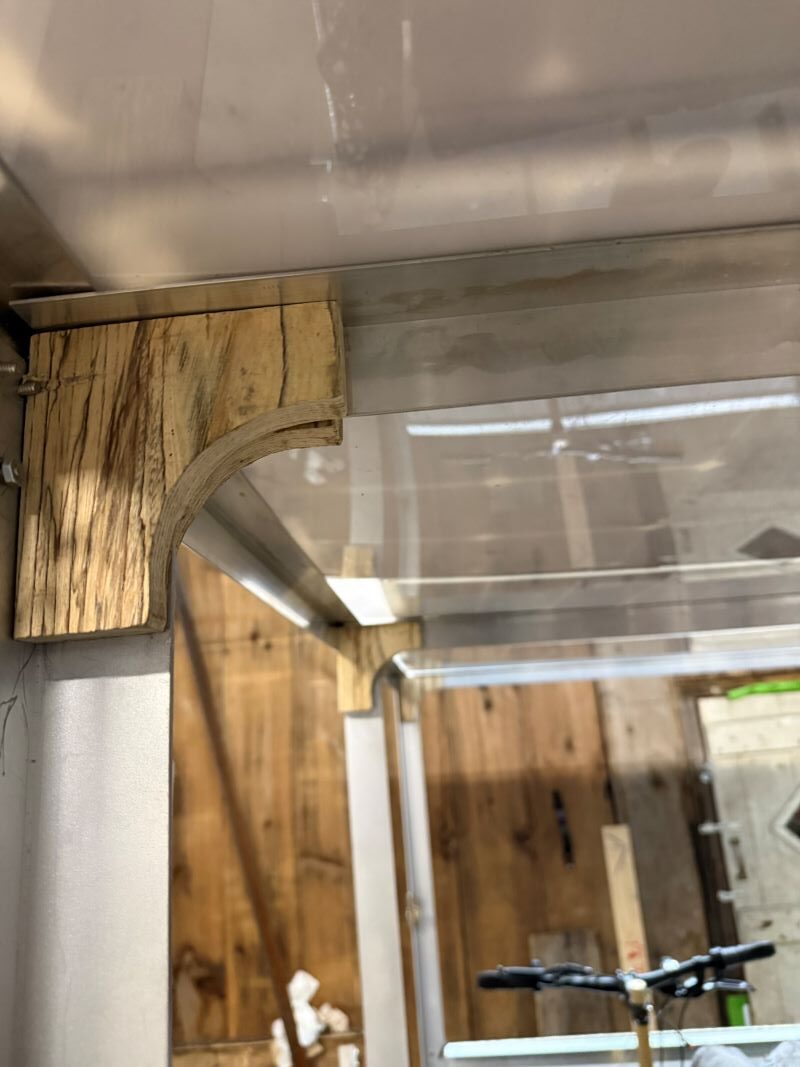
There is a 3/4” plywood floor, to which are attached aluminum poles, and steel angles. Poles anchor additional aluminum tubes, keeping seats and wheels in their proper places. Has appropriate lights, mirrors, and all other necessary equipment. The polycarbonate cover can be deployed partly, as desired, and the entire shell folds flat and can be stored alongside the back, This can be used as a personal vehicle, or for carrying passengers or cargo, as it is, without major modification. A full-scale working prototype is under construction.

The Everybike

An electric bike has outrigger wheels for stability,

foldable and removable, a weather cover with solar panels, hand cranks for extra power and upper-body exercise, can sit or stand in a yoke while pedaling, with space for a passenger. Still being perfected.

Steven Stollman

Longtime NYC Advocate

for human-scale vehicles, including electric-assist bicycles and pedicabs, as well as a stronger local, creative and public role in determining public-space issues. I imagine streets in the future filled with clean, quiet, weather-protected, multi-person conveyances that are beautifully and uniquely crafted, shaped, and decorated by human hands, gifting our roadways with color and rhythm, as well as safe and affordable transport, bringing a degree of charm and convenience to congested urban spaces everywhere that we are afraid to even dream of enjoying.

Total Articles: 41

The Testimony

The following is testimony was given by me at the hearing at DOT today, May 29th, regarding the new rules covering ebikes:

The flowering, here in its most natural and needed environment, of human-powered, with modest electric assistance, and human-scale transportation, is the best remedy for the damage inflicted by 100 years of control of this vital aspect of our lives by the mining and manufacturing industries. Using tons of materials to move us from place to place within urban spaces, when tens of pounds will do just as well, makes sense only to those selling us this mistake, pound by pound, year after year.

When I asked a Swiss participant in the “Tour de Sol” electric vehicle event in 1989 why a country with only 6 million people had 90 percent of all of the solar vehicles in the world, he replied “We have no car company and we have no oil company”

Your actions today are opening the door much wider to a fully sustainable future. You are to be congratulated for that. Now please apply your new awareness to similar vehicles, like pedicabs and cargo delivery vehicles, that have the potential to replace dangerous, oversized and polluting alternatives.

Also, please permit those using this equipment in their work to modify it, to conform to your new requirements without having to purchase brand new equipment, if the result is exactly the same. This is an unfair burden to place upon anyone when it serves no valid purpose. You can, instead, institute a regular testing procedure to ensure compliance and the Department can use the opportunity to simultaneously provide some beneficial orientation regarding traffic rules and best practices.

TO THIS I WOULD LIKE TO ADD:

The New York Bicycling Coalition deserves much credit for bringing awareness to this issue over the last four years. They are currently leading the charge in Albany in order to bring forth appropriate legislation on the State level. Any help from DOT in this regard is most helpful and appreciated of course.

We need to learn to respond to situations such as this, whether it be new technology or unforeseen environmental effects, without waiting decades to assess and act. We may not have an infinite amount of time to deal with matters of this magnitude.

I was the NY distributor for a variety of electric bike brands, including Giant, Panasonic and FORD, without much success over the past decades and all of these machines fell far short of adequacy, since they relied on heavy lead acid batteries that made them very cumbersome. The advent of lightweight lithium ion batteries has changed the situation radically though and it is now virtually impossible to distinguish some electric bikes from non-electric ones. Most importantly, the onus of using these machines has all but disappeared. The bike culture has finally come to embrace these vehicles and those who use them. Instead of sneers you get intelligent questions about how they work. All over Europe and the rest of the world electric-assist vehicles are being welcomed. We are late to the party but at least we are getting there.

I am currently designing prototypes of wheelchair-carrying pedicabs that will require pedal-activated electric-assist motors to function properly. The benefits of this technology, especially to those with mobility challenges, will be enormous.

Thank you again, on behalf of all air-breathing animals.

Trike-share and the future of electric transport

Many of the most disturbing events taking place around the world, the Middle East, Ukraine, etc. revolve around the supply of fossil fuels. It is a militarized world because there are stores of wealth, instead of more equitable distribution, and they must be defended. The tools used to maintain the status quo are also heavily tilted in favor of big machines, military, and civilian, cars, trucks, airplanes, etc. that also depend upon these materials to provide their motive power. WWII, and even WWI, in many’s estimations, was largely decided by the combatants’ ability to manufacture, use and fuel these enormous mechanisms effectively, to employ the heavy armor that carries its ordinance into battle. In some important ways, in spite of all the miniaturization and other technological advances made in the last century, this is still true. Nobody should ignore the bravery of troops and cleverness of commanders as key factors in these matters of course, along with the righteousness of their causes, and the cooperation of populations in these struggles, but the machines, and the fuels they run on are still huge factors in determining who prevails.

Even local conflagrations, like those now taking place in Ferguson Missouri, one commentator suggested, are deeply rooted in the frequency of car stops, the assumed profiling that goes into them and the higher rate of incarceration generated by unbalanced enforcement. “The New Jim Crow”, the book I am currently reading, makes a strong argument that policing policies have had a great impact on the definition of communities and the ability of their members to assume their rightful place within societies. The remarkable revelations regarding the use of retired military equipment and the adoption of quasi-military tactics have become a serious element of the overall picture.

We have accustomed ourselves to a world where speed, power and the ability to physically overcome the obstacles that restrain our ambitions and assumed freedoms have become paramount concerns, both psychologically and practically and the source of a preponderance of violence and unhappiness. This is mostly a direct result of the importance of status and the historical differences in access to resources which the past has delivered to us in abundance. We may be able to encourage a more balanced and egalitarian approach to these situations by modifying some behaviors but the underlying influences are powerful and without examining them and finding ways to re-balance these situations, any cosmetic or minor improvements may just serve to sustain the prior contradictions and misalignments.

Our inability to face up to and deal with these important issues is dismissed by most as a consequence of our busy lives and pressures to keep things together in an increasingly pressurized and difficult environment. Who has the time to devote to causes when the garbage has to be taken out and the mortgage payments made in time? For the privileged it is mostly a question of priorities, sorting through available pleasures and choosing the most attractive ones. For everybody else, social, environmental and other problems are considered insoluble anyway and beyond the reach of the common man. It is up to the editorialists and the habitually discontented, widely regarded as maladjusted individuals with the need to complain about something, to bring up these issues and grind their molars to bring themselves a measure of self-satisfaction. The only way that things will change if there are a catastrophe and the cure might easily be worse than the problem if you’re not careful, so why bother?

This attitude is encouraged by those who would prefer that things stay the same regardless of the consequences. We are frozen in space, comforted by the amount of company we have in this paralytic coma. We know that our leaders are dunces and expect no more from them. We know our neighbors are in the same boat so why should we be the ones to stand out? The differences in priorities between old and young, black and white, male and female, in themselves are so profound and effective in determining our attitudes and ideas, that the smaller ones, like the variations in income and prospects, sink into unimportance.

We take for granted a host of incongruities and distinctions that are really unfortunate and unnatural yet too minor to rise into full consciousness. We know that everybody is different and would be horrified to live in a world where these aspects of our individual relationship to the world did not exist since we identify ourselves by them and spend a lot of time enhancing or submerging them. Sure, one person is a better dancer and another a smoother talker and that is OK. But what if one seems touched by an Angel and another doomed to fail, should that be accepted without question?

We love the competition. More so when we or our team wins, but the thrill of being in a contest where one might prevail gins up the adrenalin regardless. Some of this is perfectly natural and a wholesome way to motivate people to excel. If the game is rigged though, it can dispirit the players and make them permanently cynical. Even more importantly, it creates a model for other activities and sets standards of behavior. It has been said that in a baseball game in Japan, the perfect score is a tied one, and participants are happiest when everybody is a winner and nobody a loser. This kind of societal compassion might be pointed at by cynics as the reason that the country has been in economic distress for decades, a core failure that keeps the spirit of success from pushing individuals to achieve and thereby prosper. Another interpretation is that the commonality here is an expression of the humanity of those people and far more valuable than a trophy or medallion stuck away in a drawer somewhere.

Empathy is the enemy of dominance and can not be measured or put into a chart or a bottle to be put on a shelf. In our culture, we are captives of quantification and have sacrificed the concept of quality to the accumulation of points, square feet of house size, horsepower and stacks of possessions. Not surprisingly, 750 watts, a mere one horsepower, brings to mind a lonesome cowboy, a sad and unimposing figure, yet this is three times the figure permitted in the European Union and Asia to propel a person 25 KPH on an electric-assist bike, enough to do the job of getting somebody to work or play each day. It might be necessary to double that figure if you add a second person as a passenger or substantial sized load of goods, some weather protection or the energy to overcome a strong headwind, but it is enough for almost any purpose. Is there any rationale for keeping these vehicles off the road since bicycles are now considered legitimate vehicles everywhere and permitted on city and country roads everywhere?

The New York State situation is illustrative. The NY Times this week highlighted the increased role of electric-assist bikes in Germany, hardly a third-world country, with thousands of them in use by the post office there and a rapidly increasing presence as commuter vehicles throughout this heavily-industrialized nation. Last year, a bill here to legalize these vehicles came with a day of being passed by the NY State Legislature. The prospects for this happening next year are good, especially since the national bike organizations, People for Bikes, etc. have now indicated their strong desire for this to happen. For too long, the bike culture looked upon these devices as heretical, a departure from the ethic of self-reliance and self-propulsion essential to their vision of the role of cycles in the society. Finally, they have come to realize that there is a huge portion of the population that wants to bike but finds the exertions necessary to overcome hilly terrain, the long distances of their commutes and their desires to show up to work without having to change clothes, to be serious impediments to the use of regular bikes. Logic, fairness and common sense are overcoming historic prejudices and limitations of vision, but much too slowly.

The e-bike industry has done a pretty good job of perfecting this technology. It has come at a price though, in that typical bikes are in the $1500 to $3000 range and the cost of lithium-ion batteries is still relatively high. There is the talk of breakthroughs that will radically lower these costs and extend range while making the vehicles as light as typical mountain bikes rather than the 60-80 pounds that were the rule when lead-acid batteries were the norm. The designs are beginning to evolve rapidly as well, with Kickstarter and other such venues highlighting exotic and exciting-looking alternatives with extra features such as special communications, health-monitoring and mobile-device charging becoming standard equipment on many models. Instead of merely taking regular bikes and adding on a motor these vehicles are now beginning to forge an identity of their own. Prices in the $3000-$5000 range are no longer unusual and every major automobile company from Ford to Mercedes is featuring their own version of this new transport modality. Models with higher speeds, beyond those permitted under the Federal law that limits them to 20 MPH without assistance, are also becoming more popular here, even though they may require more paperwork and permits.

In spite of all these changes, the real potential of this modality to radically transform our transportation systems is still to be realized fully. This will involve the shift from the two-wheeled model, a bike basically, to the three-wheeled version usually referred to as a trike. Our concept of trikes is conditioned by their identity as the vehicle of choice for 3-6-year-old kids. The hilarious notion, popularized by the old “Laugh-in” bits, of a full-grown person precariously turning the wheel of his tiny tricycle too quickly and tumbling over sideways, or the elderly resident of a retirement community tooling along at 3 MPH, still dominates our thinking. Human-powered and electric-assisted hybrids, with some weather protection and freight capacity, like the ELF, are now being born, even appearing this month on the cover of the Hammacher-Schlemmer catalog, but are still rare and virtually invisible. In time, they should become the most common form of travel, especially when they can become part of vehicle-sharing systems. Many new designs will need to be perfected and introduced to the public and overcome the limitations imposed by unjustifiable rules, such as the one proposed in New York State which prevents those under 16 years of age from riding as passengers.

Sure, over time we will be able to overcome these restrictions and sense will prevail but we are already decades behind in our thinking and really need a leap forward to make up for some of this lost time. One of the reasons that it is difficult to accomplish this is because of the pressures exerted by those with the largest stake in the existing system. Keeping archaic laws in place is possible through the intransigence of public officials who automatically endorse the policies already in place without considering their actual impact. It took 10 years for the NYS Senate to even consider the legalization of e-bikes even though a bill had been passed in the Assembly each year all during that time.

This reflexive endorsement of the status quo is a willful failure to consider the improvements to our lives that new technology can sometimes provide, with no other rationale than the protection of existing interests and their historical limitations. Imagine if we were still using landline rotary dial phones because AT and T preferred that system. More public pressure can sometimes help and the ability of these new interesting industries to promote their products matters as well, but we have lost decades due to this form of reactionary mindsets. It is a subtle form of corruption and is one of the factors that is eroding the potential for those now struggling with the exceptional pressure to survive and prosper in this economy. Downscaling is very difficult for those institutions, like governments, that depend upon the scale of economic activity without necessarily relating to the amount of useful activity involved versus the amount of waste being generated. We ordinarily do not distinguish between the two and in this case, we must.

This calculation does not even count the most important issue of all, our health. Giving us the option of using our muscles and bodies to accomplish needed work is essential to our futures. The greatest costs incurred are in health care and the loss of vitality is what shortens life and makes it less rewarding and pleasurable. Here is the opportunity to preserve our most important abilities, at the same time as we save money and improve the environment and it is not being encouraged in every way? How can that be? Are we so decadent or are our institutions so out of touch with the most pressing needs that we can not recognize this reality? Sadly, there is only one answer. We are lost and we can not expect our “guides” to bring us home. Only a much higher level of activism and consciousness can change this situation and it is ours, not others, that matters. If we can’t fix something as obvious as this, how will we ever be able to take on the more difficult questions? Answer: we can’t.

The Snell Report

https://books.google.hr/books?id=TE3wTD1ckF4C&printsec=frontcover&source=gbs_ge_summary_r&redir_esc=y#v=onepage&q&f=false

In 1974, Bradford Snell, a legislative assistant to Senator Hart of Michigan, and Judiciary Committee staff attorney, delivered an historic report on the partnership between two great American industrial powers, the General Motors Company and the Standard Oil Company (Firestone was the junior partner), which resulted in the dismemberment of our entire rail system, all in a bid to increase their profits. The report was distributed by the Government Printing Office, until GM demanded, successfully, that it be withdrawn. In subsequent years some of its observations have been challenged but the central theses are undeniably truthful and shocking in their conclusions. Here is a link to the original testimony that gave birth to the report.

This amalgamation between the largest elements of the manufacturing sector and the mining sector, to some extent as the representatives of those elements of the economy, was begun in the 1930s. Their express purpose was the destruction of the rail infrastructure of the United States of America, their home country. Many would regard this as an unmeasurably immense act of domestic terrorism. This was, without question, an assault upon our common interests, one that would be expected to be perpetrated by a sworn enemy, intent upon weakening our economy and demolishing the prospects for our future prosperity. In fact, Mr. Snell’s report also details some of the ways in which these same corporations, during WW II, also maneuvered to maintain and preserve their relations with the Axis powers, even after the war had been declared.

This was a deliberate, and ultimately successful effort, to expand the market for their products, by means of demolishing the quality and availability of their competitors’. Some are familiar, through the “Roger Rabbit” movie and other sources, with the destruction of large parts of the California traction system. Less well understood, is, that this was a nationwide, three-pronged program, which targeted Inter-urban Rail, Trolleys and Rail Freight at the same time. This campaign worked so well, that these modes of transportation are virtually gone and have been replaced by cars, trucks, and buses, vastly inferior economically and environmentally. The conversion of major streets into highways and raceways also had the collateral effect of making them unusable by bicycles and other slower and more vulnerable populations.

Over the years Mr. snell has promised to put together the complete story of General Motors and its efforts to make money and influence policy. Since the company has gone through such massive contortions over the past decades it is a seemingly unending tale, which he will no doubt, one day, finish telling. Just today, it was announced that the Federal government will sell off its remaining shares in the company and sustain only a merciful $10 billion loss, a pittance compared with the potential loss to the taxpayers and employees at the time. As an additional benefit, some pressure has been applied to encourage the development of cleaner and safer and more efficient models, but, sadly, the nature of “cars” as we know them, and the industries that supply them, remains largely the same.

There are two questions that must be answered to understand the nature of this massive re-direction of resources: How could this happen in a democracy, where the interests of the many are supposed to hold sway over the preferences of any privileged minority? Also, does the convenience, comfort, and ubiquity of these new ways to get around make them vastly superior to their rail-bound predecessors? The answers to these questions are vital to those now in the process of attempting to once again bring about structural change to these areas of our lives. The expansion of human-scale transportation like electric-assist bikes, new power sources for electric cars, buses and trucks, and the land-use and other associated issues related to these developments will define our future, in some key ways, and need to be addressed in their fullness.

Next week, some more information, such as the complete “American Ground Transport” report, will be linked up to this site. This week, two events took place in the electric-assist bicycle universe here, one welcome and the other tragic:

Bert Cebular, the founder and operator of NYCEWheels, the city and country’s leading purveyor of electric bikes, died in a para-glider accident. Practicing sensitive “touch and go” procedures, he is the person who would probably have used his skills in the rescue work of the future. He was a highly admired, respected and liked person and a pioneer for ten years in raising the profile of the activity. He made sure that his staff worked, maintained a real service and tech department, was a master woodworker, web designer, mechanic and creative vehicle maker, a rare polymath and forward thinker who caught the wrong gust of wind and will be sorely missed. There is a memorial ride this morning through the snow.

The other development was a demonstration, organized by the Urban Justice Center, of over 100 restaurant deliverers, mostly Asian, who are being swept up in the city’s recent campaign to “ban” electric-assist bikes here. It is a welcome step that these hard-working people, using environmentally-optimized transport, having been demonized by the auto-advertising addled press as a hazard to navigation, are fighting back. They will have the opportunity to establish the benefits of what they do and how they do it. Some contributions to improving the current situation will need to come from the restaurant industry itself, such as a campaign to eliminate any sidewalk riding, by deliverers as well as others. A new Mayor and City Council, perhaps somewhat more sensitive to the conditions under which hard-working people must maintain themselves, should improve prospects here. Political figures at both the State and City level, and the media, will need to be educated, given rides and helped to understand the issue better, apart from the overblown rhetoric which has been defining it in the public’s mind for too long. The health value of this new transport modality to the older population and others will be brought forward and its real nature made plain. It’s about time.

The Downscaling Conundrum

Aug 24, 2014. Times Article Viewed: 9331

For over 150 years of the industrial revolution, bigger has always been better, but in the 21st century figuring out how to downscale will be the most daunting challenge mankind will face.

Many of the most disturbing events taking place around the world, the Middle East, Ukraine, etc. revolve around the supply of fossil fuels. It is a militarized world because there are stores of wealth, instead of more equitable distribution, and they must be defended. The tools used to maintain the status quo are also heavily tilted in favor of big machines, military, and civilian, cars, trucks, airplanes, etc. that also depend upon these materials to provide their motive power. WWII, and even WWI, in many’s estimations, was largely decided by the combatants’ ability to manufacture, use and fuel these enormous mechanisms effectively, to employ the heavy armor that carries its ordinance into battle. In some important ways, in spite of all the miniaturization and other technological advances made in the last century, this is still true. Nobody should ignore the bravery of troops and cleverness of commanders as key factors in these matters of course, along with the righteousness of their causes, and the cooperation of populations in these struggles, but the machines, and the fuels they run on are still huge factors in determining who prevails.

Even local conflagrations, like those now taking place in Ferguson Missouri, one commentator suggested, are deeply rooted in the frequency of car stops, the assumed profiling that goes into them and the higher rate of incarceration generated by unbalanced enforcement. “The New Jim Crow”, the book I am currently reading, makes a strong argument that policing policies have had a great impact on the definition of communities and the ability of their members to assume their rightful place within societies. The remarkable revelations regarding the use of retired military equipment and the adoption of quasi-military tactics have become a serious element of the overall picture.

We have accustomed ourselves to a world where speed, power and the ability to physically overcome the obstacles that restrain our ambitions and assumed freedoms have become paramount concerns, both psychologically and practically and the source of a preponderance of violence and unhappiness. This is mostly a direct result of the importance of status and the historical differences in access to resources which the past has delivered to us in abundance. We may be able to encourage a more balanced and egalitarian approach to these situations by modifying some behaviors but the underlying influences are powerful and without examining them and finding ways to re-balance these situations, any cosmetic or minor improvements may just serve to sustain the prior contradictions and misalignments.

Our inability to face up to and deal with these important issues is dismissed by most as a consequence of our busy lives and pressures to keep things together in an increasingly pressurized and difficult environment. Who has the time to devote to causes when the garbage has to be taken out and the mortgage payments made in time? For the privileged it is mostly a question of priorities, sorting through available pleasures and choosing the most attractive ones. For everybody else, social, environmental and other problems are considered insoluble anyway and beyond the reach of the common man. It is up to the editorialists and the habitually discontented, widely regarded as maladjusted individuals with the need to complain about something, to bring up these issues and grind their molars to bring themselves a measure of self-satisfaction. The only way that things will change if there is a catastrophe and the cure might easily be worse than the problem if you’re not careful, so why bother?

This attitude is encouraged by those who would prefer that things stay the same regardless of the consequences. We are frozen in space, comforted by the amount of company we have in this paralytic coma. We know that our leaders are dunces and expect no more from them. We know our neighbors are in the same boat so why should we be the ones to stand out? The differences in priorities between old and young, black and white, male and female, in themselves are so profound and effective in determining our attitudes and ideas, that the smaller ones, like the variations in income and prospects, sink into unimportance.

We take for granted a host of incongruities and distinctions that are really unfortunate and unnatural yet too minor to rise into full consciousness. We know that everybody is different and would be horrified to live in a world where these aspects of our individual relationship to the world did not exist since we identify ourselves by them and spend a lot of time enhancing or submerging them. Sure, one person is a better dancer and another a smoother talker and that is OK. But what if one seems touched by an Angel and another doomed to fail, should that be accepted without question?

We love the competition. More so when we or our team wins, but the thrill of being in a contest where one might prevail gins up the adrenalin regardless. Some of this is perfectly natural and a wholesome way to motivate people to excel. If the game is rigged though, it can dispirit the players and make them permanently cynical. Even more importantly, it creates a model for other activities and sets standards of behavior. It has been said that in a baseball game in Japan, the perfect score is a tied one, and participants are happiest when everybody is a winner and nobody a loser. This kind of societal compassion might be pointed at by cynics as the reason that the country has been in economic distress for decades, a core failure that keeps the spirit of success from pushing individuals to achieve and thereby prosper. Another interpretation is that the commonality here is an expression of the humanity of those people and far more valuable than a trophy or medallion stuck away in a drawer somewhere.

Empathy is the enemy of dominance and can not be measured or put into a chart or a bottle to be put on a shelf. In our culture, we are captives of quantification and have sacrificed the concept of quality to the accumulation of points, square feet of house size, horsepower and stacks of possessions. Not surprisingly, 750 watts, a mere one horsepower, brings to mind a lonesome cowboy, a sad and unimposing figure, yet this is three times the figure permitted in the European Union and Asia to propel a person 25 KPH on an electric-assist bike, enough to do the job of getting somebody to work or play each day. It might be necessary to double that figure if you add a second person as a passenger or substantial sized load of goods, some weather protection or the energy to overcome a strong headwind, but it is enough for almost any purpose. Is there any rationale for keeping these vehicles off the road since bicycles are now considered legitimate vehicles everywhere and permitted on city and country roads everywhere?

The New York State situation is illustrative. The NY Times this week highlighted the increased role of electric-assist bikes in Germany, hardly a third-world country, with thousands of them in use by the post office there and a rapidly increasing presence as commuter vehicles throughout this heavily-industrialized nation. Last year, a bill here to legalize these vehicles came with a day of being passed by the NY State Legislature. The prospects for this happening next year are good, especially since the national bike organizations, People for Bikes, etc. have now indicated their strong desire for this to happen. For too long, the bike culture looked upon these devices as heretical, a departure from the ethic of self-reliance and self-propulsion essential to their vision of the role of cycles in the society. Finally, they have come to realize that there is a huge portion of the population that wants to bike but finds the exertions necessary to overcome hilly terrain, the long distances of their commutes and their desires to show up to work without having to change clothes, to be serious impediments to the use of regular bikes. Logic, fairness and common sense are overcoming historic prejudices and limitations of vision, but much too slowly.

The e-bike industry has done a pretty good job of perfecting this technology. It has come at a price though, in that typical bikes are in the $1500 to $3000 range and the cost of lithium-ion batteries is still relatively high. There is the talk of breakthroughs that will radically lower these costs and extend range while making the vehicles as light as typical mountain bikes rather than the 60-80 pounds that were the rule when lead-acid batteries were the norm. The designs are beginning to evolve rapidly as well, with Kickstarter and other such venues highlighting exotic and exciting-looking alternatives with extra features such as special communications, health-monitoring and mobile-device charging becoming standard equipment on many models. Instead of merely taking regular bikes and adding on a motor these vehicles are now beginning to forge an identity of their own. Prices in the $3000-$5000 range are no longer unusual and every major automobile company from Ford to Mercedes is featuring their own version of this new transport modality. Models with higher speeds, beyond those permitted under the Federal law that limits them to 20 MPH without assistance, are also becoming more popular here, even though they may require more paperwork and permits.

In spite of all these changes, the real potential of this modality to radically transform our transportation systems is still to be realized fully. This will involve the shift from the two-wheeled model, a bike basically, to the three-wheeled version usually referred to as a trike. Our concept of trikes is conditioned by their identity as the vehicle of choice for 3-6-year-old kids. The hilarious notion, popularized by the old “Laugh-in” bits, of a full-grown person precariously turning the wheel of his tiny tricycle too quickly and tumbling over sideways, or the elderly resident of a retirement community tooling along at 3 MPH, still dominates our thinking. Human-powered and electric-assisted hybrids, with some weather protection and freight capacity, like the ELF, are now being born, even appearing this month on the cover of the Hammacher-Schlemmer catalog, but are still rare and virtually invisible. In time, they should become the most common form of travel, especially when they can become part of vehicle-sharing systems. Many new designs will need to be perfected and introduced to the public and overcome the limitations imposed by unjustifiable rules, such as the one proposed in New York State which prevents those under 16 years of age from riding as passengers.

Sure, over time we will be able to overcome these restrictions and sense will prevail but we are already decades behind in our thinking and really need a leap forward to make up for some of this lost time. One of the reasons that it is difficult to accomplish this is because of the pressures exerted by those with the largest stake in the existing system. Keeping archaic laws in place is possible through the intransigence of public officials who automatically endorse the policies already in place without considering their actual impact. It took 10 years for the NYS Senate to even consider the legalization of e-bikes even though a bill had been passed in the Assembly each year all during that time.

This reflexive endorsement of the status quo is a willful failure to consider the improvements to our lives that new technology can sometimes provide, with no other rationale than the protection of existing interests and their historical limitations. Imagine if we were still using landline rotary dial phones because AT and T preferred that system. More public pressure can sometimes help and the ability of these new interesting industries to promote their products matters as well, but we have lost decades due to this form of reactionary mindsets. It is a subtle form of corruption and is one of the factors that is eroding the potential for those now struggling with the exceptional pressure to survive and prosper in this economy. Downscaling is very difficult for those institutions, like governments, that depend upon the scale of economic activity without necessarily relating to the amount of useful activity involved versus the amount of waste being generated. We ordinarily do not distinguish between the two and in this case, we must.

This calculation does not even count the most important issue of all, our health. Giving us the option of using our muscles and bodies to accomplish needed work is essential to our futures. The greatest costs incurred are in health care and the loss of vitality is what shortens life and makes it less rewarding and pleasurable. Here is the opportunity to preserve our most important abilities, at the same time as we save money and improve the environment and it is not being encouraged in every way? How can that be? Are we so decadent or are our institutions so out of touch with the most pressing needs that we can not recognize this reality? Sadly, there is only one answer. We are lost and we can not expect our “guides” to bring us home. Only a much higher level of activism and consciousness can change this situation and it is ours, not others, that matters. If we can’t fix something as obvious as this, how will we ever be able to take on the more difficult questions? Answer: we can’t.

Times Article Viewed: 9331

How to build a human/solar-powered vehicle

Find some old, discarded, broken, or unused bikes of any description.

Find a pad of paper and a pencil or pen and look in the library for helpful information.

Begin to imagine what a different kind of vehicle might look like and how it might work.

Call a friend or two so that this can begin to be a cooperative group project

Make a poster with an email describing this project and what you hope to accomplish.

Find some unused space to work or put the request for one on the information poster.

Contact local hardware, and second-hand stores, to ask them to contribute needed materials.

Offer all local businesses the opportunity to sponsor and provide resources for the group.

Collect a basic hand and power tool kit and selection of nuts and bolts, tape, epoxy, etc.

Offer other locals, with an interest in this process, the opportunity to become involved.

See if there are engineers, mechanics, artists, craftspeople, or anyone willing to pitch in.

Let the local media know what you are doing so they can publicize and help you.

Post your progress on AMovement.org so you can invite comments and help.

Follow the advances that other groups are making and continue to learn from them.

Bring local officials into the picture and encourage them to pursue your ideas seriously.

Learn the history of transportation in this country and how it has been manipulated.

Give everybody rides in your vehicle and begin re-evaluating and re-designing it.

Use the experience of the following something from idea to reality to solve other problems.

Establish the value of believing in yourself and learning to be as creative as possible.

Persuade all local educational establishments to consider beginning their own project.

Work to use the results of these efforts to bring forth actual enterprises and products.

Ride around and show off what you have done in order to inspire more similar efforts.

Steps

1. This is an invitation to individuals and groups, literally everywhere, to design and construct examples of the kind of transportation we need in order to survive this period. Must be as minimal as possible, with a human-powered component and a solar/electric one. This can be for individuals or small groups and should pay attention to a variety of factors, ease of construction, low cost, durability, beauty, originality, safety, comfort, reproducibility, energy use, sympathy with local social preferences, and culture, and weather.

2. Word of this project will be spread through the cooperation with Worldwide contacts in the educational, art, health, governmental, and environmental communities, who have the willingness to help initiate, and publicize, this activity. This could be the City of New York, perhaps on behalf of the countless different nationalities, and diverse lands of origin, of the current residents of Queens, home of two historic World’s Fairs.

This bottom-up and continuous event, taking place everywhere simultaneously, is the complete opposite of the classic version of these spectacles. Still, the creativity, the rides, and pleasurable aspects, the International factor, and the important research into new designs and technologies that are badly needed at this time, all capture the essence of our memorable past events.

3. Instead of expensive temporary pavilions, the Internet will serve as the reigning Colossus, enabling full communication among participants, exchanges of ideas, and sharing of resources. Rather than using competition as the means to encourage involvement, this approach has the potential to create a worldwide family of contributors, and cooperation that can be a model of participatory democracy.

4. A unit can be formed with the task of identifying local sponsors and enabling them to connect to local efforts. Bringing local governments into the picture is valuable and their support can be crucial, especially if the local school system becomes involved, but this can be done, anywhere, without asking anybody’s permission. Having a shop or workspace can make this much easier, but any garage or other not-precious space can serve this purpose. If a car repair shop decides to help, their access to tools and expertise can be crucial. If a school is willing to adopt this program into their existing ones, that is fine too.

5. The goals here are to maximize participation while demonstrating the ability of communities to use their own human resources to contribute, profoundly, to solving their problems.

While it is very ambitious, it is also intended to put emphasis on the smallest unit, the group of friends, the class, and the family. Changing discarded bikes into a method for developing a full-service, local transportation system, can be done with hand tools and widely available knowledge, of design and fabrication. It can involve seamstresses and carpenters, welders and mechanics, cyclists and electricians, digital magicians, teachers and organizers, artists, craftspeople, and local residents, all anxious to strengthen their neighborhoods and clean their air.