In Pursuit of the Perfect All-Weather LEV

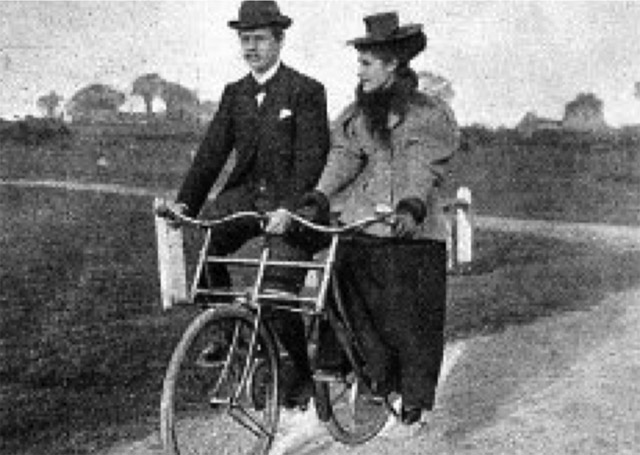
Late 19th-century ‘Socialable’ bicycles put riders side-by-side, unlike tandem bicycles. Modern examples are still being custom-made.

Oct 19, 2014

Times Article Viewed: 49086

Bicycles are great, but they have their shortcomings,

especially as the weather turns wet and cold. What’s needed to make them viable year-round are creative solutions that meld form and function into the perfect Light Electric Vehicle.

While there is almost no image more elegant or romantic than a person simply riding a bike, we are constantly entangled in innumerable schemes to wed us to something grand, a car, a nice big house, which is intended to inflate our sense of self and give us a greater sense of well-being. Seldom displayed is the ragged couple dragging themselves into that home, in that car, the lines of worry etched deeply into their foreheads, trying to figure out how they are going to make the next payment on these behemoths or finance a needed repair. Of course, the second home, or second car, has now entered the picture and how can the Jones’ ever keep up when it is only a matter of time before the next generations appear and begin to assert their right to all that the earth provides without limit? The Merry-Go-Round keeps spinning faster and faster and even historic floods and droughts are not enough to slow it down enough to get on or off without accompanying power failure.

Also see EV World’s interview with William Mulyadi on the Virtue enclosed tricycle featured at the 2014 Interbike show in Las Vegas.

Now that the school year is in full gear it may be instructive to project oneself back into the time when each of us was enrolled in one of these august institutions. Fitted with a bookbag, (now a backpack), we were dropped off, or made our own way, into a crowded classroom filled with kids just like ourselves, wondering if we would be able to do what was expected of us and meanwhile get along with the others. Another big issue was behavior. If the teacher was temporarily absent we spent the time ribbing each other over something trivial, an article of clothing or a new haircut or misspoken word and the wisecracks and teasing went on until the teacher appeared. Often, for at least some of us, that was not enough to stop the errant activity, but soon order was restored and the sound of chalk on slate brought us back into line. Some kids kept it up, as often as not, and had to be shushed or berated to sit down and behave themselves. Restlessness prevailed regardless since kids are naturally energetic and spontaneous until they have been tamed and disciplined into orderly automatons. Slowly, the pressure to conform and fit in is applied and few escape its gravity.

Most of us could not wait until the time between classes when we could have a few minutes to whoop it up and get to the next classroom. This varied from grade to grade and kid to kid and the rules of the school about talking and being restrained in our behavior, but the time gaps between sitting there, and being told not to move around too much and keep quiet and not disturb the class, were precious. Even more important, in the midst of all those calls for self-control, were lunch periods and recesses, where you could move about more freely and express yourself more completely, where you could, in effect, be yourself. Since we are all different and especially when it comes to how we regard and relate to others, this was a unique experience for each of us and could be troubling if you didn’t think you fit in quite right or had problems that few recognized or related to very well. Peer pressure starts early and has a powerful effect on all of us, although much more on some than others. Going along and doing well is the most important thing for many, while the opposite is true for a significant number of others and these patterns can continue for a lifetime for quite a few.

There are some factors that affect everybody in that class though. You must become comfortable in a seated position, facing forward and being as passive as possible. Sure, you need to answer a question if the teacher has one, although not too eagerly or often or the other kids will think you are a nerd or kiss-ass. Acting or speaking out of turn will earn you a reprimand and really outrageous behavior a trip to the Principal’s office. If you do it often enough you will get some pills to take and will be regarded henceforth as a troubled child in need of extreme discipline or worse. Order is what matters and going along with the program. There are too many bodies and not enough time to master the essential skills, reading, math, and comprehension, so there is no time or patience for being too spontaneous or expressive. This is a giant Viking ship and all of the oars must be pulled in unison or the voyage will be delayed or misdirected. We are being trained to be little conformists, to find our rightful places, and to fit in so that needed jobs can get done and good order preserved. Ergonomically awkward sitting down becomes more natural than standing or lying down. Or running.

Consequently, for many, sports becomes an important release. There is the ability to get physical at a time when the body is growing and vigorous activity provides an outlet for the energy that we possess in abundance and is always looking for a channel to express itself. There can be tension too, do you make the team, are you good enough, is your team a winner, but the participation alone is gratifying and healthy if it doesn’t get too competitive. The bad news is that recess is in a recession, takes away valuable time from studying for the standardized tests that teachers and principals are judged on, requires resources that are in short supply, and is being eliminated along with the music and art programs that experience shows do so much to motivate and improve attitudes. We are in a death spiral when it comes to providing a really well-rounded education along with memorization and drills. The impact on our mental health and ability to truly understand who we are and where we want to go in this life is being short-circuited and demolished by one-dimensional measurements and a lack of depth in these venues.

Why is it so difficult for this society to get the point about what matters the most and how to reach it? Mostly it comes from a lack of understanding of the nature of society and how it functions. A cab driver from Haiti last week, a hard-working fellow enjoying the music on his radio, commented about the life here and the lack of connections among people. His country, one of the poorest on the planet, with deprivation as common as sunshine, is a wonderful one to him he said because everybody regards each other as family. What is good for you is good for me. Here, we are all in a race, sometimes described as one between rodents, and what benefits your neighbor may mean that it is costing you. The media embraces this message and amplifies it until it is deafening. If your own kid is doing great, that is what matters. If your city’s team is winning you should be happy. If your country’s economy is improving, who cares if the other guy is in trouble. What is missing from the picture is the way in which your economy is dependent upon the others, that their problem is soon yours. If the educational system is producing mostly losers, unsuitable for more than the merest tasks and rewards, how long will it be before this malaise undermines your own kid’s fortunes? This lack of connectedness is fatal to the big picture’s health and so-called recessions elsewhere can easily turn into depressions here.

One way in which this process has evolved has to do with the wealth which is now in the hands of different races. We are now aware, following the economic disaster recently barely averted and still poised to swallow us all in its potential aftershocks, that the material holdings of those called “White” people, conventionally those descended from Europeans, is 20 times that of those we call “Blacks” or African-Americans. Latinos are only slightly better off. Is it any wonder that vast swaths of our population regard themselves as persecuted and unfairly treated? Certainly, it does denote a shocking disparity and distance from the egalitarian ideals that we are all taught to embrace and respect as part of the American ideal. Furthermore, does it come as a big surprise that the average person, of any race or nationality, living from week to week and enveloped in insecurity, feel immersed in worry?

Our habitual wasting of the material resources that have been provided to us, (whether or not we deserve them), is nothing compared with the waste of human resources that we perpetually witness every day all around us. It is so considerable that it barely scratches our consciousness. Nowhere is this more obvious than in transportation. Whereas one horsepower is enough to get us where we are going, we expect to have 200-300 to get the job done, without a second thought about all of the resources needed to feed that mighty herd. 80% of the time, only one-sixth of the seating capacity of the vehicle is in use. I can remember many long hours standing by the side of a windy or rainy highway wondering why nobody would consider sharing that empty space with a needy, non-threatening-looking civilian with his thumb hanging fruitlessly in mid-air. This machine sits idle 90% of the time and that is alright we compute since it is there when we want it, with nary a thought about who might really need it at that moment. It is giving us a wide variety of maladies, from heart disease to diabetes, kidney malfunctions, and bad backs, but we think it is an unalloyed blessing. We are deluded and living in a fantasy world constructed from TV commercials and smug assumptions of our superiority and dangerous fantasies in regard to the permanence of these conditions.

Lately, I have spent a lot of time making models of tricycles with a variety of features that are missing from our conventional forms of mobility. I wonder why, since we ordinarily avail ourselves of a variety of postures during a given day, from prone to standing, sitting, leaning, maybe even crouching, yet we have been conditioned to sit, the most unhealthy of them all according to medical authorities, almost all of the time. Your car, your desk, your dinner table, and train or bus, all demand that you assume this position and stay there. The conveyances that I am currently construing, permit the widest number of different body positions that are possible. When we get to school, past kindergarten, sitting is the only permitted way to position ourselves. We are not even given the choice between a tall stool and a conventional chair. We may not crouch or stretch out on the floor lest we get “dirty” or encourage undisciplined behavior. It is either follow the rules or get out. Instead of listening to our bodies, which crave some difference in attitude, we are commanded to obey, and we do. There is claimed to be an inner logic to this that we are too young and stupid to understand but really it is just for the convenience of the managers, who want to encourage “responsible” predictable behavior and will enforce their commands without fail.

The second element is the source of the motive power, conventionally either a motor or leg power. To these choices, I would like to add arm power as well. The “Rowcycle” is one example of this and I would add the choice of an electric-assist motor as well. The combination of the three, arm, leg, and motor, is superior to any one of them by themselves but is virtually unavailable in any vehicles with the exception of some recumbent and disabled vehicles that use two or more of them in tandem. Why not all three? Because it has not been the rule up to now and we are creatures of habit and captives of the conventions that have been most popular up to now. Some of it is technological since the advent of lithium-ion batteries has now made practical the inclusion of electric-assist motors on primarily human-powered vehicles easy and economical. Mostly it is the difficulty of popularizing any severe variations on what we have been accustomed to. There is no retail marketplace that is available to sell and display and offer free test rides of these variations on the usual, so they are virtually invisible. The internet will change that somewhat but the pace needs to pick up much faster and that will require more ambitious and energetic ways to get the word out.

Two wheels have many advantages over three, most of them based upon the increased efficiency of a single-track vehicle over one with three tracks like a tricycle. These advantages disappear when the need to minimize the weight of the vehicle is reduced due to the addition of the electric-assist motors. Lessening rolling resistance demands high-pressure tires and the increased bumps and shakes produces by the triple-track vehicle make the single-track one vastly superior. But if you can use bigger and softer tires, which are much better at absorbing these imperfections of the roadway, that advantage is more than made up for by the increased stability and utility of a three-wheeled device. Since we have just begun to enjoy these electric-assist motor benefits, the advanced design of these three-wheelers is in the infant stage. Creative designers are just beginning to evolve the slickly-aerodynamicVelomobiles of yesterday, into the comfortable and safe, and reasonably efficient, rather than maximally-efficient conveyances of tomorrow.

Weather protection is an essential feature of any up-to-date vehicle. Rain, hot sun, wind, airborne grit and dust, cold, all discourage riding out in the open all of the time. In order to become the ordinary means of transport, a vehicle must be able to protect the rider against the worst effects of these annoying elements. Nobody expects a car or bus or train to expose the rider to a host of unhealthful and disturbing elements but bike riders assume that this is part of life and unavoidable. Putting an umbrella above a bike is to invite a gust of wind to carry you into oncoming traffic, a dreadful thought. Assuming a lower position, while providing visual signals of the presence of the rider, flags, LEDS floating above, streamers, and the like, offer great advantages through a lower center of gravity. Three wheels and an electrical-assist motor and its batteries add weight down low where it contributes the most to safety, and guard against the negative effects of the increased surface area that weather enclosure requires. We have some wonderful weather-resistant and very lightweight materials available today that allow for tight, transparent enclosures to be made that can be easily displaced when not needed, so this improvement in the usability of the vehicle can be deployed only when necessary. No industrial-scale vehicle can offer this kind of variability to the rider. Tiny battery-powered heaters embedded in clothing and body-heat itself can be quite efficient and the rush of air past the body is a form of air-conditioning that has always been there. Shade to block the sun when needed is relatively easy to provide and windscreens are easy to deploy on stable tricycles.

The bike is essentially a single-person device. There are tandems but they are rare and require good coordination between riders. We can have side-by-side or tandem-style multi-person human-powered vehicles that, because they are on a stable three-wheel platform, do not require anything special from the riders. One could even be severely disabled and it would be of no consequence. Even three or more people could ride in a single-vehicle with no problem. We have not seen this very often so we don’t consider it possible but it is not really a problem, just very unusual so we are unaccustomed to the possibility. The multi-person ”Sociables” of the 19th century laid the groundwork for this but have, sadly, subsequently disappeared. We can bring them back and build on that tradition, expanding the common bicycle into the vehicle it was meant to be.

All of these improvements in the safety, utility, practicality, and range of features available for muscle-powered, electric-assisted vehicles, primarily futuristic tricycles, are ready to be developed today. They will change the expectations that we have for the most appropriate use of materials and resources that we need to cultivate for our own benefit and survival. It will involve no sacrifice of comfort or other pleasures, in fact, it will enhance our existence, help us to be healthier and more vigorous. It is the reason I am devoting my energies to the development of these possibilities and suggest that you do too.

A Glimmer of Hope for E-Bikes in the Empire State

Jun 02, 2014. Times Article Viewed: 6804

What a difference a year and a new city administration can make. There is no opposition now as, in the waning weeks of the current session of New York State’s legislature, there’s a chance that bills legalizing electric-assist bicycles may come to a vote… 13 years after the idea was first proposed.

It now appears that the New York State Senate will move the bill legalizing electric bikes forward. This welcome move comes at the very end of the session and leaves just enough time to pass it and reconcile it with another bill that is ready to pass the Assembly. That bill contains two restrictions which will put painful limitations on use: persons under 16 may not ride as passengers and helmets are required for adults. Since you can ride a kid on a Harley-Davidson or a Schwinn, why are e-bikes singled out as especially hazardous? I’m not sure that this restriction exists anywhere else in the country or even the world. I think it may be motivated by a sincere desire to protect the vulnerable from harm, but by doing it this way, it prevents electric-assist transportation from evolving into its fullest expression, as family-friendly vehicles, at least in this state. It is hard to blame someone for not seeing that minimal vehicles can provide for weather protection and passenger capacity if you have never seen one, or even a picture of one. It is not in your experience and it is not in your imagination, so it doesn’t exist.

Bike groups, from the NY State Bicycle Coalition to the city’s Transportation Alternatives, including all of the major national organizations, are consistent in their recommendations that individuals use bike helmets. They are also all, however, strongly against making this a requirement under the law. The fact is that the number of riders is reduced tremendously by this requirement, and research shows that this makes it much more dangerous for the resulting riders. There is safety in numbers after all. Also, importantly, car drivers get closer to helmeted bikers and cyclists tend to be more adventurous and less risk-averse since they feel protected by their headgear. Adults can decide if they want a plastic bowl on their head, or even a full-tilt jet fighter pilot helmet, with an outside air supply, but almost everybody agrees, let it be a personal decision, not the law. It is perfectly understandable that a public official would be inclined to want to protect his constituents from harm when possible and helmets are a bit of safety gear. This is a counter-intuitive situation however and requires study and independent thought. Regular bikes go 30 MPH and faster and these electric-assist models go only 20 MPH max. They should be considered more dangerous? It doesn’t make a lot of sense.

The two legislatures will need to work out these questions over the next couple of weeks, in a conference committee context. They may well do this now, 13 years after it was first introduced in the Assembly, especially since the NYC legislature is ready to pass a resolution urging them to do this. Last year, this was not the case. Even though these same bills passed the transportation committees in both houses, unanimously, a call from the Mayor was enough to kill them. He didn’t want it to look like he favored the riding habits of restaurant deliverers. This year, there’s a new Mayor and City Council, and Rafael Espinal and Ydanis Rodriguez, chairs of their committees in the NYC Council, are working to help provide us with access to this important new form of healthy, high-tech transportation. What a difference a year can make. It is still not decided but there is a good chance that this can actually happen.

When I tried to describe the current situation to somebody this week they were incredulous. How could electric bikes be illegal and stretch Hummers fine and dandy? Is this legal jumble the primary reason that millions of these handy devices are sold in Europe every year and mere tens of thousands here? The Federal law from 2002 says clearly that their law supersedes State laws that are more restrictive, but over 30 States regulate these machines the way that they feel like it anyway, with some defining them as mopeds and others as motorized vehicles. The companies who are selling these products are not of the magnitude needed to engineer a massive public relations and public information campaign to put their products on the map. Laws that restrict the use of your legal product can be challenged but it is a costly campaign. The issue has not been pushed yet by the environmental movement or health groups, except in all of their ads, which feel almost naked without a bike in the picture.

Imagine a world in which the telephone land-line companies had been able to stop the spread of cellphones, what we now like to call smartphones. We would have been left in a world of only dumb phones, with no other features besides fixed-location voice communication, and we’d still be spending $2 a minute for long-distance, plenty more if an operator is involved. Now it is a penny and the operator is a robot who always sounds like it is happy to hear your voice. We are in that place now when it comes to transportation technology. If you thought AT&T was hard to budge, just think how difficult it has been to do anything about industrial-scale transportation and its well-heeled and well-mobilized adherents. The resistance to change is a natural phenomenon Those who are in control are willing to use any means, natural or unnatural, to maintain their hold on the situation. Making roads too dangerous for pedestrians, and small vehicles have been a major weapon used against human-scale travel for a century. Lax enforcement of traffic offenses, the forgiveness offered to drivers who end up being an instrument of death, are others. A recent news story featured a dapper fellow with a Ferrari, who had just gotten his 15th DUI, and was ready to get back on the road.

The spectacle of the privileged pumping poison gas into their vicinity, while they semi-reclined in air-conditioned splendor within their cocoons, also serves to discourage the unadorned and unprotected, from disturbing the status quo. The chemical stew in which we are being marinated, in our close urban quarters, on a nice hot day with no wind, is being concocted out of an unknown combination of substances, with letters and numbers for names. It is not dope in the sense that we would begin to shudder and shake if we left the city for the piney woods and found ourselves outside of its fumes for a period of time, but we really don’t know how it operates and what it is doing to us. It is not a matter for conspiracy theories, it is a subject for serious scientific research, much of which is neglected because its conclusions could require changes that those in power do not want to have to deal with if they don’t have to. What happens to populations that are surrounded by different mixtures of these chemicals over time? Do they become more passive and accepting of these substances? Is this the physical manifestation of what we call a self-fulfilling prophecy?

The problem with epidemiological studies is their cost, the time they take and the need to establish control groups, in order to isolate causative factors and relevant comparisons between different populations. They are the most reliable evidence of a phenomenon, the kind that can not be ignored. In contrast, anecdotal information, which merely relates the experiences of a particular group and issue being studied, can be fragmentary and therefore not entirely convincing. Does this mean that we should ignore what is before our eyes? Do we need to study whether oil trains can be derailed, if there are reports of it every week? We know that living in the vicinity of a big highway, especially one that suffers from congestion, is going to send your asthma rates through the roof. Your kids are going to have trouble concentrating in school and local streets are a powerful magnet for those avoiding the traffic on the big road, so playing on the street becomes a version of Russian Roulette.

Sure, it used to be worse when all those dirty factories were working away, and no environmental laws even existed or were enforced in any serious way. We have much to be thankful for and not everything is just going downhill. We can’t use that progress as an excuse to not look hard at what is in front of us though. We have no larger responsibility then to be the protectors and preservers of what deserves to be there. We don’t yet have the most effective means to collect our influences and focus them, and we are deeply distrustful of all movements and organizations and rightly so. Some wish that an alien would alight, give us a reason to recalibrate and recalculate. That is just waiting for the messiah in a secular guise. We don’t need a planetary awakening to know that there is work to do here.

Politics is always a contest, who is right, who is wrong. When we are all wrong, or all right, that should be enough. If we did nothing but exhaust those issues about which we, practically all agree, we could get them out of the way and move on the more fractious and difficult ones. Ralph Nader, our National Conscience, has begun to search out areas of agreement among those of ostensibly different, even contrary, views, and use those overlaps to help advance worthwhile causes. That sounds about right. We are never going to agree about everything and trying, causes a lot of conflicts. If we can not agree to agree on those matters that we do agree on we are, clinically speaking, nuts.

This does not mean that those who continue to dissent should be treated like yesterday’s french fries. It is just that we need to prioritize. If we can’t even get down the list, past the things that nobody in their right mind would disagree about, the need to make sure that everybody has access to drinkable water for instance, where can we go, what hope is there left? We are doomed if we allow ourselves the indulgence of endless conflict when the urgent business at hand goes neglected. It is easy for the emotional element of this to overcome the reasonable and lead us into an invisible cul de sac. We throw all of our energy into our own dilemmas so there is nothing left over for anybody else. We have been offered one last chance to prove, for all time, that we are not simply addicted to the chase and therefore fatally bored with the prize. This may or not be true but, in the final analysis, it doesn’t matter. The problem is that nobody likes a sore winner.

Times Article Viewed: 6804

A Plan B for New York’s Bikeshare System

Mar 30, 2014. Times Article Viewed: 6470

Rumors are rampant that New York City’s Citibike bicycle share program is struggling financially after one of the worst winters on record. Here’s a Plan B for improving and maybe even saving this valuable service.

Now that the NYC Bike-share program is under severe pressure from a weak balance sheet, it is being subjected to a measure of overdue analysis, to seek to improve, maybe even save it. The Mayor has invited Alta, the operator, to explore creative means to continue this program and pay its costs. In 2011, I was one of the 6 bidders for this contract. I partnered with Deutsche Bahn, the German Railway Company, who have maintained the sophisticated “Call-a-Bike “ system for over a decade. Their orientation is transport rather than advertising, so they are not concerned about earning income from sprawling, sometimes very intrusive, banks of “docking stations”, really huge 3-D billboards. They instead have developed a means for bikes to be found and provided to renters through GPS, so they can be sensibly dispersed throughout convenient and appropriate spaces.

In contrast, the European billboard company JC DeCaux, set the pattern which is deployed here, popularized their version of the phenomenon and demonstrated that it could be done profitably. Their contract in Paris called for them to be given thousands of billboard faces in exchange for the right to put up conspicuous implantations in the most popular and congested sidewalks in the city. Ironically, it was announced, the same week that the distress of the bike-share program has gone public, that DeCaux has purchased the Spanish company who currently holds a 20 year long NYC contract, to build and maintain the 3,000 bus shelters, 300 newsstands and other street furniture here. Nobody would be surprised if they were exploring taking over the part, or all, of the NYC bike system too.

The current business model made it possible to attract a $40 million investment by Citibank here, which has resulted in an advertising and PR bonanza for them. The positive exposure that they have gotten from this, all over the world, is invaluable. They can portray themselves as active environmentalists and responsible members of the business community, at the same moment that they are settling immense cases regarding the fleecing of consumers, mortgage holders, etc. Regardless, they don’t want to put up any more loot for the foundering system and the operators are scrambling for additional funds. Every other form of transportation, from cars to trains, is provided with government funding to various degrees. Half the cost of your subway ride and a huge percentage of road building and maintenance costs is borne by the public through government grants and expenditures. Not bikes though. They must be 100% self-supporting to even exist. Does that seem fair?

We need to attract more attention to the potential of human-scale and human-powered transportation to meet our needs. Until we are able to further develop the designs of these vehicles it will be difficult for the average person to visualize this change. Finding ways to encourage this activity, which are also within the range of available financial resources, is important. Here is one plan, to use the upcoming 50th and 75th anniversaries of the New York World’s Fairs in 1939 and 1964 to capture the energy needed to launch a web-based celebration of human creativity, ingenuity and inventiveness. We can use all the help you can muster, so get in touch. Check out SharingUmbrellas.org. Meanwhile, here is a summary of our initial 2011 proposal, to organize and operate the NYC Bike Share program. The first element declares our willingness to go along with their requirements and proposed architecture. In contrast though, we saw this program as an ideal platform, from which to launch the next generation of high-tech, electric-assisted, weather-protected, cool, beautiful and exciting machines, the first step, rather than the last step, in the process

Plan B
Our bid will consist of two elements. The first, which we refer to as Plan B, will provide or exceed all of the stated requirements of the current New York City Department of Transportation Request for Proposals:

10,000 identical, durable, bikes equipped with GPS and other electronics
10,000 “docks” capable of securing them throughout Midtown and Lower Manhattan
600 kiosks to enable users to access the system
Suitable locations to place the equipment
Relevant experience
The ability to mount a test

Our improvements over the requirements of Plan B

Bikes: Don’t have to be the standard design because locating device can be put on different vehicles
Kiosks: All there but not needed everywhere. Re-configured by local artists to fit into the community.
Docking stations: 25,000 stanchions can go anywhere. No congestion created.
Ads: Primarily for suppliers is optimal. Minimized at least. Local where possible.
Scope: Citywide used by commuters overnight and visitors and residents by day.
Coverage: As many vehicles as needed, 50,000 or more as indicated in the City Planning Comm. study
Diversity: Of design, with common identifiers, and user groups, like kids and the transport-challenged
Participants: Local businesses, community groups, enthusiasts, artists, entrepreneurs, families

Plan A
We feel that this program has the potential to provide an important new tool for improving this community’s physical health and economic welfare. This enterprise intends to work with local businesses and community groups throughout the city, and in nearby suburbs, to maximize bike availability for everyone and minimize the time it takes to accomplish this. We will also support the designer/maker community’s efforts to creatively explore the potential of slow-moving, human-scale and muscle-powered transportation, to rapidly evolve.

NYC Bike Stores
We have already gained the support of the two largest bike store chains and a number of independents in the NYC area, in establishing a program that would enable stores to cooperate in the development of this program. They derive significant income from rentals and it is possible that this encouragement of cycling may actually do some harm to their survival. Competition from the internet and mass-market retailers, as well as current economic conditions, have put great pressure on this business already.

Group Riding
The participation in this program of one of the major providers of social networking tools will enable us to organize programs to offer the additional safety as well as other benefits of using this activity as a new and very powerful form of live and in-person, direct social-networking.

Bike Manufacturers
Trade show aspect: As a supplement to the 10,000 Plan B bikes, we intend to deploy a large number of others, of the greatest possible variety of cost and type, for the use of travelers. We will invite a good many manufacturers, whose products are known to be of good quality, to provide from 10 to 100 of their bikes for this program. We will make sure that they are provided with adequate and appropriate security in a variety of forms. Some will have GPS devices, some electronic locks, others less expensive but adequate security devices. Each manufacturer will be required to make an arrangement with one or more local bike shops to maintain their equipment while it is in use in this program.

Manufacturers will be paid an agreed-upon amount over the course of the three years of their equipment’s use in the program. If there are any significant equipment problems, any product will immediately be removed from the system. Surviving this environment intact will be a badge of honor and sign of quality. Potential purchasers of the bikes will be able, through the GPS system, to track the location at any time of every bike. This becomes the ultimate bike durability testing ground and year-round bike show.

Local Entrepreneurs
Designer builders: We are missing many features on the current design of bikes, which goes back to the 19th century. Back then they had many features not available today, like the famous side-by-side sociables and we have never had weather-protected or aerodynamic models in popular use. If the work of making these newly evolved vehicles takes place in this city and they are able to be put quickly in wide use, we will see the rapid birth of several new industries. They can provide well-paying jobs to skilled makers, both creators and fabricators of green transportation devices that can be exported throughout the world.

Connections to Transit
We have had conversations with a number of people from the transportation agencies, the MTA, the Port Authority, NJ Transit etc. We have been encouraged on all sides and promised cooperation in the siting of facilities and other matters concerning these efforts. The Director of real estate for the MTA, Jeffrey Rosen, felt that there were numerous ways in which the agency stood ready to be as helpful as possible.

Input from the Community
We have contacted every Community Board in the city and asked them for lists of locations in which they thought would benefit most from a program such as this. The density outside Manhattan is only a third as great in some areas and the usefulness of this program is most evident in the areas with the greatest population and pedestrian traffic. Regardless, this equipment will be welcome all over the city, especially in those neighborhoods with sufficient activity to justify its placement.

Our intention is to make fleets of vehicles available to social service centers on a fixed schedule, so that they may arrange mass bike rides of their members, for excursions, as recreation and for healthy exercise. We will do this on a non-profit basis. This will expand on the social networking potential which bikes encourage.

Connections to Local Businesses
Aside from bike stores, who are to be included in this program to the greatest degree possible, we will also seek the cooperation of other businesses, especially those in the vicinity of sizable emplacements which are open very long hours. While the central system is totally automated, many locations around the city support business that keep long hours, add to the security of the system by their very presence, and who could sell memberships, or provide other key services to the system

Kids
Education: There are bike groups in the city, like the 5Boro Bike Club, who have developed programs for helping young people develop safe and sensible behavior while involved with bikes. Plan B, a totally-automated system, ordinarily does not permit the participation of children under 18 years of age. As long as proper conditions are provided, insurance is available for this type of activity and our system intends to maintain a fleet of at least several hundred kid-friendly bikes, that would be provided to registered legal organizations that have collected proper waivers from parents and made other needed arrangements, so that children may spend time on a bike getting some healthy exercise.

Work
There are a number of programs in the city to help young people gain competence in the repair and maintenance of bicycles. Recycle-a-bicycle is the best known but Time’s Up and other organizations all provide opportunities to learn how to take care of bicycles, their own and, ultimately, others’. Some would like to employed by this program to earn some income and advance their knowledge in this field. Others could be on trikes, ferrying bikes around to needed locations from those that are overloaded.

The Creative Element
Decoration: Some find the uniformity of equipment in a program such as this to be reassuring and comforting. Others find the bland uniformity and repetitive commercial messages boring at best. We would like to encourage creative design in the way bikes to look. While some common design elements are helpful for those trying to find or identify the equipment, it is otherwise unlike the existing bike culture, where the individuality of bikes is a source of pleasure to many. Giving artists a chance to put their mark on this art-aware city benefits, everyone.

Design: The standard “Safety” bike was perfected in the 19th century and has been getting only marginally better for 120 years. It is time to move ahead on a number of important functional, experiential and aesthetic matters. Among them are:

Weather protection. There is a type of human-powered vehicle called Velomobiles. Strong but light coverings provide riders with a comfortable journey even in poor weather. Utility. There are already bicycles made for deliveries, three-wheelers, some with freight-carrying boxes, etc.

Transformation. Through the use of advanced design techniques, bikes can be collapsed and folded, fitted with trailers and otherwise made more suitable in dense urban environments.

The Transportation-Challenged
Access: The ADA appears to require than accommodation must be made for a variety of communities within this program. How to do that exactly is yet to be determined but discussions are taking place with informed and caring members of this community.
Innovative design: There need to be many more vehicles that permit those of varying abilities to ride together in a social environment.

Trikes aid that needing added stability, who comprise a very large group.
“TAB” (Temporarily able-bodied) co-usage: Many vehicles made primarily for the transportation-challenged can well be used by everybody. It would be a good idea for those who are still totally mobile to experience the kinds of vehicles made for those who are not.

Times Article Viewed: 6470