25 years ago we put on a show at the Municipal Art Society in NYC called “Going Nowhere Fast”. It covered a full range of transportation modalities and identified the problems and possibilities inherent in them, from Rail Freight to Solar Cars. It was a largely dismal survey of the state of our services, some history and some opining as to the future. During the months that it was up there, we held panels and attracted some attention to the issue, but an honest assessment of the results would conclude that it wasn’t going to make much of a difference. I’m glad we did it but its title was far more prescient than I would have wished. The same show could go up again, (and I still have all of the original 6′ tall panels,) it would be very hard to find anything that was not as true today as it was then.
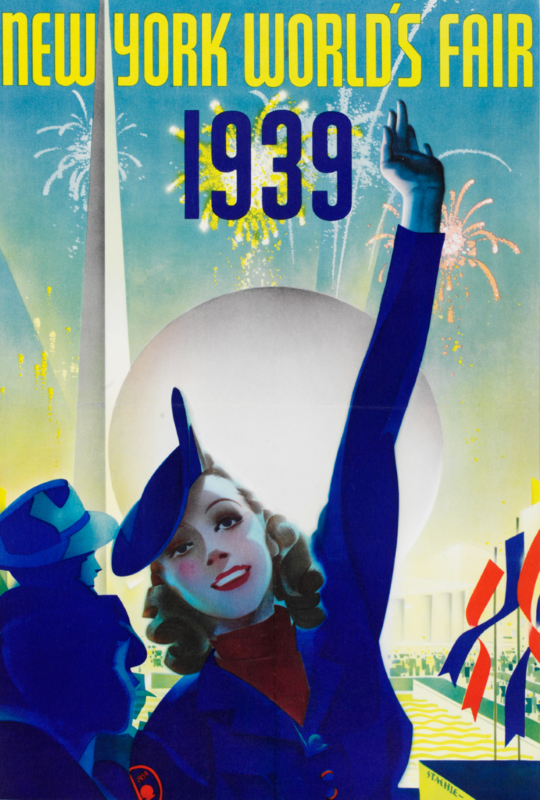
The direction that we are headed has been established for at least the 75 years, since the GM FUTURAMA dominated the 1939 NY World’s Fair. Now better known as the title of a freaky but funny TV cartoon show about robots and intelligent crustaceons, this pre-war giant, 3D, moving panorama, was a full-immersion spectacle. It was calculated to sell the maximum number of cars, which, ironically, at that moment were becoming impossible to buy, since every plant was soon fully engaged in war materiel production. The picture that is painted of the world to be, was not far off in many respects too, even if the automated roadway that it promised for 1960, is only now coming into focus. The suburbs, stretching out forever, the little houses and their little yards, once the nasty war was out of the way, became the shape of our suburban universe, from Long Island to Catalina Island.
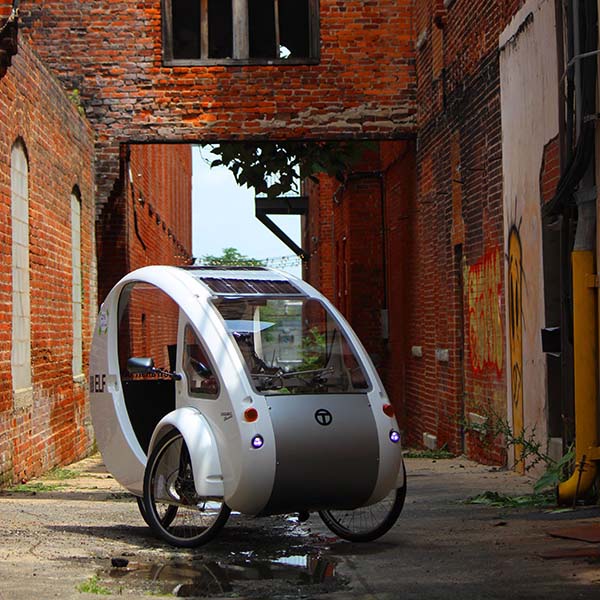
At the same moment, the MAS exhibit was being prepared, what the NY Times’ energy maven, Matthew Wald, accompanying us, referred to us as a “ragtag” crew of vehicle designers and builders, was making its way slowly from Washington DC to NYC. This caravan, that we labeled LightWheels, over a week’s time, stayed in college dorms and other available venues and made its way across the landscape in short bursts, setting up, in each location, for a local show and tell, and press event. Since we had the beautiful Stanford University Solar Racer as our glamorous centerpiece we attracted positive attention and lots of stories about the technologies that could change the direction of our transportation systems and put us on a more sustainable path. Electric bikes and handmade Solar vehicles converted electric cars and utility vehicles all demonstrated the possibility of non-highway-centered, or petroleum-fueled and human-scale transportation options. We even gave people a chance to try them out.
It was certainly not as impressive as the 10-day Tour de Sol events taking place in Switzerland throughout the 80’s, with hundreds of vehicles and thousands of spectators. We probably did give some impetus to those who decided to try to reproduce the European event here, the Northeast Solar Energy Association. They spent years doing an Americanized version of the Swiss event, found some corporate sponsorship, mostly from car companies, and eventually banned human-powered vehicles entirely, thus forsaking the central rationale of the original event. Our demonstrations in DC were difficult to arrange and greeted with considerable indifference but we persevered nevertheless. In the days before Lithium-Ion batteries, the burden of dragging so much lead around in order to advance the technology of personal transportation was really too much to bear, and hard to justify, and electric vehicle acceptance stalled for decades partly over this lack. There were those like Jim Warden of MIT, who worked around these limitations in the 80s and bragged of vehicles with hundreds of miles of range and other remarkable accomplishments, but even hard information about advances was so badly covered, that it made little difference. Bravo Bill Moore.
One of those who we expected to be supportive of us in DC, for all of its irony, was Jay Rockefeller, Senator from West Virginia, scion of the great Rockefeller dynasty. When I called his office I expected a rousing welcome and invitation to visit, along with the sponsorship of a reception on the steps of the Capitol. Instead, I was given a short lesson in economics and a friendly rebuff. It was explained to me that Mr. Rockefeller was, indeed, a strong proponent of electric cars. The reason for this was his understanding that these nice, big, heavy cars would consume a large quantity of electricity which would end up being generated by the burning of coal, which was mined in his state and he was strongly in favor of this. But, since I had explained to her that we had a double purpose, to promote the virtues of electric-powered mobility and the benefits to be garnered by the scaling down of our needs, to emphasize the virtues of human-scale applications of this technology in electric bikes and other minimal configurations, her interest disappeared. She was, at least, honest enough to explain to me that this was not going to require the massive consumption of coal, which was the primary interest of the Senator, and therefore he would not be interested in being helpful to us.
There is a similar disinterest in this subject evidenced by the major media. There are no bike ads or electric-vehicle commercials on TV. The biggest individual advertisers may be mobile phone companies, but overall, the Automobile industry is the biggest factor in all paid media. The bicycle industry has always suffered from an inferiority complex when it comes to heavy-duty promotion. The only exception to this in modern times is the popularity which the Tour de France had occupied, since an American became the biggest winner in the race in history. TV coverage improved and the beautiful French countryside is very photogenic, the non-stop picnic by the side of the road pleasant-looking and engaging. Of course we now know that this was not the pure athletic spectacle that we had been led to believe it was, but rather a wild, cross-country drug-fest. Cycling, an activity considered so healthy that it decorates an amazing percentage of prescription drug ads, is a victim of the same over the top, insanely competitive and out-of-proportion tendencies, rampant in every other aspect of our lives.
As transportation, cycling is in its infancy. Denmark may be the leader of the pack, but once upon a time it was Vietnam that was reknowned for the ubiquity of its bicycles. There is no doubt that this was a feature of a society with meager access to resources, a poor country where the population could not afford anything but a bicycle to get around on. It can be romanticized as a portrayal of a place with unusual balance in its habits, or one which is close to the ground and essential, rather than caught up in Western materialism. Regardless, increased prosperity has brought with it a flood of scooters and motorbikes with plenty of automobiles thrown in for good measure. Bikes are for those with no choice.
Mechanization is surely one element of the process which enables populations to begin to enjoy the comforts and pleasures that come with a consumer society. It is not a sign of cultural decline when peasants can educate their children, get their goods to market and do less back-breaking work, although factory environments can surely be life-deadening. It is, nevertheless, the slippery slope that we call “advanced” and “developed”. Those of meager means, the vast majority of all of those who are alive now, here and around the world, are constantly being reminded of the wonderfulness of all of the goods that will be their ticket to a better way of life.
Whether it is a pack of cigarettes or a new TV, the game is on, the girls in the ads are very pretty, and we will be judged by our success at climbing this ladder into status and prosperity. It is a seduction, plain and simple and more sleaze, tease and wheeze than the promised Stairway to Heaven, but at least it suggests that there is a way forward and maybe even a way out. Climbing over the bodies of your neighbors to gain elevation has its hazards though, and unless dizziness is your goal, whatever you do, don’t look back and don’t look down.
It appears to me that we are turning into a world of activists, that we are reversing decades of minimum involvement by the masses in the determination of their destinies. It is happening on different continents and the response of established governments is not exactly the same, although the resistance to change is the most common response, and violence is often the result. In this country, ever since the under-reported and failed anti-war protest of ten years ago, it has been a sad period for political activism, aside from the Tea Party version. Curiously, the original, colonial Tea Party, was a bit of blame-the-victim, racist, black-bag op terrorism, with a spoonful of patriotism, and so is the current one for many of its most passionate adherents. The difference is that back then, we were rising up against protected monopolies and giant corporations, whereas the current version is largely funded by these megaliths.
We can do better, much better. If we need a theme song, how about the Automat’s egalitarian and inclusive “Let’s have another cup of coffee”? We can organize friendly people in all the coffee shops, and let the people who have trouble with including everybody, have tea shops. We can have Starbucks and the corner diner and the morning breakfast table and they can have the crumpets. We can have meetings morning noon and night, all over town, to figure out how to take back this puppy from the beast. Confused and frightened people, looking for help are being told, ”Sharing is Socialism”. So elevators and trains must be hotbeds of Marxism, and water mains and sidewalks a sinister, devious plot, to tie us together and make us dependent.
So what is the needed response to the Tea Party? COCOA, Coffee Conversation Action maybe? It’s not a Party exactly, (even though a little fun is always a welcome relief from the tedium), or a means to anoint the already too self-important with additional titles and privileges. Rather it’s a minimal mechanism for building an energetic, ongoing, constantly-evolving plan to maximize the chances that our species can have a healthy future on this rock. It is also an action agenda, without hysterical, lying demagogues, and without non-stop, one-dimensional self-interest masquerading itself as the common good and crushing our humanity in its path. We had sound-outs and teach-ins, but we need a continuously-refreshed framework that frees us with the truth instead of confining us in lies, open for business wherever and whenever sippers meet.
That’s the Coffee Conversation Action Agenda, COCOA2. Namely: Move over a little so there’s room for everybody and when it’s freezing out there, who doesn’t need something hot to drink to help take off the edge? No matter how cold the facts get out here, friend, in the coming days, please remember what your Mom told you about what you had to do if you wanted to get into Heaven, and make mine hot Cocoa thank you, not hate-filled Cuckoo.
The ’60s are portrayed as “Sex, Drugs and Rock and Roll”. This is not inaccurate as much as it is incomplete. I would add “Exploring, Questioning and Demanding Proof”. Faced by the prospect of being drafted into a war that seemed totally unjustified, which was being sold as a Modern Crusade, against both Militant Buddhism and Atheistic Communism, members of my g-g-g-generation needed to process, and act upon, each of these three oxymorons, of stupendous contradictory magnitude, simultaneously. Fortunately, we baby boomers had the help of psychedelics and other multi-dimensional lubrication or the stresses created could easily have sent the entire of us down the Rabbit Hole for good. Of course, we had Gracie Slick as our travel agent and Vietnam vet, Country Joe and the Fish, winding us up with the “I feel like I’m fixin’ to die rag”, so the luckiest among us never got lost in the maze or fooled by the cover story.
We expected that the realizations being experienced by nearly everyone, the appreciation of the importance of Civil rights and even more subtle questions like gender-equality and Women’s rights, would inevitably lead to more honest and equitable society. All forms of music were being listened to and combined within a single song or album as East met West and everybody shook their behinds in what felt like your own special way. Many will argue that the ideals revered in the ’60s, tolerance, peace, free expression and love of your fellow-creature, obscured the more serious issues like survival and crime, but the dramatic increase in political participation and activism was a sign of health and vitality in a largely self-satisfied society.
The sixties gave us a whole population unwilling to accept its prerogatives and privileges at the expense of their fellow-creature, who questioned every single verity and turned a lot of them into cartoons that gave them the status and perspective needed to understand them.
Oddly, when charts are made, measuring the use of energy and its production, the most important form of it, human-power, is ordinarily excluded entirely. Fueled by calories, most available from rooftops, yards, fields, and window-boxes, truly locally-grown foodstuffs, we require only muscle-power, with a little help from our fiery neighboring star, to prosper. We’ve pummeled her with abuse and continue to, but Mother Earth still pushes forth new life unceasingly, regardless. As for us, the machines, people, give us water and something to chew on and we are amazingly productive devices. It is not just salty sweat being manufactured either, it is also brilliant labor-saving insights that are being generated. Think about how hard life would be without N.Tesla’s AC current, his induction motors and electric starter in your car. It is our good fortune that homo sapiens have been gifted with an infinitude of skills and constructive inspirations spread, albeit somewhat unevenly but still universally, amongst us. How lucky can a species be?
Were we, as a whole, to develop the means to have easy and free access to this rich pool of resources, we would certainly find ourselves on the critical path to our most fulfilling destinies. By unleashing this phenomenal storehouse of wealth, composed of the sum of the vast knowledge gained by all of us, through our jobs, our experiences, and adventures, we thereby enter the Age of Abundance and leave the Age of Scarcity behind. Unfortunately, we have spent centuries, weighed down by an incomplete picture of biology, weather and such, searching for better answers to our questions, rationing our goods, providing them only to those with the means. This is our history.
Now that we are able to produce a virtually infinite amount of anything, it is only through the systematic waste of resources, especially the human ones, that it has been possible to maintain the myth of scarcity within an obscuring cloud of overabundance, for the last several decades. While the armed conflict has been the most effective way to destroy the value of both the material world as well as the living one, a century of overconsumption has left its mark on every activity. Meantime, those with factories want them to run continuously, so the first task becomes convincing everybody both that they need this thing, beyond reason, and the last, that they should not share it with anybody else. Planned obsolescence and raging fashionability will do the rest. The Waste-God must be served or the wheels of commerce grind to a halt and we are done for, or so the market says or curses if you will.
While bike-sharing and other attempts to get a grip on this suicidal drive are gaining serious traction, this good news for almost all of us is anything but that, to those whose activities provide them with huge profits from the generation of waste. The military establishment, for instance, will fight like mad to preserve their benefits for themselves. They are able and willing to do this in spite of the damage it wreaks on their fellow-creatures, and sometimes even on themselves, but they can not stop their destructive ways, because they have no way to sustain their current lifestyles without these profits. They are addicted to the ability to have their way, to superimpose their view of reality and their bankrupt value system on a pacified public. They are supported by those who pretend that the numbers tell the story and can never focus down closely enough on what is on the ground, to include it in their world-view.
One feature of our profound misuse of resources is in the prison system. A famous wag once claimed that if you steal a loaf of bread, they will put you in jail whereas if you steal a railroad, they make you a US Senator. A friend of mine was featured on CNN this morning, being granted bail for the crime of being a heroin addict and being accused, falsely it turns out, of supplying Philip Seymour Hoffman with his fatal overdose. This fellow, Robert Aaron, is renowned within the city’s musical community as one of the most accomplished and talented musicians around. He is also one of the nicest and most modest and generous people you might have the pleasure to meet. He is the polar opposite of the stereotype of a junkie, the useless slouch, dangerous and untrustworthy person. He works constantly, sometimes for very small pay, often to help aspiring artists to establish their presence. He plays in scores of styles and on a dozen instruments. Wyclef Jean, who he arranged for and played with for a decade, Mick Jagger, David Bowie and hundreds of other musicians, have improved their offerings due to his attentions. Now he is facing prison and our loss of access to his gifts, because of his current need for his, admittedly often self-destructive, medicine. The system is ready to relegate this fine, non-violent, talented person to a bare cell, where he can no longer help anyone to realize themselves, or to enlighten us. A total waste. (Contributions to his bail fund are welcome.)
Meanwhile, prisons have become an “industry”, with profit-centers and ROI charts. The society with the highest rates of incarceration is also the one which has the greatest propensity to reduce everything to numbers, to de-humanize and disguise what amounts to institutional torture. Sure, those who harm others must be held accountable in order to reduce this kind of activity, but is punishing and causing pain to people a way to improve them or is it just a form of rough vengeance, a page torn from the stone age?
We do the same thing to older folks, who have slowed down or whose skills are less needed because of onrushing automation or outsourcing. Couldn’t schools make room to allow those with a lifetime of learning, to be enabled to pass that valuable information down to the next generation? At the end of the 19th century, with industrialization taking full hold, innumerable hand-crafts were rendered obsolete and its skilled practitioners put out of work. Wood and metal workers with centuries of development contributing to their production of useful and beautiful products were rendered irrelevant, because there was a machine that could do it almost as good, or even sometimes a little better, at a rate thousands of times faster than their hands could match. An army of illustrators, fine artists, could no longer afford to fill their brushes and pens with India ink after the technology of taking and printing photographs took hold. Their loss? No, ours.
With clothing, imagine the work needed to handpick raw material, process it into yarn or thread, weave it into the fabric and make it into a garment, compared with our mechanized version of mass production, engineered by giant machines. Delivering a complex and finished piece of clothing, made by handwork only, is still the rule in some parts of the world but only the very poor or very rich have access to this system. The ability of machines to be so productive has been a mighty boon to our assumptions about what we are due and we have become used to having it all. A closet and dresser filled with garments that once would have taken a regal sweatshop to provide us with, could, until quite recently, only have belonged to a member of a noble family but instead, these former luxury items were bought for a pittance from a huge chain store. We are drowning in products but we have lost our self-identity as producers.
Likewise our food. If you had been a member of the royal family of a 19th-century empire, the presence of fresh fruit in the colder months or any foods out of season would have indicated a truly elite status. In fact, the range of ordinary products available to the masses, from soft cushioned toilet paper to a shelf of 100 exotic spices from around the world, were not easily acquired by even the most privileged members of any society in former times. Yet, we take them all for granted, without half a thought. The technologies that made it possible to live like a KIng, on a pauper’s ransom, have accustomed us to a level of comfort and ease that were unimaginable heretofore. One consequence of this is our unsupportable assumption that we should be able to have unlimited access to everything. Along with this sense of entitlement has come a lack of concern about the origins or consequences of this condition. One of the seemingly inevitable results of overabundance is a lack of understanding of or responsibility for the downside of this equation.
When it comes to transportation, the most egregious examples of imbalanced activity are to be found here. A stretch Hummer is a potent symbol for all that is wrong with this picture. It is instructive that the origin of this abomination is to be found on the field of battle. It is a weapon in the form of an automobile. We can combine its purposes as a life-protecting device into one of a life-destroying one and these identities merge and blend into one another seamlessly. It is wonderful to feel impervious in a dangerous world but our vulnerability is always with us, no matter what.
We spend a lot of energy projecting strength, and swagger with a coating of suave will always be a crowd-pleaser. Displaying this on the outside is often a cover for a lack of inner confidence and durability on the inside though. The cure for elitist, top-down definitions of our value and nature, is much more bottom-up, creative and life-affirming phenomena. Block parties without the tube socks. The stakes keep getting higher and the time to repair the breach shorter. I keep thinking that this is something about the importance of music, and its main components, like harmony, tone and pace, style and rhythm. Meanwhile, if we do have to sing for our supper, I think we should at least be able to pick the tune, and choose the main course, and be treated like guests, not servants.
You can hear some of my songs, free, on http://www.SteveStollman.com/ produced and with musical accompaniment by Robert Aaron, on all wind & string instruments and keyboards.
I’m not sure what Disqus is, but I know it eats comments. One of the pleasures of writing pieces like this is the responses that it can provoke. Sadly, often nothing is said in response to the 2000 or so, of what I am willing to admit are sometimes intentionally-provocative words, that get thrown down on these pages every week. This, in spite of a thousand or more visits. The length of those visits is unknown and they may be mostly quick hellos rather than deep conversations, still, it has been the case, some weeks, that a half dozen or more visitors have decided, after they have finished reading, to make their feelings known at the bottom of the page. Sometimes these have been very complimentary and friendly and other times not. This is normal, to be expected, and include plenty of disagreements or differences of opinion. Truth be known, regardless, I wish every one of you would say something, even if it was minimal, give an opinion, state a fact, but…
For some reason, Disqus, the mechanism employed to capture and display comments on EVWorld, likes to show them when it feels like it and otherwise keeps them secret. Odd but true. Since this is my 20th contribution in a row to this blog, which has become a regular feature of my life for a bit, I will admit that I miss the occasional barbs and bouquets. I wonder if they were taken out to a lonely field, like in an episode of the Sopranos or Boardwalk Empire, and dispatched in the tall grass, or given a more dignified end, perhaps in a restful archive by the sea, or slowly floating cloud. I have seen them come back to life a few times too, only to disappear once again, an agonizing flashback to what might have been and actually was, but is no more.
I had a job once, which may have been my best one ever, being the head waiter, really doorman, at the Village Vanguard, a jazz music club in Greenwich Village for the past 500 or so years. As this was a place that many luminaries made it a point to record at, it had a heady bill on, almost continuously. At this time it was a couple of famous musical giants, bassist Charles Mingus and saxophonist Coleman Hawkins, each with their own groups. Since both of these fellows could be described as Demi-Gods of their craft, some of the greatest artists of our time in any field, I wish I had spent more time listening to their mutterings and exclamations, but I do remember one. Mingus was notorious for his displeasure at the bad, which is to say inattentive, the behavior of his audience. This was a club, with drinks and a small amount of food, no hushed concert hall, but the sounds made there, at times, were as amazing, transporting and important, as any made anywhere.
Regardless of the fact that this was a basement joint, in a raucous neighborhood, Mingus would simply stop the music, if there was too much noise and too little appreciation that this was the finest music on the planet being performed before them. In one such episode, after he stormed off the stage, I remember “The Hawk”, as he was popularly known, nattily dressed, standing ramrod straight but not very tall, approaching the great bass player and telling him, “You have to play them quiet Charles”, in a sympathetic but chiding voice. The point is, if I expect more people to make more comments about my writing, I’m going to have to “Play them noisy”, more openly daring them, that is you, to join the picture and establish a presence.
I notice that a few weeks ago, Popular Science decided to abandon their comment function altogether. Too many little spats and petty problems probably, which took up space and discouraged others with more substantial points to make, from even participating. Who wants to get lost among the slings and arrows filling the air, aimed at nobody in particular? I’m sure their legal department was pelted with controversies over libel and patent infringement and other matters which soaked up time and bled expenses. It is a sad day though when scientific and technical inquiry can not be matters for lively discussion and widely varying points of view. Fortunately, there are still many many thousands, maybe millions, of online forums on every imaginable subject to help promote healthy controversy and fact dissemination. Generating directories, that rate them according to their relevance and popularity, needs to be a priority, and that process is, thankfully, well underway.
Sure, there is plenty that is of little weight or value in the mix, but also a lot of important information, that is now having a much easier time finding its way to the public. In balance, the flood of new information is a boon to honest inquiry, even if it is also hard to sift through and the major outlet for loony stuff too. The filters that have always been there, to separate the wheat from the chaff (and too often, to serve the chaff and call it wheat), claim a high degree of reliability for their product. It used to be that if you read it in the paper it was true. The TV had the same power, to grant, to their presentations, an aura of certainty and finality. It was rare that they actually deserved such confidence, but there wasn’t much competition. It is clear, in many minds, that the opposite is now the case.
We are having to be much more discerning, to question the quality of our sources, to come to rely on certain ones because of their proven track records. We have been lied to and misled too often, and by experts, to simply accept what we are told without a high degree of skepticism. Our gratitude must go out to the Bill Moore’s of this world, who devote such a substantial portion of their life on this planet, to trying to figure out what matters and what is true, because it is beyond the ability of each of us to do this for ourselves. I opined in one of my previous pieces about the way in which the commercial media serves the interests of its advertisers rather than its consumers. The movement away from that integrity-sapping formula, is what is needed, and demonstrated by EVWorld and many other worthwhile and truth-seeking web sources.
The Underground Press of the 60s and 70s forced the aboveground press to pay more attention to differing viewpoints. I was proud to be its distributor for a time here in NYC. Unfortunately, the shrinking of the printed press has left us with somewhat fewer of them as potential sources, even while the world of apps and blogs has multiplied the total of potential resources, all reachable free, easily and electronically, by a factor of infinity. The increase of Localism is partly a realization that common conditions, even those prevalent on a broad scale, can often best be affected by the collection of individuals, in physical reach of one another. This has been most conspicuous when it comes to food issues, especially in areas where there is local production of some kind. The addition of community gardens, roofs and other projects in urban spaces is growing rapidly too. Interest in the origins of what ends up on your table is surging and CSAs and variations on them are spreading every day. The connections between the most mundane daily concerns and the big questions, the ones that supposedly matter most, become more apparent every day.
The Chicago SEED, the Atlanta Great Speckled Bird, the L.A Free Press and all the rest of the Undergrounds were totally independent and self-reliant operations. The late ’60s generated much interest in the ways that governments functioned or didn’t, on account of the war primarily but for many other reasons too …
The Permian Extinction took 95% of all living species. It is thought to have been caused by the release of a great store of methane from its oceanic vault, following volcanic activity in Siberia, powerful enough to warm the seas sufficiently to trigger this momentous killing event. Being subjected to natural forces this significant is impossible to avoid completely since we are simply temporary boarders here not the hoteliers. Voluntarily bringing about a catastrophe of this magnitude though, which is widely predicted to mirror the former calamitous scenario, is beyond madness. Yet, this is the path we have been put on, and we ought to be a lot unhappier about it than we are.
Ward McAllister, a social chronicler of the late 19th century, calculated that 400 of the most important swells of the time could fill Mrs. Astor’s ballroom and this became known as the ultimate measure of status, not dissimilar to the Fortune 500 perhaps. I suppose the same tiny number of exceptionally privileged people are the very ones who will be invited onto the Heavenly Biosphere, ready to re-populate the earth and assert their ultimate superiority by surviving the catastrophe that all of them have been so strategic in bringing about. A few may suspect, between cocktails, that this was the plan all along.
The US is now the world’s top energy producer, according to the WSJ and MSNBC’s caffein-addled Joe expects the effect of this is going to be “staggering”. No doubt he means that we are in a stronger and better situation, no longer completely at the mercy of some sheik in sheep’s clothing or Russian oil Czar. Missing from the equation is the contribution made to the total by human energy, hands, and fingers, human power, muscle power, fueled by calories from food instead of barrels of oil or tank-loads of liquid gas or rail cars of coal. Every time something is lifted, or pulled or pushed or bent or chipped or scraped by hand, energy is expended and even in a world that has been industrialized to its limit, there is still a huge proportion of “work” performed by mere homo sapiens using their bodies and sweat to bring about the needed result. When energy sources are measured, nuclear, petroleum and coal with a few renewables thrown in, is all that is spoken of, although all of our original arts and crafts are still alive and essential in the mix. Deep down we know that human transport, by walking our 10,000 steps a day or pushing the pedals on a bike is an essential aspect of preserving and enhancing our lives, not a cumbersome burden. Ease beckons though, and we vegetate.
When analyzing economic data a good deal is made of the cost of materials and the cost of labor. Factoring in the cost of the education of the people doing the work or their degree of satisfaction with their lives and their efforts is seldom mentioned, even though it might be, in the final analysis, the most important element of all. Human-powered equipment, designed to be operated on the human-scale, like bikes, some farm equipment, for that matter most kinds of computer and assembly work, comprises a huge proportion of the work being done every day around the world. While there are other power sources being used, electricity, animal, water, etc. the indispensable element has always been and remains, for the moment, the human one.
Regardless, since the trend over time has been to replace the human-powered with the mechanical or electronic, we have now reached the point where we can automate so deeply that the danger is that we are seemingly running out of the need for people altogether. Unemployment is not just a feature of an economy not operating at full speed, it is a permanent condition since we are no longer in need of very much maintenance and supervision for these machines. They are even being taught to repair themselves. It is not just factory workers, even doctors and lawyers are being rendered less useful by the day as every task, no matter how complex or difficult, is being assigned to an app or mechanical robot to deal with. Meanwhile, we busy ourselves with the increasingly trivial, social networking that concentrates on keeping you in close touch with your host of friends while the rest of the population learns to ignore you as well as you ignore them. Is this still a society, or just a bunch of random pieces of the flesh who have lost interest in forming themselves into a picture, who have learned to love their fragmentation as much as they once reveled in their connectedness?
Meanwhile, water downstream from a fracking operation in Pennsylvania is showing alarming levels of radiation, 200 times the normal. This is a minuscule problem of course compared to what is happening in Fukushima Japan, where water containment vessels are springing leaks and an immense pile of still radioactive material is perched precariously atop destroyed reactors and the government is having as much trouble containing the information about the risks which are now growing more treacherous continuously, as the engineers are having to try to do the seemingly impossible task of cooling off this hellacious fire. I thought that conservative politicians and political conservatives, in general, were risk-averse, eager to protect their treasures from eroding in value or putting their lives and futures in jeopardy. Actually, science-denial, the foundation of any belief system that relies upon magic and superstition, is essential to most myth-making institutions, be they religion-based, profit-making, pleasure-intoxicated or simply power-addled and unable to let go.
If the price of oil goes down sufficiently, this form of extraction, currently destined to destroy a serious portion of our dwindling clean groundwater supply, is no longer viable. So here is another powerful reason for one arm of the energy industry to keep oil prices as high as possible to protect its other arm. Can’t let the price get too high of course or too many people will switch to electric or hybrid cars and damage the market. These calculations are crucial to the foreign policy and economic decisions of scores of nations including “Superpowers” like Russia and the US. It is a mystery to me, why we would let a small handful of self-centered interests dominate our common interests, except that they’ve been doing it for what seems like forever. They spend a lot of money to convince us that they are our friends and appear to do a simply terrific job of doing that, but innumerable Gulf of Mexico critters would strongly disagree with their campaign of self-congratulation. Melting the Arctic so that a fleet of oil tankers can shave some miles off their long journeys is easily the worst bargain in the history of the planet earth, and we are being told that we are the “beneficiaries” of this chilly gift. Hardly.
Since energy is so important in the production and movement of foodstuffs, the consequences of price manipulation affect the price of other necessities as well. It is no wonder that people feel powerless in the face of forces so strong and seemingly uncaring. It is not just foreign policy and other great matters that seem beyond our understanding or influence, it is even the skies above our heads that are filled with mysteries. Rumors of such dangerous and secret practices as climate manipulation through the seeding of clouds with aluminum and other potential toxins swirl about, still considered unproven but with more convincing evidence accumulating daily. The undeniable loss of the livability of the breathable portion of the atmosphere to pollution and political and economic expediency, begs the question, “Who is watching the store?” and how come the back door got left open and the shelves are bare?
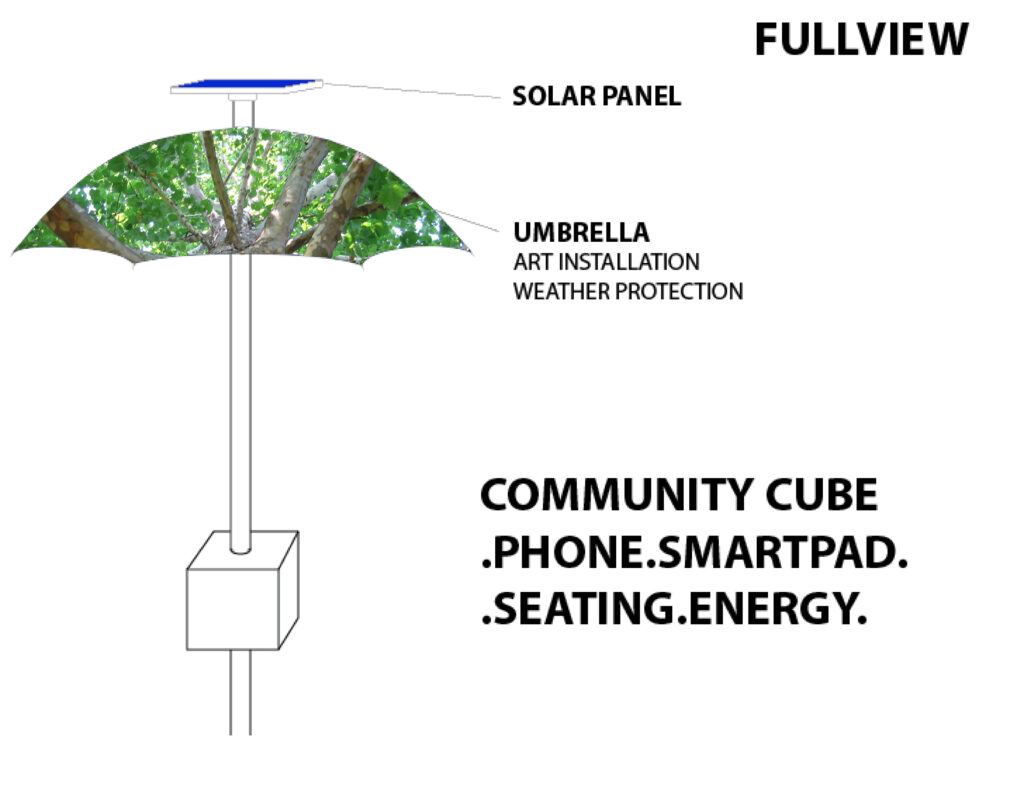
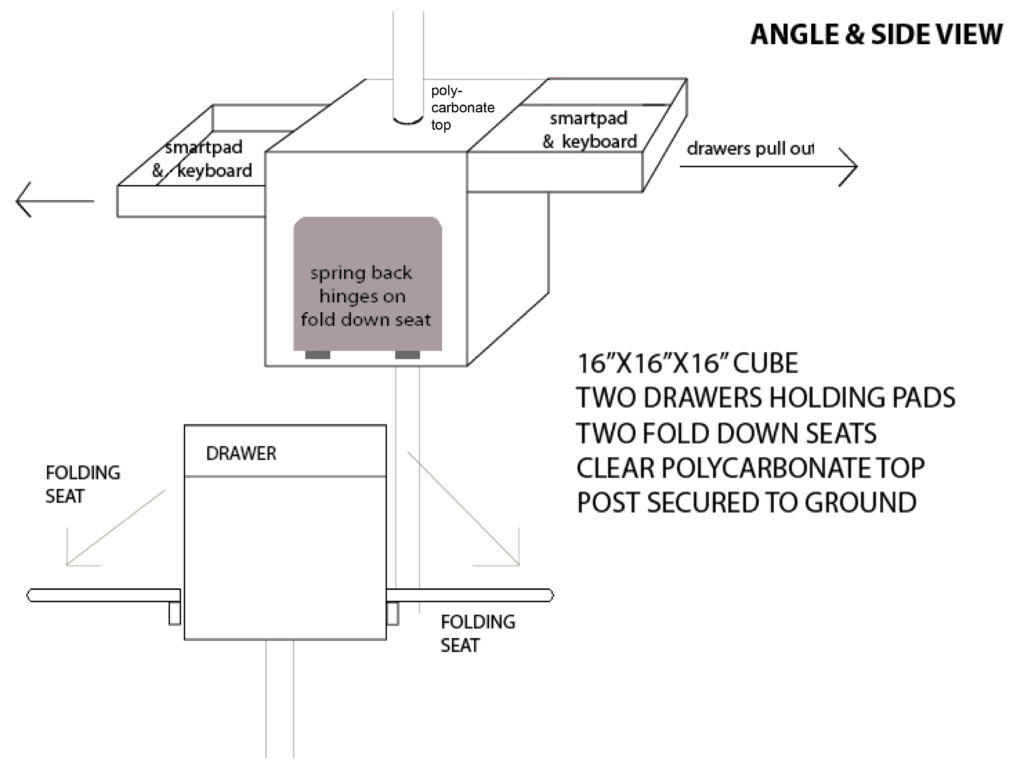
Frankly, I don’t think we can solve this problem through more talking and petitioning and complaining. If we have the capacity, species-wide, to take on these challenges by applying our creative talents to the case, there is some possibility of emerging bruised but intact. Look at SharingUmbrellas.org and let me know what you think. There are artists and craftspeople and designers and builders who can bring some new thinking to the fore and raise our aspirations sufficiently to make a difference. I fear that unless we are able to provoke the makers and the dreamers to enter the fray and deploy their talents, we are destined to tumble over the cliff we are being led to, clutching our smartphones to our breastbones and screaming “No bars, no bars, no bars”.
Now that the NYS legislature has ratified its identity as the lamest State Legislature in the country by once again failing to pass a bill legalizing electric-assist bikes, the campaign to reverse this mindless course is already beginning. Since this part-time governing body suspends all activity during a Summer recess that does not end until the New Year, there is plenty of time to strategize and plan for the next Sisyphean assault on Albany Mountain.
Unfortunately, there are two distinct approaches being taken by the two bodies and that must also be resolved. Ass. Gantt is convinced that adults must be forced to wear helmets on these machines, in spite of the urging of NYC’s, NYS’s, and all the National bike groups’ insistence that, as with ordinary bicycles, this decision needs to be left up to each adult person to make for themselves. That is in addition to the numerous scientific studies from both here and abroad that prove that requiring helmets is, on balance, a very, very bad idea. One important factor is that it reduces the number of riders so substantially that it makes it much more dangerous for everybody else. Counter-intuitive but true. Also irrelevant to your own personal decision whether you want to use one or not, but this is a perfect case of “Don’t confuse me with the facts, I’ve already made up my mind”. He also insists that nobody under 16 years of age be able to ride as a passenger. This inexplicable limitation means that an electric-assisted bike can never function as a family vehicle, one of its greatest potential uses. In contrast, the Senate bill simply reflects the Federal requirements, one horsepower, 20 MPH, etc. Reconciling these two bills will require prodigious effort, made more difficult since we are still saddled with a Medieval, top-down political system, with leaders as Barons and Committee Chairs as Dukes. Maybe an e-bike jousting tournament would catch their attention.
Speaking of Royalty, it appears that the exiting Mayor of NYC, Mike Bloomberg, was the person who applied the coup de grace to this year’s attempt to bring mobility sanity to the Empire State. It seems that the bike-share program in NYC, one of the Mayor’s pet projects, is achieving major success. A million rides and no serious accidents later, the nay-sayers are holding their tongues for the moment. While over-large docking stations and pervasive outdoor ads are aggravating some citizens, even reporters are being charmed by the ubiquity and utility of these lumbering devices. Unfortunately, Mr. Bloomberg, before the popularity of the bike share system had been established, decided to shield himself from some of the nasty tabloid editorials equating electric bikes with the riding habits of the energetic immigrants hauling hot food around the town to their hungry and anxious customers. To keep from being labeled rabidly pro-bike, while these same car-ad filled excuses for journalism lambasted him for bike lanes, bike share, e-bike deliverers, etc. etc. he decided to defend his reputation by trashing e-bikes.
Strategic? Certainly. Hypocritical? At least grossly inconsistent. Reversible? He won’t be in office next year. It is really a shame that another year must be wasted. Both branches of the legislature, this year, wrote bills which were then taken to their “third reading”, which meant that they were ready to be voted on. Then, from what is being said, the Mayor used some of the brownie points he had accumulated when he decided to personally donate considerable sums of money to a variety of Republican State politicians. The leverage that this provided him was enough to put an umbrella in the spokes of this pro-bicycle legislation, a strange action by the most pro-bike elected official ever in this part of the world. It might have made more sense for him to lean on his Police Commissioner to enforce traffic laws and lessen the bad behavior of some hard-driven piecework laborers, rather than penalizing a host of older cyclists who would like to extend their enjoyment of this healthful activity by getting a little help from a tiny electric motor.
While in France and Germany there are already large experiments with electric-assist bike-sharing, here in the U.S. such programs are all tiny experiments engineered by some smart college students. What better way is there to demonstrate the new pleasures that environmental responsibility will afford us than bringing on the rides, everybody’s favorite part of a carnival or fair? Those looking to raise both awareness and levels of activity around a host of important matters, like extreme climate change, can not find a more accessible subject around which to generate participation, maybe even have some fun. The fact that the alternative to sane transport is oil wars and repo men only enhances the relevance in engaging what was once considered wimpy and marginal. Cycling in its many guises, including the commercial varieties that cargo cycles and pedicabs can bring, points up the absurdity of banning human-scale electric vehicles in a place like New York City, that is over-run with badly maintained, ridiculously over-sized trucks, hazardous to all human life, even when they are not moving.
Who does not want to replace as many of these monsters as possible? How can it be done without some motor power, to supplement human power, which is, however, often, all that is really needed? It is our mind power which is lacking, because we simply can not imagine another world in which sanity has been restored to this element of our lives. When this revolution comes however, don’t expect to hear about it on car and oil ad-supported television or in automobile ad dominated tabloids like the New York Post. And beware of politicians who are cowed by their smarmy misleading editorials, which do nothing but broadcast undeserved contempt for hard-working “others” on their “other” vehicles and their extreme undeserved love of themselves and the status quo, no matter how destructive, irrational or unsupportable, it is.
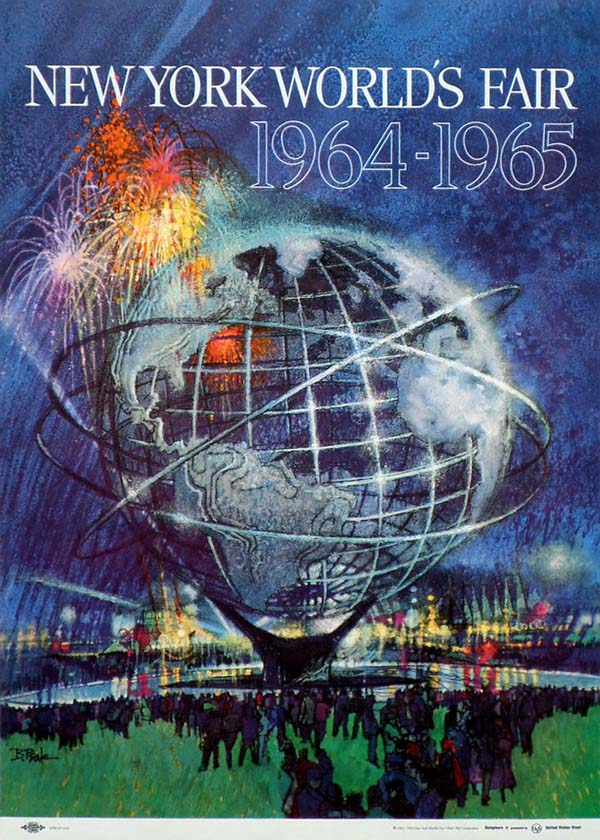
Celebrating the Anniversaries of the 1939. and 1964. New York World’s Fairs
Celebrating the Anniversaries of the 1939. and 1964. New York World’s Fairs
By Steven Stollman
This Anniversary Celebration of the two notable World’s Fairs staged in New York City during the Springs and Summers of 1939-40 and 1964-65, intends to preserve the essential spirit of these events, the varieties of Cultural Expression, the marvels of Cutting-Edge Technology, the Fun, the Food, the Rides and all the rest. Taking place in 2019 and 2020, its focus will be on a bottom-up, modern, and fully interactive interpretation of this classic exposition, while adding the novel notion of simultaneous mini-events, taking place at many diverse locations around the country and the world at the same time, instead of just in one place.
As a prime focus, artists, craftspeople, designers, mechanics, and engineers are being encouraged to begin immediately to fabricate the next generation’s human-scale transportation system, the weather-protected bikes, and wheelchairs that will fill our urban spaces. We will work to motivate individuals and small groups to begin this work, where they are and right away. In the Spring of 2019, we will invite them to bring their creations to the World’s Fairgrounds in Queens New York, to show them off and exchange ideas with other participants. Meanwhile, they will have been working for a year to expose these ideas to their own communities while also exhibiting them on our website. We will also be reaching out to individuals and institutions here to provide hospitality to visiting builders and transportation companies, to help get their vehicles here for the show.
Another theme prominently featured will be Agriculture and Nutrition, with opportunities developed for city-dwellers to experience growing environments directly, by facilitating inexpensive travel to rural environments while also providing ethnically-rich and nutritious foodstuffs to all. The ultimate goal here is to habituate people to eating more consciously and healthfully, while also more greatly appreciating the range of tastes and preferences enjoyed by those with different backgrounds and influences. The third major subject category is the ways in which neighborhoods can become friendlier and more supportive of their own resources, both human and natural. We want to help answer the question: How can members of communities organize and express themselves more fully, in order to take more responsibility for their surroundings and have a greater influence over them?
The last major area of interest here is in Cultural Expression and the diversity which characterizes our planet as expressed through music, dance, poetry, and other distinctive ways of interpreting our lives. As well as seeking out opportunities for these expressions to take place during the event, in keeping with the traditions which have characterized events such as this historically, we intend to invite demonstrations of the role that technology does and can play, in helping us to enjoy these creative performances.
The ordinary definition of a World’s Fair is a collection of exhibits, put together by large corporations, industries, and Governments, to impress the public with their grasp of the future and value to us in the present. Visitors are expected to congregate where huge, expensive but temporary pavilions have been constructed, to house elaborate exhibits. Spectators are expected to be dazzled and impressed with the importance of these enterprises and their products and take home souvenirs that will someday earn them a fortune on eBay. Despite the typical grand scale and the sense of remoteness that it sometimes invokes, the fact is that most attendees enjoy these spectacles enormously and never forget the impression that they made on them. Of course, now that TV (first demonstrated in NYC at the 1939 Fair) has rendered the most exotic the most commonplace, we need a re-working of this experience and a more interactive approach.
Communications and information are two fields that have developed extraordinarily in recent times, much of it through miniaturization and already have changed the way we live dramatically. Transportation, the next field to be revolutionized, and miniaturized, is a subject that has been overly influenced by the self-centered agendas of those in a position to benefit from maintaining the status quo. A car today is, in an urban environment, as absurd as a twenty-pound cellphone. The President of the United States says our “Economy is built on innovation”. Around the world, many of the tasks we perform are done with archaic tools, oversized cars, and trucks prominently among them. Intensive research into available alternatives is crucial. By creating conditions that permit us to more easily learn from one another, we are better able to use the benefits that are generated by this activity, while continuing to fuel our researches and making it easier to adapt our thinking and behavior to best utilize our new knowledge.
The Chinese Politburo many years ago decided to favor funding road-building and car manufacturing over mass transit and more recently had even begun to ban bikes and electric bikes from some roads, until popular discontent forced them to reverse their stands. The wisdom of giving more attention to the needs of the majority of the population is clear but the means to accomplish this is less so. What is obvious to nearly all is the need to begin to conserve resources. The danger of simply following the example of the United States and the Western industrialized world, which defines progress as growth, is manifest, and traffic jams now plague every continent. Substituting quantity for quality in determining the nature of our economic success is causing enormous problems. In a world where hunger is still a serious problem, converting food into fuel for cars is only the most obvious example of our folly, but not the only one.
We must figure out how to provide ourselves with the level of creature comfort that we are now accustomed to in our transportation system, without the enormous economic and environmental costs that this now entails. The most direct path to this end is human-scale and human-powered vehicles, with electric assistance. They can provide the means for this conversion to take place, from industrial-scale vehicles, especially petroleum-powered, which are inherently both dangerous as well as unsuitable for crowded urban environments. If the internal combustion engine had just been invented there is no way that we would have allowed it on our streets. Poison gas in any quantity is forbidden in indoor spaces, but so common that it is virtually invisible in our shared spaces.
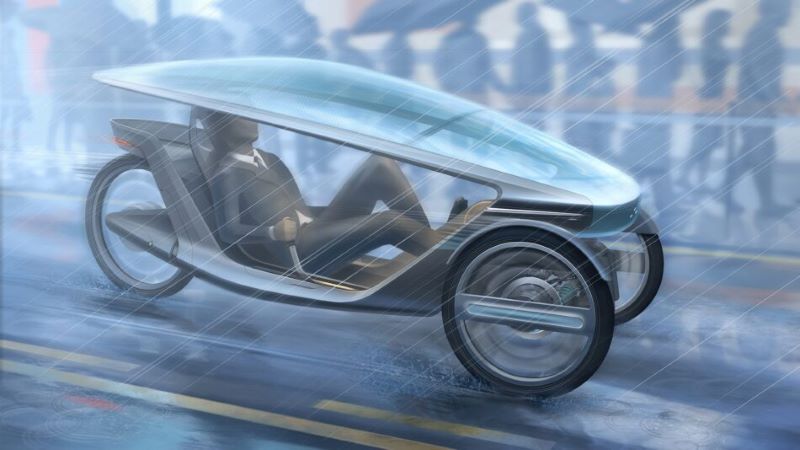
This insult to our health and well-being is only tolerable because it has been with us for so long. Those who benefit from its inherent hazards and inefficiencies spend enormous amounts of money to convince us otherwise. The real problem is the lack of suitable alternatives. There is not even wheelchairs (which could be another name for cars) or bikes, an essentially 19th-century design, with umbrellas. Upgrading the least expensive modes of travel sufficiently to replace the outmoded ones we currently use will have an enormous influence on our surroundings. Multi-ton vehicles traveling at common speeds have an immense negative impact on our sense of peace and tranquility. While we now associate all of this hyperactivity with the energy of the urban experience, the noise alone is often so intrusive that you can not even carry on a normal conversation.
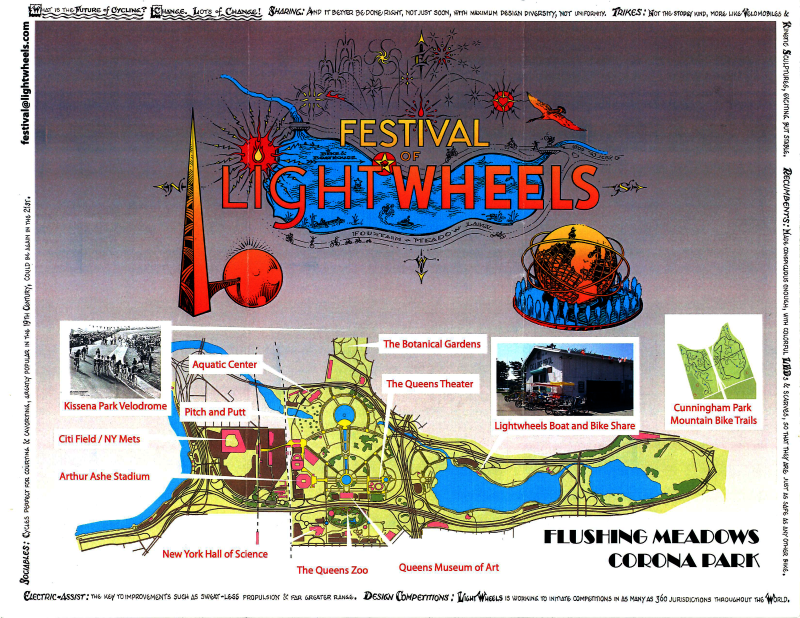
It makes good sense to use the 1255 car-free acres of Flushing Meadows Corona Park, the World’s Fairgrounds, to bring together a host of creative, ingenious and caring people, to take on this important challenge and demonstrate how it can be dealt with, to a vast local and global audience.
Why call something a World’s Fair?
A number of good reasons:
It is taking stock of our ability to create objects and activities, that can improve the quality of our lives, and help us to be fully aware of the times we are in and, most importantly, what is coming.
It helps to put needed attention on important issues, while also using art and creative expressions as key factors.
It highlights the many unique places in the world and the cultures that exist there, which can expand tolerance and appreciation of differences.
This proposal endeavors to retain the innovative and welcoming spirit of these historical events, but it is also structured in some ways that are the very opposite of the classical model:
It is taking place everywhere in the world, in every country at the same time.
A variety of regional gatherings will supplant the usual single location.
It is taking place starting now and continuously, with no arbitrary time limit.
It cost nothing to exhibit or to share in the activity taking place.
In order to initiate this program it will require :
A means to reach out, as widely and quickly as possible, to all potential participants.
A program to solicit money and in-kind contributions, to be given directly to builders.
A non-profit established, to help local groups to gain economic and political support.
A website, www.AMovement.org to provide the means for programs to communicate.
An artist, who can illustrate the shape and goals of this effort with effective images.
A group of supporters, willing to be helpful in gaining visibility for this undertaking.
Funds, are sufficient to reward, appropriately, those providing professional services.
Anniversary Celebration of the 1939-40 and 1964-65 New York World’s Fairs
All Summertime 2022-2025
WHAT:
Advanced Design Bikes and Wheelchairs to share and on exhibit, and innovative visions of our human-powered future
Featured, along with more evolved human-scale transportation, will be improved nutritional options, creative uses of public space, healthier recreational activities, and fuller appreciation of the natural world
WHERE:
Flushing Meadows Corona Park, Queens, N.Y. and 1255 acres of car-free public space, N.Y’s World’s Fairgrounds, & in localities around the country & the world.
WHEN:
From 2022 and 2025, to coincide with the 60th anniversaries of the 1964-65 New York’s World’s Fair.
WHO:
Though Queens is already home to the broadest assemblage of peoples, speaking more different languages than anywhere in the world, it is the intention of the organizers to involve local communities everywhere, from 191 other countries, 49 other States, 61 other counties, and 59 NYC Community Boards, 360 venues, all, in effect, represented by their local residents’ entries. Through the Internet and a focus on sustaining localized activities, we will endeavor participation to be maximized everywhere and thereby enable everyone who desires, whether here or in their own community, to be involved.
We are in the process of gathering another group of individuals who would like to declare their support for this program. The list below was assembled when we were still the operators of the Bike and Boat rental concession in Flushing Meadows Corona Park in New York City, during our first attempt to bring this all together previously. Unfortunately, electric-assisted human-powered vehicles were still in legal limbo at that time, and doing this would not have been possible. The current version of this event does not require that the location of previous World’s Fairs any longer be central to this effort. (In fact, New York City is currently discouraging electric bikes, even though they can not be distinguished from ordinary bikes) and trikes, from using the park. It is expected that this situation will change soon but it doesn’t matter, since work will be going on in small groups, using permitted space, to build their vehicles, everywhere in the world. All public streets and other public spaces are always available to exhibit and share in the enjoyment of these new means of getting around.
Kent Barwick, Former Director of Municipal Art Society and NYS Council on the Arts
David Gurin, Former Commissioner of Transportation, Toronto Canada
Carlos Pujol, CEO Cemusa, NYC Street Furniture Contractor
Garrett Brown, Inventor of the Steadycam and Skycam
James Weisman, Legal Director of United Spinal Association
Sherry Huss, Director of The Maker Faire
Jay Townley, Consultant at American Bicycle Industry
Wendy Brawer, Founder of The Green Map Project
Dr. Alan Moore, Art Historian/Exhibit Organizer
John Dowlin, Publisher Bicycle Network News
HOW:
Like Fairs of the past, the emphasis here will be on creativity, expression, tolerance, education, technology, and enjoyment. Unlike the usual format, there will be no large and expensive pavilions meant to be dismantled after the event. Instead of limiting participation to large-scale organizations, it is the intent of the organizers to put the focus here on the accomplishments of individuals and small groups of people by demonstrating our ability to have a positive effect on our common existences, to contribute to healthier and more active lives and to reduce the harm we may, even unintentionally, cause each other.
Financing is always an issue and first of all, as befits an anniversary celebration, we will invite all of the former exhibitors to be a part of this event. We will ask them to provide as many small grants as they can, to various deserving local efforts, to commemorate their previous involvement. We are also inviting any other business or government unit to do the same thing, to provide small amounts of money to individuals and small groups within their communities to help them develop a project which can be part of this event. The Organizing Committee, charged with turning this idea into a reality, will be comprised primarily of volunteers and will largely use their own resources and contributed facilities to guarantee the success of this effort. We can further encourage these developments by expediting access to travel, hospitality and other needed support to visit designers and builders, by soliciting help, especially from those who hail from their home towns, to help enable the broadest involvement possible.
While experienced professionals in various areas will be needed to help guide this undertaking, it is our intention that, through the broad participation of students and non-profit organizations we can keep costs to a minimum. A detailed working plan and timeline will be developed soon and distributed to all those aiding in this effort.
WHY:
As the place where the Flushing Remonstrance occurred, one of America’s earliest attempts to establish universal respect for the differences in belief that exist, and the first home of the United Nations, there is no location more suitable to build upon these efforts to venerate our humanity. As in previous Fairs, appreciation of others from different backgrounds, having a good time, experiencing evolving technologies, and exposure to varied forms of expression are central to the event.
What will be different about this version of a World’s Fair will be a vigorous effort to encourage direct involvement in these issues, to maximize participation by individuals rather than institutions, and an emphasis on heightening appreciation of the potential for people of any age or background to make significant contributions to our common evolution, to engage their own creative energies in the service of others. Applying ourselves to issues like nutrition and the use of natural resources that concern all of us will enable participants from everywhere to relate to these important questions and their resolution.
One subject that concerns us all is the production and provision of healthy and nutritious food. This also involves the growth and gathering of foodstuffs as well as improved guidance in the preparation and consumption of life-preserving and life-enhancing nutrition. Being exposed to comestibles from everywhere in the world gives us the opportunity to improve and change our habits, to appreciate the lessons learned from different cultures over time regarding the best ways of appreciating our natural environment and its products, expanding our tastes, and improving our choices. We will encourage suppliers to focus on healthier, more economical, and therefore preferential foodstuffs. Keeping in mind the effect of these choices on the health of our planet is another important dimension. How we use our land is a factor in how the future looks and must not be ignored.
While a number of subjects will receive significant attention here, we recognize that important technological advances have made real breakthroughs in lightweight transportation possible today and the economic and environmental burdens of the current system are considerable. This high-profile, prestigious showcase can serve to motivate designers, builders, and allied enterprises from everywhere to bring new ideas forward, and into the real world quickly. Developing variations on the common bicycle, to help bridge the gap between minimal and maximal transport, is long overdue. We know that bicycles, wheelchairs, artisanship, and stress on shared resources are common features in the lives of people from every corner of the world.
Using our combined ingenuity, creativity, and experience, we can reshape how we get ourselves, and our goods, around, how we deploy our shared resources, and how we help influence others to understand their best choices. If we do this in the process of enjoying pleasurable experiences, there is hardly a better way to illustrate this potential and its desirability. While the public is accustomed to regarding “educational” activity as possibly boring or tedious, here the opposite is the case.
For instance, these machines, whether previously called wheelchairs or recumbent trikes, can be used by everyone, if made well enough, not just a special population. Making available colorful, easily-usable, creative vehicles, new varieties of electric-assisted and human-powered transportation, regardless of former definition or category, can completely remove the existing onus of using a wheelchair. The best-designed vehicles can enjoyably be used by the young, the old and everybody in-between. These machines might well end up resembling each other more than they look like their current versions. We can vault over ancient and worn-out categories into new and more relevant distinctions. Is it weather–protected? Is it beautiful? Can you carry your friends on it? Is it different than anything you have ever seen? Do you wish you had made it? Can you use it when you want to and leave it conveniently for somebody else to enjoy when you are finished?
Encouraging innovation and accelerating the healing process of the planet is now job number one. There can be an infinite number of worthy projects cataloged, described, shown in action. This resource will begin by culling the best examples from existing databases.
We will encourage new ideas, even if only in the form of a drawing, a model, or something that only the designer/builder rides, which can be practically anything and may be used by other designer/builders only, in a kind of exchange. If the public is going to be allowed to use it within a confined space and protected environment, a more strict set of standards will have to be used. If it can be ridden away, to use in the rest of the park, the most stringent requirements will exist. We will employ a peer-review process, so that selection of participating vehicles is as fair and high quality as possible and so that all parties to this activity can have what amounts to a continuing ongoing forum so they can contribute their ideas and concerns, and participate in the process of addressing them.
Everybody needs green spaces, exercise, and safe, non-destructive, and affordable ways to get around.
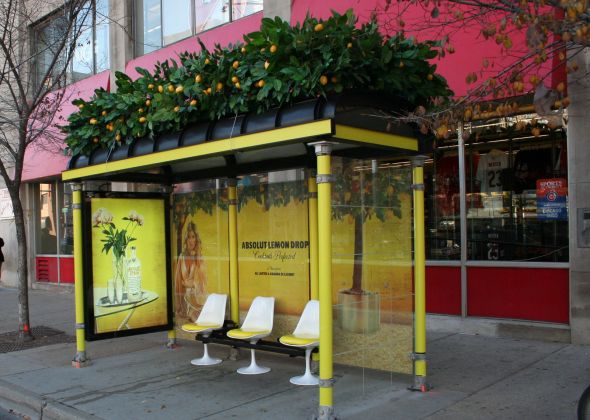
Providing some shelter, as little as a large “Umbrella” is essential in making our public spaces fully habitable. This endeavor will also encourage the design and construction of unique, beautiful, and interesting structures, to provide weather protection, especially to public transit users. We will also encourage a process that will enable local artists, craftspeople, and others to formulate these structures for their own neighborhoods and for those communities to have a hand in this process.
We are dedicated to improving everyone’s ability to enjoy their shared spaces, especially parks by preserving and enhancing their natural beauty while expanding access to new, healthful, non-intrusive activities. In the words of urban historian Lewis Mumford, the Godfather of the 1939 New York World’s Fair, “Year by year our cities grow more complex and less fit for living. The Age of Rebuilding is here. We must remold our old cities and build new communities better suited to our needs”.
How to build a human/solar-powered vehicle
Find some old, discarded, broken, or unused bikes of any description.
Find a pad of paper and a pencil or pen and look in the library for helpful information.
Begin to imagine what a different kind of vehicle might look like and how it might work.
Call a friend or two so that this can begin to be a cooperative group project
Make a poster with an email describing this project and what you hope to accomplish.
Find some unused space to work or put the request for one on the information poster.
Contact local hardware, and second-hand stores, to ask them to contribute needed materials.
Offer all local businesses the opportunity to sponsor and provide resources for the group.
Collect a basic hand and power tool kit and selection of nuts and bolts, tape, epoxy, etc.
Offer other locals, with an interest in this process, the opportunity to become involved.
See if there are engineers, mechanics, artists, craftspeople, or anyone willing to pitch in.
Let the local media know what you are doing so they can publicize and help you.
Post your progress on AMovement.org so you can invite comments and help.
Follow the advances that other groups are making and continue to learn from them.
Bring local officials into the picture and encourage them to pursue your ideas seriously.
Learn the history of transportation in this country and how it has been manipulated.
Give everybody rides in your vehicle and begin re-evaluating and re-designing it.
Use the experience of the following something from idea to reality to solve other problems.
Establish the value of believing in yourself and learning to be as creative as possible.
Persuade all local educational establishments to consider beginning their own project.
Work to use the results of these efforts to bring forth actual enterprises and products.
Ride around and show off what you have done in order to inspire more similar efforts.
The New York Bicycle World’s Fair
A decade ago,
I was the operator of the Boat and Bike rental concession in Flushing Meadows Park, the site of the 1939 and 1964 World’s Fairs. I proposed then that an anniversary celebration of these events be held, but with a different architecture. Instead of large, expensive, and temporary pavilions, sponsored by the biggest corporations, USA States, and foreign governments, the usual top-down affair, it was proposed that this event be a bottom-up, multi-year celebration, centered on creative designs of human-powered and electric-assisted vehicles. Further, it was proposed that these efforts, by individuals or small groups, be supported, in part, by cooperating foundations, companies, cities, and educational institutions, and take place in New York City, as well as in other locations around the world, on an ongoing basis.
Back then, the proposal for these exhibitions and demonstrations was intended to serve to raise the awareness of the potential of these technologies to provide us with their considerable environmental and economic benefits, while developing more interest and involvement in their possibility to contribute to more healthful and needed advances in our ordinary habits. Now, a decade later, after the crucial evolution of battery and motor technology, we are witnessing rapid progress in this realm and every day brings new products and ideas forward. The utility and pleasure provided by these machines have now been established everywhere.
While these developments are certainly welcome, there is still an important opportunity to open this process fully, to engage artists, designers, engineers and mechanics, and others, to contribute to this evolution. Providing a place, like car-free Flushing Meadows Park, to provide one of the central venues for the public to experience these advances, to ride and share these devices and exhibit the results of their creative efforts, will further accelerate their development and wide use.
It is not necessary for any organization to control this activity or directly manage it. Rather, it can be publicized and popularized and become one of the ways for this important technology to become a part of our lives more rapidly and provide for a far wider range of design options. Weather protection, multi-person devices, easier access, and improved safety are some of the areas in which we need to pay more attention. Bicycling is ordinarily a solitary activity and is usually limited to use in fair weather, thus preventing its fullest benefit. The introduction of helper motors has already considerably expanded the number of users, but the most stable, comfortable, and utilitarian models are still rarely available. The ability to use vehicles in all kinds of weather conditions, hot, cold, rainy, etc. limits their ability to replace the multi-ton vehicles that monopolize our open spaces. Multi-passenger “Sociables” that were once popular, is rarely in evidence. All this can change as our ambition to fulfill the potential of these machines is explored and realized.
Recent events, in the form of fires and floods and pandemics, may have been interpreted, by some, as a kind-of Biblical message. For others, this is an urgent call for action, to explore the most dramatic changes in our consumption patterns, of fossil fuels especially, as soon as possible. There are a few changes that will be more effective in countering this challenge to our survival. Creativity is sometimes just a path to pleasure but it can also be a kind of medicine, the most effective response to a dangerous threat. It is time for us to take this remedy to heart, to use the transformation of our public spaces as a conspicuous demonstration of our ability to confront our common challenges and resolve our most serious crises, joyfully and effectively.
A Plan Goals Environmental
Accelerating needed changes
Introducing new concepts
Widening public awareness
Economic
New companies forming
Money saved
Lessening waste
Lowering costs
Aesthetic
Beauty, not just utility
Uniqueness vs. manufacturing
Participants Designer/Builders
Existing
At schools
Artists/Sculptors
Concepts as well as actualities
Work that excites interest
Organizations
NGOs
Health
Environmental
Justice
Transport
International
Professional
Engineers
Designers
Art
Community
Queens Museum
Hall of Science
Improvement groups
International Foreign Governments
Transportation ministers
Environmental agencies
Health departments
Previous exhibitors
Businesses
Organizations
Comity
Environmental
Politicians NYC
Jessica Ramos
Eric Adams
NYS
Heads of relevant committees
Agencies
NYSERDA
Sponsors
Foundations
Personal
Sierra Club
NRDC
Foreign Governments
Transportation ministers
Environmental agencies
Health departments
Previous exhibitors
Industry
Corporations
Former participants
Government Agencies
NRDC
Commerce
DOT
Businesses
Local
Industry-based
Bike-related
Individuals
Stollman
???????
Schools Universities
Community Colleges
High Schools
Trade Schools
Strategy Local buy-in first
Massive email
Request for lists
Public records
Press
Social media
Print and broadcast
Pre-events and exhibits
Budget Minimal $5000 seed money
Primarily volunteers
Outreach through Social Media
Legal setup established
Totally transparent
GoFundMe or other
Structure Democratic, majority-ruled
Members are invited
Temporary initially
Activity aided not managed
Supporters
Financial
Signatories
Co-sponsors
Staff
Organizer
Media person
Graphic artist
Treasurer
NYWFAC 2022-2025+
It is now, finally,
legal to operate pedal-activated, electric-assisted cycles in New York City. Fortunately, fully-evolved versions of these machines, multi-passenger, weatherized, beautiful and accessible, will eventually fill our streets. Meanwhile, vehicle designers, from around the country and the planet, are therefore invited to visit here, over the next few years, to bring their creative versions of these devices, including wheelchairs, here, to show-off and use.
The primary venue for this undertaking is Flushing Meadows Park, in Queens New York, now celebrating the Anniversaries of the historic 1939 and 1964 World’s Fairs that took place there. Its wide paths and many open spaces are perfect places to demonstrate the next generation of healthful, safe, appropriate, maybe even beautiful, urban vehicles. Giving the public the opportunity to experience this multitude of options is of great benefit to both the creators of these new, up-to-date conveyances and their eventual users.
This program will also seek to initiate efforts in other places with similar goals. Traveling to NYC will be impossible for many, so helping to generate local support for projects from both public, private and non-profit sources, needs to be done as well.
This “event” is more like the sun rising, a natural occurrence, an inevitability. We have finally, as a species, realized that we must use the resources that we have more consciously and responsibly, especially as regards transportation. As a result, bike-sharing and electric vehicles, for instance, are becoming standard and welcome features of cities everywhere.
At the same time, there is the realization that we must begin to seriously upgrade the quality and utility of these devices, enable them to provide better weather protection and creature comforts, make them beautiful and inspiring instead of merely utilitarian. There are ingenious people everywhere, artists, mechanics, designers, who can contribute to the expansion of the varieties of vehicles available and their improvement, and should.
Showing these devices off, and letting others use them, as part of a grand showcase, in order to generate more colorful and beneficial activity in this realm, is one goal here. Contributing substantially to resolving one of our most vexing environmental catastrophes is another. Appreciating one another’s creativity while having a good time is another.
An Invitation
To Makers Everywhere
To Build A Vehicle & Show It Off On The World’s Fairgrounds Of New York City
There is an urgent need within our cities to develop personal transportation that bridges the gap, between the bare minimum, the bicycle, and scooter, and the oversized, multi-ton automobile. These new, safe, light, comfortable, and easily used devices, must retain a muscle-powered option. This is essential, in order to encourage the widest possible enjoyment of the substantial economic, environmental, and health benefits that we can provide for ourselves.
Because these vehicles operate on a human scale, this creative work can be done by a wide range of designers, mechanics, artists, sculptors, and makers. Materials can include fabric and wood along with the usual metal and plastic. Motors and other parts can be recycled from discarded or re-purposed items. Taking part in this process is open to anyone with the desire to participate. As a “World’s Fair”, taking place in a neighborhood with the most diverse population on earth, along with numerous local projects taking place at the same time, the broadest possible involvement is possible.
1939/1964 New York World’s Fair Anniversary Celebration 2022-2025 will perform only two tasks: we will let as many people know about this program as possible and expedite communications in general: we will also endeavor to motivate individuals and businesses, where ever they are, to lend support to their own local efforts, even to begin one. This will help in bringing attention to these projects and generating resources. Scheduling local get-togethers and exhibits and establishing cooperative efforts do not require anybody’s permission. It is not necessary to voyage to NYC to take part here either, although it would be welcome. There are no contest, or prizes, at least yet. Being part of this is winning. Expressing yourself, by making it easier to get around, while enabling more life energy to flow through our limbs and senses, is the goal.
Avanti!
Participation
nyworldsfair.org
will be the first World’s Fair to take place all over the world at the same time. Participation is gained by scheduling a regular and convenient time and place, for yourself and your neighbors to exhibit and work, on local, muscle-powered-vehicle building projects. We need to accelerate the design and development of human-scale and human-powered and electric-assisted transportation for work, travel, pleasure, and exercise.
We can celebrate these Fairs’ high-tech surprises, International favor, and good fun, with few rules to limit originality, (only pedal-activated vehicles please) while enabling crowd-sourcing and cooperation to help us solve serious problems. We need cycles and wheelchairs that are safer, healthier, more affordable, more beautiful and unique, and easier to access, share and use. We need many creative people to initiate these efforts.
Individuals and small groups are being encouraged to begin projects to re-define these modes of transport and bring them from their current 19th-century configurations into the 21st Century, with weatherization and motorization, etc. Submissions will be sorted by type, cargo, passenger, multimodal, amphibious, etc., and also by geography, and will be freely viewable on nyworldsfair.org. Artists, engineers, mechanics, and designers are all being invited to take part in the creation of much better, and greener, transport options, for everyone and from everywhere.
A World’s Fair Celebration for Everyone
Preserving the Most Important Classic Features of these Historic Occasions: International, Inclusive, Technology, Education, Fun, Rides, Shows and Snacks
Differences Between Previous Fairs
There is an admission Charge. There is a fence around the perimeter. There are large, temporary, expensive pavilions. Participants are large corporations and governments. Visitors are mostly passive observers and consumers. The intention of exhibitors is to dazzle and impress. This takes place for some months over one or two years heavy initial expenses make economic viability rare. The residual benefits of momentary events are few. There will be long waits to enter complex busy exhibits. It will take several years of planning to participate. Surrounding communities barely participate or benefit. There is no control over the healthfulness of food etc. The “World” has to come to you from somewhere else. There is no meaningful interaction among exhibitors. The emphasis is on the proprietary and the profitable. The Industrial Scale World is what matters most here. We are taught that seriousness is the opposite of fun Everybody has to come to this place to participate.
This One Planned for 2019.
It is in a public park and admission is free. There are pesky highways but no walls. There are mobile traveling exhibits on wheels. They may sponsor individuals and small groups. There are continuous opportunities to interact with. Presenters aim to motivate others to join them. This activity becomes a part of this park and others. This low-cost approach guarantees solvency. This is the start of new transport infrastructure. Numerous small-scale opportunities will proliferate. Exhibitors can decide at any time to be involved. All surrounding neighborhoods are a part of this. Here is proof that good tasting can be good for you. People from everywhere are already in Queens. Open Forums on Human Powered Vehicle design. The public’s interest in its own public space is key. The Human Scale dimension is the one we live in. Yet Human-Powered Transportation is a lot of both. This happens here and there and online and off.
THE DONUT
Maybe I am wrong,
and there is no small army of mostly young, creative, ingenious, and entrepreneurial people, everywhere, who are ready, now, to contribute their best efforts towards re-designing our urban transportation systems, in order to improve our ability to survive the current climate crisis, and have a really good time while they’re doing it.
Maybe it is impossible to use tiny human-powered vehicles, with solar/electric assistance, to replace archaic multi-ton, gas-powered behemoths.
Maybe we can not construct these new conveyances so they offer full protection against bad weather when needed, safely and comfortably, but are otherwise open to the air.
Maybe it is not possible to enable riders to stand, lean, sit or recline, as they wish, instead of always being forced to sit, like children in school or when being served a meal.
Maybe personal vehicles can transform into person/cargo-carrying ones, so we can travel alone, or with others, as we please.
Maybe we can make certain that everybody, regardless of their abilities or economy, has equal access to local mobility.
Maybe bikes are simply too small and cars are way too big, and we need a Goldilocks moment, when we realize, suddenly, that the “Just Right” is, obviously, what is missing.
Maybe what we still need, is far greater than what we already have. Put another way, in spatial terms, the hole may be much bigger than the donut.
Sharing Umbrellas
Sharing Umbrellaswill be the first World’s Fair to take place all over the world
at the same time. Participation is gained by scheduling a regular and convenient time and place, for yourself and your neighbors to exhibit and work, on local, muscle-powered-vehicle building projects. We need to accelerate the design and development of human-scale and human-powered and electric-assisted transportation for work, travel, pleasure, and exercise.
We can celebrate these Fairs’ high-tech surprises, International favor, and good fun, with few rules to limit originality, (only pedal-activated vehicles please), while enabling crowd-sourcing and cooperation to help us solve serious problems. We need cycles and wheelchairs that are safer, healthier, more affordable, more beautiful and unique, and easier to access, share and use. We need many creative people to initiate these efforts.
Individuals and small groups are being encouraged to begin projects to redefine these modes of transport and bring them from their current 19th-century configurations into the 21st Century, with weatherization and motorization, etc. Submissions will be sorted by type, cargo, passenger, multimodal, amphibious, etc., and also by geography, and will be freely viewable on SharingUmbrellas.org Artists, engineers, mechanics, and designers are all being invited to take part in the creation of much better, and greener, transport options, for everyone and from everywhere.
The end of the Anniversary Celebrations for the 1939 and 1964 World’s Fairs will be on October 16th and 27th 2019. We will use the 11 days between those dates, to commemorate the legacy of these historic events, through exhibits and demonstrations of the futuristic human-powered vehicles being designed and built over the next two years. We will congregate during those days in Flushing Meadows/Corona Park in New York City, the site of the original Fair, and in all the other places around the world being used for these regular gatherings over this time, to be amazed, learn from one another, take some rides and have some serious fun.
SHARED:
SPACES AND FACILITIES Communication/Information/Transportation/Shelter Parkland/Sidewalks/Streets/Neighborhoods
VEHICLES AND RIDES Transport/Utility/Human-scale/”Wheelchairs” Muscle-powered/Electric-assisted/Urban-friendly
A campaign, over two years, from this Summer until late 2019, to encourage individuals and small groups to work on designing and building the next generations of human-scale urban transport vehicles and neighborhood-originated and operated, Transportation/Information/Communications Stations.
Although we are celebrating the 80th and 55th Anniversaries of the 1939 and 1964 World’s Fairs, instead of occurring only in NYC, this effort will take place at the same time in myriad locations. Wherever there is the interest, the tools and skills needed and a place to work, a group may form and identify itself.
Current wheelchairs and bikes do not provide weather protection, places for passengers or gear, the whole array of creature comforts, and other features that would permit them to be used by everyone at all times and ultimately replace, multi-ton, industrial-scale, urban-unfriendly vehicles.
Unique all-purpose shelters can be made by local artists and craftspeople, to provide protection against bad weather at bus stops and elsewhere, to give neighborhoods natural gathering spots and bulletin boards, ways to encourage help availability, organize healthy exercise, and enable resource-sharing and rides.
Local businesses, environmental, arts and education organizations, and former world’s Fair exhibitors will be asked to offer support to local groups working on these projects, to give them seed money, or in-kind contributions of materials and services, to publicize and help transport their final products to NYC.
We will expedite hospitality for participants, to find Queens residents willing to open up their homes to makers from their original home cities. This place, with the most diverse population on earth, is ideal to celebrate the universality of ingenuity and curiosity and our problem-solving abilities.
Celebrating the Anniversaries of the 1939 and 1964 New York World’s Fairs
This Anniversary Celebration of the two notable World’s Fairs staged in New York City during the Springs and Summers of 1939-40 and 1964-65, intends to preserve the essential spirit of these events, the varieties of Cultural Expression, the marvels of Cutting-Edge Technology, the Fun, the Food, the Rides and all the rest. Taking place in 2019 and 2020, its focus will be on a bottom-up, modern, and fully interactive interpretation of this classic exposition, while adding the novel notion of simultaneous mini-events, taking place at many diverse locations around the country and the world at the same time, instead of just in one place.
As a prime focus, artists, craftspeople, designers, mechanics, and engineers are being encouraged to begin immediately to fabricate the next generation’s human-scale transportation system, the weather-protected bikes, and wheelchairs that will fill our urban spaces. We will work to motivate individuals and small groups to begin this work, where they are and right away. In the Spring of 2019, we will invite them to bring their creations to the World’s Fairgrounds in Queens New York, to show them off and exchange ideas with other participants. Meanwhile, they will have been working for a year to expose these ideas to their own communities while also exhibiting them on our website SharingUmbrellas.org. We will also be reaching out to individuals and institutions here to provide hospitality to visiting builders and transportation companies, to help get their vehicles here for the show.
Another theme prominently featured will be Agriculture and Nutrition, with opportunities developed for city-dwellers to experience growing environments directly, by facilitating inexpensive travel to rural environments while also providing ethnically-rich and nutritious foodstuffs to all. The ultimate goal here is to habituate people to eating more consciously and healthfully, while also more greatly appreciating the range of tastes and preferences enjoyed by those with different backgrounds and influences. The third major subject category is the ways in which neighborhoods can become friendlier and more supportive of their own resources, both human and natural. We want to help answer the question: How can members of communities organize and express themselves more fully, in order to take more responsibility for their surroundings and have a greater influence over them?
The last major area of interest here is in Cultural Expression and the diversity which characterizes our planet as expressed through music, dance, poetry, and other distinctive ways of interpreting our lives. As well as seeking out opportunities for these expressions to take place during the event, in keeping with the traditions which have characterized events such as this historically, we intend to invite demonstrations of the role that technology does and can play, in helping us to enjoy these creative performances.
The ordinary definition of a World’s Fair is a collection of exhibits, put together by large corporations, industries, and Governments, to impress the public with their grasp of the future and value to us in the present. Visitors are expected to congregate were huge, expensive but temporary pavilions have been constructed, to house elaborate exhibits. Spectators are expected to be dazzled and impressed with the importance of these enterprises and their products and take home souvenirs that will someday earn them a fortune on eBay. Despite the typical grand scale and the sense of remoteness that it sometimes invokes, the fact is that most attendees enjoy these spectacles enormously and never forget the impression that they made on them. Of course, now that TV (first demonstrated in NYC at the 1939 Fair) has rendered the most exotic the most commonplace, we need a re-working of this experience and a more interactive approach.
Communications and information are two fields that have developed extraordinarily in recent times, much of it through miniaturization, and already has changed the way we live dramatically. Transportation, the next field to be revolutionized, and miniaturized, is a subject that has been overly influenced by the self-centered agendas of those in a position to benefit from maintaining the status quo. A car today is, in an urban environment, as absurd as a twenty-pound cellphone. The President of the United States says our “Economy is built on innovation”. Around the world, many of the tasks we perform are done with archaic tools, oversized cars and trucks prominently among them. Intensive research into available alternatives is crucial. By creating conditions that permit us to more easily learn from one another, we are better able to use the benefits that are generated by this activity, while continuing to fuel our research and making it easier to adapt our thinking and behavior to best utilize our new knowledge.
The Chinese Politburo many years ago decided to favor funding road-building and car manufacturing over mass transit and more recently had even begun to ban bikes and electric bikes from some roads, until popular discontent forced them to reverse their stands. The wisdom of giving more attention to the needs of the majority of the population is clear but the means to accomplish this is less so. What is obvious to nearly all is the need to begin to conserve resources. The danger of simply following the example of the United States and the Western industrialized world, which defines progress as growth, is manifest, and traffic jams now plague every continent. Substituting quantity for quality in determining the nature of our economic success is causing enormous problems. In a world where hunger is still a serious problem, converting food into fuel for cars is only the most obvious example of our folly, but not the only one.
We must figure out how to provide ourselves with the level of creature comfort that we are now accustomed to in our transportation system, without the enormous economic and environmental costs that this now entails. The most direct path to this end is human-scale and human-powered vehicles, with electric assistance. They can provide the means for this conversion to take place, from industrial-scale vehicles, especially petroleum-powered ones, which are inherently both dangerous as well as unsuitable for crowded urban environments. If the internal combustion engine had just been invented there is no way that we would have allowed it on our streets. Poison gas in any quantity is forbidden in indoor spaces, but so common that it is virtually invisible in our shared spaces.
This insult to our health and well-being is only tolerable because it has been with us for so long. Those who benefit from its inherent hazards and inefficiencies spend enormous amounts of money to convince us otherwise. The real problem is the lack of suitable alternatives. There are not even wheelchairs (which could be another name for cars) or bikes, an essentially 19th-century design, with umbrellas. Upgrading the least expensive modes of travel sufficiently to replace the outmoded ones we currently use will have an enormous influence on our surroundings. Multi-ton vehicles traveling at common speeds have an immense negative impact on our sense of peace and tranquility. While we now associate all of this hyper-activity with the energy of the urban experience, the noise alone is often so intrusive that you can not even carry on a normal conversation.
It makes good sense to use the 1255 car-free acres of Flushing Meadows Corona Park, the World’s Fairgrounds, to bring together a host of creative, ingenious, and caring people, to take on this important challenge and demonstrate how it can be dealt with, to a vast local and global audience.
Anniversary Celebration of the 1939-40 and 1964-65 New York World’s Fairs
All Summertime 2019 & 2020
WHAT:
Advanced Design Bikes, Boats, and “Wheelchairs” to share and on exhibit, and innovative visions of our human-powered future
Featured, along with more evolved human-scale transportation, will be improved nutritional options, creative uses of public space, healthier recreational activities, and a fuller appreciation of the natural world
WHERE:
Flushing Meadows Corona Park, Queens, N.Y., and 1255 acres of car-free public space, N.Y’s World’s Fairgrounds, & in localities around the country & the world.
WHEN:
June through September 2019 and 2020, to coincide with the 80th and 55th anniversaries of the 1939-40 and 1964-65 New York’s World’s Fairs.
WHO:
Though Queens is already home to the broadest assemblage of peoples, speaking more different languages than anywhere in the world, it is the intention of the organizers to involve local communities everywhere, from 191 other countries, 49 other States, 61 other counties, and 59 NYC Community Boards, 360 venues, all, in effect, represented by their local residents’ entries. Through the Internet and a focus on sustaining localized activities, we will endeavor participation to be maximized everywhere and thereby enable everyone who desires, whether here or in their own community, to be involved.
Kent Barwick, Former Director of the Municipal Art Society and NYS Council on the Arts
David Gurin, Former Commissioner of Transportation, Toronto Canada
Carlos Pujol, CEO Cemusa, NYC Street Furniture Contractor
Garrett Brown, Inventor of the Steadycam and Skycam
James Weisman, Legal Director of United Spinal Association
Sherry Huss, Director of The Maker Faire
Jay Townley, Consultant at American Bicycle Industry
Wendy Brawer, Founder of The Green Map Project
Dr. Alan Moore, Art Historian/Exhibit Organizer
John Dowlin, Publisher Bicycle Network News
HOW:
Like Fairs of the past, the emphasis here will be on creativity, expression, tolerance, education, technology, and enjoyment. Unlike the usual format, there will be no large and expensive pavilions meant to be dismantled after the event. Instead of limiting participation to large-scale organizations, it is the intent of the organizers to put the focus here on the accomplishments of individuals and small groups of people by demonstrating our ability to have a positive effect on our common existences, to contribute to healthier and more active lives and to reduce the harm we may, even unintentionally, cause each other.
Financing is always an issue and first of all, as befits an anniversary celebration, we will invite all of the former exhibitors to be a part of this event. We will ask them to provide as many small grants as they can, to various deserving local efforts, to commemorate their previous involvement. We are also inviting any other business or government unit to do the same thing, to provide small amounts of money to individuals and small groups within their communities to help them develop a project which can be part of this event. The Organizing Committee, charged with turning this idea into a reality, will be comprised primarily of volunteers and will largely use their own resources and contributed facilities to guarantee the success of this effort. We can further encourage these developments by expediting access to travel, hospitality, and other needed support to visiting designers and builders, and by soliciting help, especially from those who hail from their hometowns, to help enable the broadest involvement possible.
While experienced professionals in various areas will be needed to help guide this undertaking, it is our intention that, through the broad participation of students and non-profit organizations we can keep costs to a minimum. A detailed working plan and timeline will be developed soon and distributed to all those aiding in this effort.
WHY:
As the place where the Flushing Remonstrance occurred, one of America’s earliest attempts to establish universal respect for the differences in belief that exist, and the first home of the United Nations, there is no location more suitable to building upon these efforts to venerate our humanity. As in previous Fairs, appreciation of others from different backgrounds, having a good time, experiencing evolving technologies, and exposure to varied forms of expression are central to the event.
What will be different about this version of a World’s Fair will be a vigorous effort to encourage direct involvement in these issues, to maximize participation by individuals rather than institutions, and an emphasis on heightening appreciation of the potential for people of any age or background to make significant contributions to our common evolution, to engage their own creative energies in the service of others. Applying ourselves to issues like nutrition and the use of natural resources that concern all of us will enable participants from everywhere to relate to these important questions and their resolution.
One subject that concerns us all is the production and provision of healthy and nutritious food. This also involves the growth and gathering of foodstuffs as well as improved guidance in the preparation and consumption of life-preserving and life-enhancing nutrition. Being exposed to comestibles from everywhere in the world gives us the opportunity to improve and change our habits, to appreciate the lessons learned from different cultures over time regarding the best ways of appreciating our natural environment and its products, expanding our tastes and improving our choices. We will encourage suppliers to focus on healthier, more economical, and therefore preferential foodstuffs. Keeping in mind the effect of these choices on the health of our planet is another important dimension. How we use our land is a factor in how the future looks and must not be ignored.
While a number of subjects will receive significant attention here, we recognize that important technological advances have made real breakthroughs in lightweight transportation possible today and the economic and environmental burdens of the current system are considerable. This high-profile, prestigious showcase can serve to motivate designers, builders, and allied enterprises from everywhere to bring new ideas forward, and into the real world quickly. Developing variations on the common bicycle, to help bridge the gap between minimal and maximal transport, is long overdue. We know that bicycles, wheelchairs, artisanship, and stress on shared resources are common features in the lives of people from every corner of the world.
Using our combined ingenuity, creativity, and experience, we can re-shape how we get ourselves, and our goods, around, how we deploy our shared resources, and how we help influence others to understand their best choices. If we do this in the process of enjoying pleasurable experiences, there is hardly a better way to illustrate this potential and its desirability. While the public is accustomed to regarding “educational” activity as possibly boring or tedious, here the opposite is the case.
For instance, these machines, whether previously called “wheelchairs” or “recumbent trikes”, can be used by everyone, if made well enough, not just a special population. Making available colorful, easily-usable, creative vehicles, new varieties of electric-assisted and human-powered transportation, regardless of former definition or category, can completely remove the existing onus of using a “wheelchair”. The best-designed vehicles can enjoyably be used by the young, the old, and everybody are in-between. These machines might well end up resembling each other more than they look like their current versions. We can vault over ancient and worn-out categories into new and more relevant distinctions. Is it weather–protected? Is it beautiful? Can you carry your friends on it? Is it different than anything you have ever seen? Do you wish you had made it? Can you use it when you want to and leave it conveniently for somebody else to enjoy when you are finished?
Encouraging innovation and accelerating the healing process of the planet is now job number one. There can be an infinite number of worthy projects cataloged, described, and shown in action. This resource will begin by culling the best examples from existing databases. To help bring attention to the importance of preserving our aquatic resources, we can include a wide variety of boats, from radio-controlled to wind-propelled, scale models or full-sized, which can look and work beautifully on the quiet waters of what was once known as “Fountain Lake”. Additionally, this lake can be utilized to exhibit artworks, some in the form of boats, others launched for fun or art’s sake.
We will encourage new ideas, even if only in the form of a drawing, a model, or something that only the designer/builder rides, which can be practically anything and may be used by other designers/builders only, in a kind of exchange. If the public is going to be allowed to use it within a confined space and protected environment, another, a more strict set of standards will have to be used. If it can be ridden away, to use in the rest of the park, the most stringent requirements will exist. We will employ a peer-review process, so that selection of participating vehicles is as fair and high quality as possible and so that all parties to this activity can have what amounts to a continuing ongoing forum so they can contribute their ideas and concerns, and participate in the process of addressing them.
Everybody needs green spaces, exercise, and safe, non-destructive, and affordable ways to get around.
Providing some shelter, as little as a large “Umbrella” is essential in making our public spaces fully habitable. This endeavor will also encourage the design and construction of unique, beautiful, and interesting structures, to provide weather protection, especially to public transit users. We will also encourage a process that will enable local artists, craftspeople, and others to formulate these structures for their own neighborhoods and for those communities to have a hand in this process.
We are dedicated to improving everyone’s ability to enjoy their shared spaces, especially parks by preserving and enhancing their natural beauty while expanding access to new, healthful, non-intrusive activities. In the words of urban historian Lewis Mumford, the Godfather of the 1939 New York World’s Fair, “Year by year our cities grow more complex and less fit for living. The Age of Rebuilding is here. We must remold our old cities and build new communities better suited to our needs”.
A World’s Fair Celebration for Everyone Preserving the Most Important Classic Features of these Historic Occasions:
International, Inclusive, Technology, Education, Fun, Rides, Shows, and Snacks
Differences Between Previous Fairs
There is an admission Charge. There is a fence around the perimeter. There are large, temporary, expensive pavilions. Participants are large corporations and governments. Visitors are mostly passive observers and consumers. The intention of exhibitors is to dazzle and impress. This takes place for some months over one or two years heavy initial expenses make economic viability rare. The residual benefits of momentary events are few. There will be long waits to enter complex busy exhibits. It will take several years of planning to participate. Surrounding communities barely participate or benefit. There is no control over the healthfulness of food etc. The “World” has to come to you from somewhere else. There is no meaningful interaction among exhibitors. The emphasis is on the proprietary and the profitable. The Industrial Scale World is what matters most here. We are taught that seriousness is the opposite of fun Everybody has to come to this place to participate.
This One Planned for 2014
It is in a public park and admission is free. There are pesky highways but no walls. There are mobile traveling exhibits on wheels. They may sponsor individuals and small groups. There are continuous opportunities to interact. Presenters aim to motivate others to join them. This activity becomes a part of this park and others. This low-cost approach guarantees solvency. This is the start of a new transport infrastructure. Numerous small-scale opportunities will proliferate. Exhibitors can decide at any time to be involved. All surrounding neighborhoods are a part of this. Here is proof that good tasting can be good for you. People from everywhere are already in Queens. Open Forums on Human Powered Vehicle design. The public’s interest in its own public space is key. The Human Scale dimension is the one we live in. Yet Human-Powered Transportation is a lot of both. This happens here and there and online and off.
Shared
A campaign,
from the Summer of 2022. until late 2025 and beyond, to encourage individuals and small groups to work on designing and building the next generations of human-scale urban transport vehicles and neighborhood originated and operated, Transportation/Information/Communications Stations.
SPACES AND FACILITIES Communication/Information/Transportation/Shelter Parkland/Sidewalks/Streets/Neighborhoods
VEHICLES AND RIDES Transport/Utility/Human-scale/Wheelchairs Muscle-powered/Electric-assisted/Urban-friendly
Although we are celebrating the 80th and 55th Anniversaries of the 1939 and 1964 World’s Fairs, instead of occurring only in NYC, this effort will take place at the same time in myriad locations. Wherever there is the interest, the tools and skills needed and a place to work, a group may form and identify itself.
Current wheelchairs and bikes do not provide weather protection, places for passengers or gear, the whole array of creature comforts, and other features that would permit them to be used by everyone at all times and ultimately replace, multi-ton, industrial-scale, urban-unfriendly vehicles.
Unique all-purpose shelters can be made by local artists and craftspeople, to provide protection against bad weather at bus stops and elsewhere, to give neighborhoods natural gathering spots and bulletin boards, ways to encourage help availability, organize healthy exercise, enable resource-sharing and rides.
Local businesses, environmental, arts and education organizations, and former world’s Fair exhibitors will be asked to offer support to local groups working on these projects, to give them seed money, or in-kind contributions of materials and services, to publicize and help transport their final products to NYC.
We will expedite hospitality for participants, to find Queens residents willing to open up their homes to makers from their original home cities. This place, with the most diverse population on earth, is ideal to celebrate the universality of ingenuity and curiosity and our problem-solving abilities.
Payphone Design Contest
Our submission to the 2013 New York City “Payphone” Design Contest
Unique all-purpose shelters can be made by local artists and craftspeople, to provide protection against bad weather at bus stops and elsewhere, to give neighborhoods natural gathering spots and bulletin boards, ways to encourage help availability, organize healthy exercise, enable resource-sharing, rides, etc.
VEHICLES NEED STATIONS AND PEOPLE NEED SHARED SPACES
A campaign, over two years, from this Summer until late 2015, to encourage individuals and small groups to work on designing and building the next generations of human-scale urban transport vehicles and neighborhood-originated and operated, Transportation/Information/Communications Stations.
Although we are celebrating the 75th and 50th Anniversaries of the 1939 and 1964 World’s Fairs, instead of occurring only in NYC, this effort will take place at the same time in myriad locations. Wherever there is the interest, the tools and skills needed and a place to work, a group may form and identify itself.
Current wheelchairs and bikes do not provide weather protection, places for passengers or gear, the whole array of creature comforts, and other features that would permit them to be used by everyone at all times and ultimately replace, multi-ton, industrial-scale, urban-unfriendly vehicles.
Unique all-purpose shelters can be made by local artists and craftspeople, to provide protection against bad weather at bus stops and elsewhere, to give neighborhoods natural gathering spots and bulletin boards, ways to encourage help availability, organize healthy exercise, enable resource-sharing, rides, etc.
Local businesses, environmental, arts and education organizations, former world’s Fair exhibitors, etc. will be asked to offer support to local groups working on these projects, to give them seed money, or in-kind contributions of materials and services, to publicize and help transport their final products to NYC
We will expedite hospitality for participants, to find Queens residents willing to open up their homes to makers from their original home cities. This place, with the most diverse population on earth, is ideal to celebrate the universality of ingenuity and curiosity and our problem-solving abilities.
The 11,000 locations of current payphones were chosen primarily due to their potential to market their advertising panels. There are 25,000 more locations no longer active largely due to their relative lack of marketability, though they are already wired and potentially suitable. Meanwhile, since the City’s new criteria focus on their value to our communities, to serve in a variety of important roles, it is clear that they should now be dispersed throughout the city, in every neighborhood, rather than concentrated only at highly commercialized sites. Clearly, there could be many more, placed carefully, to provide a comprehensive system throughout the City.
The variations in terrain, pressure from congestion, and visual character of these diverse places suggests also that the amount of space taken up by these objects, and their relationships to the spaces around them must vary greatly, in order to best serve our neighborhoods. While the core equipment, like current phones, must conform to the existing communications and information technology requirements, the ability to develop these new facilities in such a way as to maximize their benefit to their surroundings and in harmony with them, is not only possible but vitally important as well.
One of the best networks of potential locations for phones is the 9,500 existing bus stops not currently served by shelters. Buses go where the people are and currently these stops are provided with nothing more than a pole and sign and map of the route. While many may be in sparsely-settled, relatively-unsuitable areas, the majority are along streets with substantial populations. There are currently no plans to provide shelters there since the existing franchise is limited to 3,200 fixtures. Since cellphone and solar technology have enabled the construction of a fully-functional facility without the huge expense of trenching for power and connectivity, it is no longer necessary to generate the amount of income from billboards that initially were required to justify this work.
Connectivity:
These recent technological advances, along with an infinite number of apps and other internet options, have created the opportunity to offer economical and convenient connectivity everywhere. We are now free to explore the potential to redefine our public spaces in a variety of very meaningful ways. Every plan you are being offered can take advantage of these advances by partnering with the relevant suppliers, who are happy to make their products and services available to anyone who can make use of them. The utilization of this equipment to provide local Wi-Fi, as well as everything currently online is neither expensive nor technically challenging. The ongoing success of City 24/7 here in the form of an easy-to-operate touch-screen is strong evidence that this system is already within easy reach.
Creativity:
While the current payphone design allows for some variations, we are suggesting that, to the degree possible, every one of these installations, aside from their “Equipment Modules” be as unique as possible, rather than highly uniform. This can be accomplished through the design and construction of “Umbrellas” over each location, so calls can be made and work done without having to protect oneself against falling rain or snow. Resting on strong frameworks, which also support the solar cells powering the facility, these creative constructions can be chosen through a myriad of local design contests with strong preference given to those living within the proximity of the object. Colorful, fun, or dignified, made of metal or cloth, these artistic statements can also be a unique reflection of the communities which surround them.
This system can transform our City into the friendliest environment for creative activity in the world by developing the means to use these payphone locations as both sources of art as well as being the art themselves. By enabling the screens to constantly provide examples of local creative output, the emphasis can be directed towards the work product of many of the residents of all of our neighborhoods, visual art, design, musical and written expression, etc.
To accomplish this you must design a program that will attract the positive attention of the immense creative community which makes New York its home and motivate them to relate constructively to this new phenomenon. While some make their livelihood this way, this is also an aspect of everybody’s day-to-day activity. (Improvising ways to contend with the challenges of daily life is one way that we learn to appreciate the value of creative thinking). Who knows that their next-door neighbor is a painter or graphic artist, composer, or performer? These neighborhood bulletin boards can serve to introduce us to one another and to help us appreciate the richness of talent of those living here.
Visual Design:
Billboards are intrusive and largely unpopular. Many feel that they cheapen the visual landscape. It is also possible that they lower the real estate values of adjoining properties as well. Since many people’s living spaces, homes or apartments, constitute their most important reservoirs of value, this matters considerably. If these objects were artworks, unique and well made, instead of brash advertisements, how would that affect these values? Might it enhance them rather than diminish them? Since the functional aspect of these devices has been shrunk down to a small, thin panel, why not use the rest of the space in the most aesthetic and wonderful way?
We think that this can be as important a feature of this program as the technology being made available. If screens are pointing upwards instead of outwards, as a rule, their negative impact of them is eliminated entirely.
Functionality:
Survival is the paramount concern of a substantial portion of our population. Finding satisfying and rewarding work is an urgent need. Using these facilities to provide a work exchange element, which can also be replicated online, through the posting of local needed help is not only possible but is already taking place. Running errands, walking dogs, painting apartments, many tasks are always there to be accomplished and there are already a host of websites devoted to this. Presenting their availability through the posting of qualifications and references improves the likelihood of satisfying these needs in the most immediate and dependable way.
Re-charging stations for computers and cellphones are an obvious use, but it is also possible to vend or rent these items as well. This could not be done everywhere due to security concerns, but modern vending machines dispense everything today including such items. It has become commonplace to do this in hotels and airports etc. and “Automats” have been around for more than a century. Up-to-date urban centers must develop the capacity to satisfy these needs today.
Payphones can also be combined with other kinds of needed street facilities, whether they be bus stops or new types of newsstands. At selected locations, it may be worthwhile to fully enclose these information/communication/transportation structures and make them suitable for temporary habitation by local residents. Access at different times can be provided both to those volunteering to manage them on behalf of their communities needs as well as to those making a living. Income from this activity can be used to justify the expense of construction and maintenance. Just as we once had 1500 sidewalk newsstands, this city and its historic density and diversity make even such ambitious plans practical in many places.
Community Impact:
This is the essence of this proposal since the implementation of this program could radically upgrade the availability of both helpful information as well as actual physical help. The interaction among neighbors today, almost everywhere within the city is minimal. We usually do not even know our neighbors’ names or what they do. This has its benefits in terms of privacy and freedom from unwanted and un-needed intrusions into our individual lives but it is a condition that many would choose to change. Instead of waiting for a catastrophe to remind us how much we have in common and can benefit from each other, it is time to establish mechanisms to expedite these realizations. How many people would join walking, Tai Chi, or other exercise groups, to help to improve their own or others’ health while meeting and getting to know one another?
There are already numerous blogs designed to help neighbors relate to one another much more closely. Many of these have been put together by relatively young people and a program to encourage their formation will expand this network considerably. Should these communicators be given a physical location close to where they live to “broadcast” this information locally and include the capacity to enter information as well as obtain it, this will make the formation of this mini-blogs even more attractive. Since all of these efforts are voluntary, they will cost nothing to construct and operate and may even help to generate income for the program through advertising and other commercial elements. The display of locally-produced artwork and other products could lead to some commerce as well as greater awareness.
The object here is to aim high, to not dismiss any idea or approach that could benefit this society so greatly. It should take years to roll out ideas and test them properly. Giving the public a chance to craft a stake in its own public spaces is the key. “Re-owning the phone”, as Mayor Bloomberg referred to this program, can well be the first step in “Re-owning the neighborhood”.
From the drawing board:
To the Prototype:
Sharing Umbrellas
We are inviting designs to be submitted of new human-powered and electric-assisted human-scale vehicles including so-called “wheelchairs”. We are most interested in concepts that incorporate weather protection and passenger capacity but there are no limits on type or style, speed, or cost. Cargo bikes, recumbents, folders, wheelchairs, public transit i.e. shared, or convertible from commuter to commercial, Kinetic Sculpture, and Velomobiles, all are welcome. Pictures of existing machines will be featured and drawings and models and descriptions are fine too.
The second element of this endeavor has to do with the current conversations taking place relative to the definition of public space, the role of neighborhoods and their residents in that process, and advertising in this equation. At least minimal cover, an Umbrella-like object should be available to the public at practically every bus stop instead of only 25% of them. The proliferation of unique, attractive, and community-welcomed designs for these facilities, especially if produced and fabricated by local residents, could, most importantly, do much to help encourage a new level of healthy interactions among those living and working here, even just those passing through.
Images and text from individuals and groups are already being posted on SharingUmbrellas.org and will be updated regularly. Each person will be included in the slideshow which plays on the home page and provides a link to their own page. Some will also be printed, in a full-color tabloid, issued monthly to begin, in New York City and distributed to bike shops, bookstores, newsstands and cafes, and at gatherings of those most interested in these developments. Other local groups working on these issues who want to print their own local editions will be encouraged to do this.
One venue for showing off these devices will be New York City’s largest car-free space, Flushing Meadows/Corona Park in Queens. To help celebrate the 50th and 75th Anniversaries of the 1939 and 1964 World’s Fairs, in 2014 and 2015, this great public park will serve as a natural backdrop for the public unveiling of our human-scale transportation future. Craft, technology, and the creative imagination; sharing its most intriguing fruits; learning and being inspired; all the wonders of an event that consciously endeavors to be as inclusive geographically, culturally, and socially as possible, can help expedite the rapid evolution of this key feature in our environment, how we get around.
How can the “Community Cube” be used to improve The quality of life of those who are living here?
Health
Exercise
    Walking

           Around the block, as a starting point and to keep track

           To nearby destinations for pleasure or utility

           Historical/ Architectural/ Natural etc. tours given by local residents

           Can include different speeds from relaxed to brisk up to running

           Mild competition increases motivation but no racing

           Also benefits safety

                               In case of an incident can seek or provide help

                               In numbers, there is little chance of trouble

                               More eyes on streets in general benefits all

    Stretching

              In the proximity of the location, without interfering with pedestrians

              Somewhat protected in bad weather as long as there is an “Umbrella”

              Can include guidance from a knowledgeable neighbor or online instructor

              Tai Chi

              Informal or guided includes other dance or movement methodologies

     Biking

            Shared vehicles and modest costs

            Different style vehicles

            Different age kids

            Cargo and commercial

            Cruisers

            Electric-Assisted

            Trikes

            Special Need varieties

            Multi-person

            Measured distance trips to events, attractions, tours of every kind, etc.

            For shopping, picking up kids, giving rides to friends, etc.

            Commuting (can include machines used by others during the day)

            Re-charge and lock-up aids and folders to expedite the availability
Scheduled discussions
Anyone can create a subject category and schedule a one-hour local conversation
   Information is also available later online if archived

   Can be “broadcast” to non-attendees via Skype if preferred by participants

   Can be a private conversation among a small number of people

   Cube doubles as a “Soapbox”

   Charges for some services, others are free
Monitors and moderators-Blogs for Blocks
    No age limit, 10 to 100, and cannot be small-minded or autocratic

    Those already operating can be invited to be part of this network

    Generating consensus is the goal, getting as close as possible is often enough

    Local residents choose individual or multi-person units to “operate” Cube

    Ground rules should be permissive but not abusive
Association with adjacent businesses, (at locations where they exist) provides:
    Access to services

                Power

                Sanitation facilities

                Help if needed

                Storage

    Reciprocal Aspect

                Advertising

                Goodwill

                Backup personnel

                Possible Investment

    Professionals

                Insurance

                Finance

                Accounting

                Law

                Health
Survival Issues
    Job Exchange

                Help needed and available

                            Tutoring, educating, upgrading skills

                            Physical, moving of something

                            Coping issues

                            Painting

                            Repairs

                            Horticulture

                            Cleaning

                            Childcare

                            Transport

                            Health care

                            Research/writing

                            Shopping

                            Delivery

    Tasks needing to be done

                For Pay

                Without monetary compensation

                In exchange for…………system’s own currency
Celebrations
    Birthdays

                Pictures shown

    Births

                Presents Offered

    Graduations

                Listings

    Anniversaries

                Of local events as well as relationships

    Achievements

                Share the warmth, share the glory

    Passing

                Sad, but worth noting
Life Histories
    Includes contact information

    Virtual resumes

    Willingness to volunteers

    Needs

                Work

                Personal

                Help

    Done by you, not about you
Neighborhood History
    Previous generations

                Notorious

                Early

                Continuous

                Grab it before it is done

    Commercial
Plantings
    Existing

    Possible

    Cooperatively maintained

    Native

    Micro

    Edibles
Soil conditions analysis performed
The spot itself can provide a location
The sidewalk around block=10 gardens
Artwork
    Locally produced only

    Constantly displayed

    Rotating exhibits

    Locked showcases and Virtual displays

    Music and poetry-quietly and on demand

    “Umbrella” itself is art
Enclosing the space
    Historical

    Newsstands

    Phone Booths etc.

    Mixed Use by both volunteers and private interests

                An adequate room must be provided for public uses

    Permits expanded vending opportunities
The mechanism for registering sentiment on various issues