Attaining Vision Zero

Apr 27, 2014. Times Article Viewed: 4811 

If New York City Mayor Bill DeBlasio wants to see accident deaths drop to zero in his city, he will have to ensure that there are fewer cars and trucks and more pedicabs and bicycles on his streets.
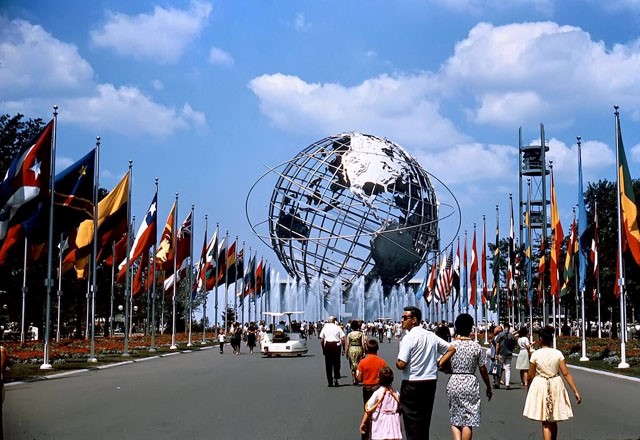
April 30th marks the 75th Anniversary of the NY World’s Fair that brought us Television, lots of cars and many other modern miracles. On that same date next week, the Transportation Committee of the NY City Council, under its Chairman Ydanis Rodriguez, will hold an important Public Hearing on Mayor DeBlasio’s Vision Zero, his initiative to reduce the number of traffic fatalities here to that number. Every year, hundreds of pedestrians and scores of cyclists are killed by motor vehicles in New York City, fewer than previously but still a lot. This is in addition to the hundreds of motorists killed by other motorists as well. The count of injuries is in the tens of thousands and the Mayor has decided to confront this carnage and to begin the process of reducing it to, in his words, Zero.

At a Town Hall meeting before a host of City Council members, the head of the city’s Department of Transportation, and other luminaries, 100 different one minute long public comments gave a good picture of their neighborhoods’ concerns and their expectations, for this bold proposed step, to improve our transport infrastructure and make it less likely that a step off a curb lands you in a hospital or worse. Many residents pointed to a corner or intersection that they found particularly problematic, and the guys who represented the taxi and black car industries gave statistics that showed that professional drivers are actually less likely to be involved in accidents than some other categories of drivers, regardless of appearances. Well, maybe. Everybody was grateful that a blue-ribbon panel had descended into their midst and was listening to their serious concerns and gripes and was offering to respond to them. Not everybody thought that anything different would actually come out of this exercise, but they were all willing to take their time out to give it a try.

A top police official listened while the question of enforcement and the lack of it, in crucial areas, came up again and again. What good are laws if they are not enforced? The city promised a more aggressive policy towards speeders, those who don’t give pedestrians their right-of-way and DUIs. A lot of people pled that the whole traffic system is slowed down, especially in residential neighborhoods, even on some major arteries, with many more bike lanes a popular request.

One minute is very little time if you are trying to say something. I used mine to point out that this was the week of the anniversary celebrations of the Fairs that took place in this very Borough 50 and 75 years ago. These events were influential in convincing everybody that cars were the wave of the future. They were a factor in rendering our roadways rail-free and bike-free, which helped to guarantee the hegemony of the automobile. I’ve suggested that we use the reminder, that these historic happenings provide, to inaugurate a program to encourage the creative design of human-scale and human-powered vehicles, perfect for dense urban environments. There are few things that the political leaders of New York could do that would have as dramatic an impact on the safety and civility of the streets of the city. Sure, reining in marauding garbage trucks in the middle of the night is important too. The 22 different bills being presented on April 30th, on this historic occasion, address a whole range of problems and opportunities. Although not included in this first batch of street-calming and traffic-controlling measures, the creative downscaling of the machines we use to get around may be the healthiest response of all, to this dangerous and toxic traffic mess.

The formula for improving the safety on our roads begins with the issue of scale. We identify two forms of this phenomenon, one is the Industrial Scale and the other Human Scale. One is measured in tons of pounds and the other in tens. The lightest vehicles may currently share the roadway in many urban environments but most are banned from highways and discouraged from using many roads on which they are legal. Historically, the smaller vehicles fall into a few separate categories. Some, like mopeds, motorcycles, and scooters, can weigh hundreds of pounds and go fairly fast. Neighborhood Electric Vehicles are an odd duck that is not allowed to go more than 35MPH and is not allowed on roads which are posted at 45MPH or faster. Bad luck chum, you are wedged in a regulatory crevice from which you may only emerge in a planned community or golf course. They are Industrial Scale because they weigh 1000 pounds or more, but share some other vehicles’ problems with access to the road.

Pedaled bikes and electric-assist models, that can only be moved when the pedals are in use, are in their own category and it is the one with the most potential to aid the Mayor in his worthy goal. All Industrial Scale vehicles are inherently dangerous, just due to the combination of speed and weight which results in their substantial momentum. Relatively slow, 15 or 20 MPH, lightweight bikes, even those with electric-assist motors, can not do the harm that a 3000-pound compact can, even at a modest 30 MPH. It has been customary for us to use minimal conveyances, like cycles, only in fair weather. The exception has been the amazingly hardy food deliverers, who manage to get around under the harshest imaginable conditions when mere mortals are retreating into trains and taxis.

We have accustomed ourselves to use, almost exclusively, these single passenger vehicles we call bikes. When it comes to automobiles, only racing cars ever fit just a single person. In China, you were allowed to have a passenger on the back or bar of your bike if you were in the country, but not the city, due to safety concerns allegedly, but hardly enforced. Sadly, the “Sociables”, multi-rider tricycles of the 19th Century are now considered exotic and the social aspect of travel on the smallest scale has been absent for over 100 years apart from a few tandems and trailers for kids.

These limitations can be overcome in many ways and thereby improve utility tremendously. This is not to say that this task is not a demanding one: these are design challenges of the first order. You must make something that is going to share the road with monsters. The weather is going to change and that includes possibly strong winds. You want to be as portable as possible, but not easy to steal, lightweight, but not easy to break, unusual or unique and therefore somewhat unfamiliar, but still easy for anybody to use safely. This is a difficult assignment but fortunately, the world is filled with ingenious people, many of whom like tough cases, who want the satisfaction of solving complex and demanding puzzles.

Doing things on a human scale can also mean hand fabrication and wide customization as well as variety and diversity of design. Hand craftsmanship has become less and less evident as market imperatives and heavy competition demand economies of scale that can only be achieved through mechanization, sometimes even leading to automation. There are great advantages to having a machine that can crank out aluminum pipe by the mile and do it fairly economically, consistently, and in a wide selection of sizes and specifications. Regardless of the efficiencies that can be achieved through some use of highly automated machinery, many operations benefit from the contributions made by live attendants, monitoring progress or completing certainly associated hand-tasks. It has been demonstrated that the ability to add the human touch to a piece can both enhance its beauty and its value.

Many factory workers are recent immigrants from parts of the world where hand metalwork and woodwork and other crafts are still popular and have many practical applications, so there are a goodly number of people practiced in the arts of handcraft. If we shift from totally mechanized to moderately so and leave room for hand-painting, first-class leatherwork, a host of optional features, some of which require measuring the recipient and testing their tastes and needs, the product is upgraded considerably, life-span extended and otherwise made better. If the only focus is on profit than it is inevitable that the human factor will be minimized. Unless there is more bottom-up momentum, if the customer is not a known person and, like the maker, an anonymous, unidentified element, we will have lost an essential aspect of our goods. What was once passed down through generations is discarded now after a few uses. We need to regain our respect for both people and the objects that they help bring into the world, give them as much care and concern as we would our spawn.

Even though cars now come with sealed modules and big replaceable units, there are still plenty of mechanics who know how to take things apart and put them back together as well as modify existing parts to fit special needs. Our biology compels us to explore ways to fulfill our requirements continuously and we do not entirely lose the ability to contrive and invent simply because we use it so little. Those who are used to employing their ingenuity, of course, will find it easier to put it into use. Artists, for instance, would be lost without it. We could all stand to have a closer relationship with our basic natures, and in touch with the instincts and talents that go with it, whether they reside within ourselves or in others.

I would urge any readers of this blog who are in the NY metropolitan area to consider coming to this hearing and speaking on behalf of enhancing a city with more electric transportation of all kinds, taxis, buses, cars and all. The trains already run on Niagara Falls juice. Many are accustoming themselves to a world filled with bikes, thanks in large part due to the currently fragile but much-loved bike-share system. It is time to begin to incorporate the new, higher-tech electric-assist bikes of all kinds into the mix, in many cases to replace the huge and dirty vans that now fill the streets. The rapid expansion of same-day delivery is going to require a bouquet of new configurations, preferably with narrow profiles, and perhaps with three wheels, that will serve the now instant-gratification society, that Amazon and eBay have decided to further advance. The same improvements that will be made to cargo bikes will translate easily to passenger-carrying vehicles like pedicabs as well.

The food delivery business is making considerable strides in generating more positive practices in the industry to help lessen the unhappiness felt when a deliverer rides his bike on the sidewalk or narrowly misses colliding with a pedestrian. This is a difficult issue, since the congested streets of midtown Manhattan especially, mean a constant dance to avoid cars and other big and dangerous vehicles. Bikes (not just electric-assisted ones) are far less hazardous of course, but also somewhat less predictable since they may want to avoid going an extra four blocks when they can simply slip carefully up the current one. There will need to be increased civility by everyone, even including pedestrians, if a reasonable situation is to be reached under such difficult and stressful conditions. Meanwhile, encouraging as much activity to take place at the Human-Scale rather than the Industrial, improves our prospects considerably, lessens noise and smoke, hazard and threat.

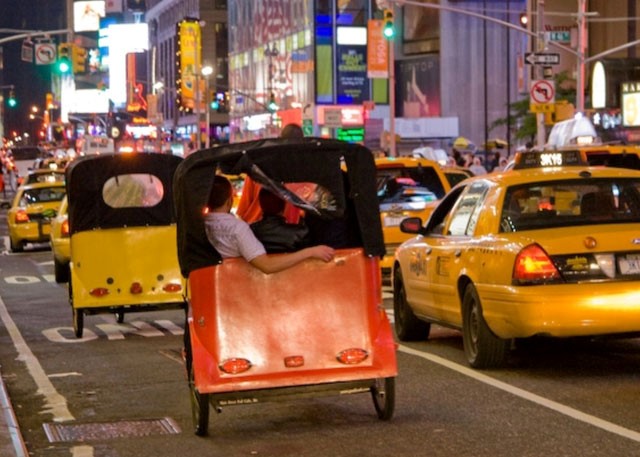
Likewise, the 850 pedicabs plying the streets of NYC are now being deployed with greater care and concern about the quality of the fleet and their drivers. The rash of bad actors has mostly left town and the new administration may improve the operations of the department enough to restore some balance in this activity. One needed improvement is the legalization of electric-assist motors of course and the incorporation of the Fair Sex fully into the industry by humanizing the experience, making it less of an extension of brute strength. Better weather protection for both drivers and passengers and progress on other needed design changes is in the works.

The groups that will be forming to design and build their own vehicles, might well consider making their project one that involves transport of people or, even better, one that is able to transform itself from freight to a passenger vehicle with ease. Providing capacity for the transportation-challenged also has to be high on the agenda. Lessening the pressure from an overabundance of large motorized vehicles will require a conscious process, of substituting multi-ton nightmares with minimal, muscle-propelled works of art, that doesn’t fill the air with poison or crush the unwary.

In his documentary “The City”, made as a prelude to the 1939 World’s Fair, the opening of which we are celebrating here, Lewis Mumford said, ”We used our hands and mastered what we put our hands-on”. This was part of his plea, to recover the values that once characterized our society, the competence and care that were so diminished, during a period of rapid expansion of industrialization, and consequent lower standards, with nobody “personally” responsible for what emerged. Re-connecting to our natural identities as ingenious creatures and re-making elements of our world, with our hands, beginning with those which we all have the greatest access to, like bikes, can help give us back the confidence we deserve and need, to move forward on all of the other issues which require this kind of creative and compassionate attention. Your contributions are welcome at SharingUmbrellas.org

Meanwhile, if you happen to be in the neighborhood, don’t forget to come to NYC City Hall on Wednesday, testify and celebrate the birth of a new Vision of getting around, one that goes way beyond GM’s slick Futurama, that thrives on the human-scale and protects and enhances the life-force, instead of diminishing it.

Times Article Viewed: 4811
Muscle Power As Fuel For Our Creative Juices

Apr 20, 2014. Times Article Viewed: 7492

We’ve shaped our society around cheap, but dirty and exhaustible energy. In the 21st century, it’s time to start thinking creatively about healthful ways to re-power our lives, by burning caloric energy instead of hydrocarbons.

We are surrounded by machines, but it is still only through the earnest efforts of homo sapiens that anything ever actually gets done here. Our fuel, the most important source of power on this planet, (forget fracking), is measured in calories, a beneficial by-product of our neighboring star’s long-burning fires. These handy green shoots live in the earth until their synchronized internal clocks order them all to break out into the air and begin their transformation into Cheerios and cheeseburgers. Not that long ago, most of us spent most of our time tending to this element of our lives. In more recent years, the whole system has appeared to be on automatic pilot, seamlessly delivering the fruits and vegetables, grains and spices that we crave and need. Our re-created Eden often feels just right and few question the inevitability of all this or our qualifications to enjoy its benefits.

In the 1950s, with the rest of the world struggling to re-build and lots of wartime technology to translate into consumer goods, this made sense. In the 21st Century, with the fortunes of the most fortunate and everybody else seemingly heading into different dimensions, the social fabric is stretching to the breaking point and only the most oblivious deny that we are in a heap of trouble. Good jobs are as scarce as hen’s teeth and four-leaf clovers. Nobody wants to leave their current positions, no matter how tired they are of doing it, lest the economy suffers another sharp blow and their protein is called cat food. This dismal situation leaves fewer and fewer good opportunities, so recent college grads are moving in with their parents in record numbers, postponing starting families and wondering if anything will ever change. When you add the accelerating effects of automation and the out-sourcing of nearly everything, the clouds that have been gathering, threaten even darker days ahead.

Owing to a growing sense of uncertainty, we have begun to focus more on our futures. Where does it leave us, if we are fashioning machines to run our machines for us when the next generation of robots, automated cars, etc. appears to move us one full step further from the processes that are responsible for the manufacture of all of these products? Since this meant smokestacks and mines for a century, we heaved a great sigh of relief when more and more of this got off-shored, grateful for the freedom from the conspicuous burdens that accompany this dirty activity. Much later on, it sunk in fully, that there were no ready replacements for all of those missing jobs and whole regions of the country took a drastic nose-dive, while the rust-belt finished rusting. Compared to the noise and dirty dust of the Industrial Revolution, clean service industries like hair-dressing, retailing and food-serving, often paid less but, in some important ways, beat the pants off of dank factories, nasty chemicals and the endless repetition of the assembly line. We thought we were moving ahead.

If you are at a broken stop-light though, how does high tech save you? If you are Detroit and you can’t keep your streetlights on, how long will it be before the water stops flowing? We take everything for granted and we are not prepared for the next phase, whatever it may be. Tending the same burger grill or passing paper bags filled with low-nutrition, highly-processed treats, loaded with sugar and salt and an amazing number of chemicals that you have never even heard of, is also deadening, and it doesn’t take long to realize it. Since you must attempt to project a pleasant demeanor, no matter how you actually feel, there are special demands from this kind of work that even exceed those extracted previously. Monastery-like prohibitions on certain kinds of speech are ordinary, the recitation of insipid conversation, “Have a nice day” etc. is widespread. The loss of individuality and personality beneath a blaze of motivational messages and unending uniformity is the result of this model. A consumer is a puzzle to be solved or a piece to be moved. We are mysteries only to ourselves. Our habits and responses are carefully monitored and processed by a “Feedback Machine” that reinforces an artificial sense of belonging but robs us of our essence, our personhood.

I think the only remedy for this is a great burst of creativity. It is also important that this energy emanates from everywhere not just current centers of activity. When the tools, materials, and skills needed are widespread, so should the ideas and projects be disbursed as widely as possible. Since the issue being addressed here is transportation, the moving of persons and their goods, it is a universal need and a vital factor in the economies and social lives of all those living on this rock. Our growing reliance upon fossil fuels to enable us to get around and grow our crops can not continue. It will either bankrupt us or turn us against one another in the struggle to maintain our lifestyles and the identities that they give us. Droughts and storms are disrupting the supplies of essential foodstuffs and Beijing and Shanghai live in places so polluted that people wear masks every day just to stay alive. The climate-change denial goes on, like the burning eyes and the runny nose, without pause.

If you own a factory, you probably don’t want to hear about “Paradigm Shifts”. If your products become obsolete, you are in trouble. You may even want to slow down the process of change altogether since this is one way to prevent your fade into history. On the other hand, if you are a person looking to have a future, you are paying attention to the shifts in demand and fashion that are going to shape that future and to determine your role in it. This difference in agendas is inevitable, given the difference between institutions and individuals, the pull of the past and the needs of the future. It is more common for individuals to be carried along on the waves generated by institutions than for those organizations to yield to the needs or desires of mere people. There is a way to modify this relationship, to give more leverage to the individual and the key is scale and creativity. Working on the human scale, on lightweight muscle-powered vehicles, for instance, does not require any institutional help. A hacksaw, a discarded bike, and some epoxy or solder and you are in business.

Our hands and our imaginations are the portals to our alternate universes. The other essential ingredient is the appreciation, and help, that others can provide to a project. Cooperation is easy when you are an infant, impossible when you are a restless child and the path to progress when you finally grow up. It is most often brought forward when it is part of a sports program or other activity that is directed from above and requires you to relinquish your will in order to be provided with a role, one which was mostly pre-defined for you. Working from the bottom up without direction from above is uncommon, but that is where the action really lives. Expertise and experience are valuable of course, but the initiative is the first ingredient, along with imagination, and nothing follows without it.

There are three distinct types of small, slow, human-scale and muscle/electric-powered vehicles that need to be re-conceptualized and re-designed. Bikes, work-trikes, and wheelchairs are each deserving of their own study, but share more features than not. In addition, there are so many conditions, from weather to terrain, which is completely different from one place to another, that there is much variety that is absolutely necessary. Other differences, from access to financing options to earning potential, can also have a major influence on developments. Conditions found in highly urbanized spaces, in developed countries, and those in places with poor roads and poor opportunities to re-charge batteries, demand different solutions. The aesthetic element, not as important as the economic, in locales where access to resources is severely limited, may nevertheless be the key to accelerating the needed conversion, from industrial-scale to human-scale transportation. When the public realizes how much color and graceful movement can add to their surroundings, they will insist that this process be nurtured in every way possible.

It is not just here in the dense urban spaces of the Northeast of the USA that this condition, the pollution, traffic delays, threats of harm, and all the rest occur. This is an important matter everywhere. Now that Amazon has announced that they want to provide same-day delivery for groceries, along with everything else, the number of cargo bikes needed is going to multiply quickly. The range of vehicles available to fulfill this mission is small. The ongoing effort to encourage creative design in muscle-powered vehicles, SharingUmbrellas.org is one venue through which designers and makers can expose and share their ideas. We are also using pedicabs that were designed in the 19th century to be used by disposable drivers, who are not even afforded a little protection from the rain. Using small electric-assist motors, this form of transportation can vault into the 21st Century and provide a healthy green form of mobility, much better than the current version of it does. Again, it is a creative design that is the key to a more humane, efficient and colorful edition of this modality.

There are no prizes yet to mobilize this program and nobody denies the benefit of having plenty of resources to fuel activity such as this. It is also important though, to demonstrate that it is the energy provided by individuals, their muscle-power and brain-power, which enables us to take on and resolve the dilemmas that life puts before us. If we want to have our institutions serve us, instead of the other way around, we have to assert our priorities and act on them, not wait for someone else to do it. How many great designs for vehicles, the bike and trike in all of its infinite configurations, wheelchairs and new machines to help the transportation-disadvantaged, are already out there and ready to be evaluated and put into use? How many could there be, if we begin to give this development the attention and importance that it deserves?

The GM Futurama at the 1939 World’s Fair, on the eve of a World War already swallowing up countries and populations, promised a perfect environment. It is not fair to criticize them for being so good at selling their vision, to a public tired of Depression and Prohibition and ready for a consumer-driven society and economy. One consequence of their eventual success though is a roadway system that fills almost all of our spaces. Some of them surround the original site of the Fair itself now, like the infamous Long Island Expressway, referred to as “The longest parking lot in the world”. The peninsula that they lead to now houses millions.

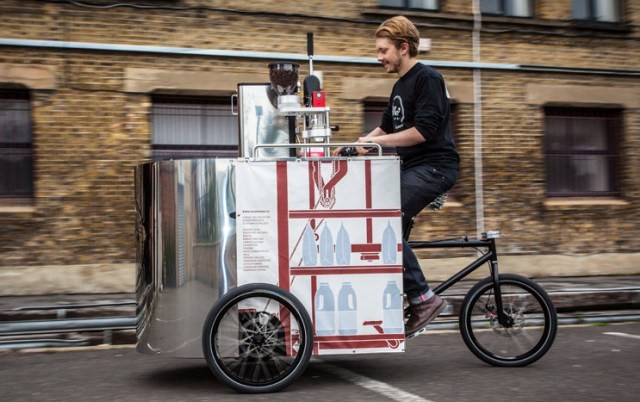
There are possible remedies. Could our highway emergency lanes provide for a continuous flow of slow, (but in many cases faster-moving), small, muscle-powered and electric-assisted devices, protected from the weather and provided with many of the creatures comforts that we can no longer do without? The ELF and TWIKE are good beginnings – as is the mobile coffee shop featured above – but we need an infinitude of variations on the theme. This week begins our celebrations of the Fair that Automobilized our world, and SharingUmbrellas.org says that we need to apply ourselves, on a very broad basis, to redesigning the pedicabs, bikes, trikes and cargo vehicles (and cars) of the future around the human scale. This task belongs to many. At the same time, we should also be fixing the roads, turning some highways into safe 150 MPH speedways, so that our local streets can be turned back into the gardens and play-spaces that can sustain our lives and bring us together, instead of forcing us apart. Fairs, not Fears.

Times Article Viewed: 7492

A World’s Fair At a Human Scale

Apr 06, 2014. Times Article Viewed: 5872

An invitation to use the power of the internet and crowd-sourcing to commemorate the 75th and 50th anniversaries of the New York World’s Fair.

As one way to take notice of these remarkable historical events, designers and builders, artists and engineers, mechanics and craftspeople, are all invited to help invent and make more real, the human-scale, human-powered transportation systems of the future. For the next two years, we are inviting individuals and groups from everywhere on this planet, to submit and exchange their ideas and be part of a massive crowd-sourcing experiment, both online and in your little, or big, neighborhood. We are suggesting that a small plot of public land, or volunteered parking lot or other private property, be provided locally, to help expedite the development of the most beautiful, and highly-functional, cycles and wheelchairs, cargo and passenger-carrying vehicles, the futuristic new machines best suited to serve the needs of our varied environments.

The emphasis must be on safety, affordability, durability, and accessibility but each project is an independent entity and may set its own goals and “rules of the road”. We know that 1HP electric-assist motors on bikes are legal by US Federal statute and important when needed to carry heavyweight or overcome wind or difficult terrain. We are choosing to abide by the 20MPH Federal speed limit on electric-assisted bikes. This project does not permit ICE (Internal Combustion Engine)-Age motors. Throttles are also forbidden, so that the vehicles produced must be pedal-activated and thus may be classified as bicycles, wherever they may be, and welcomed on the road.

Multi-passenger, weather-protected, unusual and unique vehicles are among the most desirable. It can be a drawing, a scale model or a working model. It can be imaginary or completely practical. We are hopeful that this endeavor will enable many connections to be made between creative individuals and others like themselves, who find that they are able to work together, as well as investors and governments, eager to expand this activity for economic, environmental, health or humanitarian reasons.

The World’s Fairs of old were devoted to bringing forth technology that could benefit mankind, were inclusive of all Nations, and endeavored to bring pleasures along with their lessons and marvels. These features are worth preserving. One of the participating sites in Flushing Meadows Corona Park, the site of two great Fairs in the past. Thanks to technology, this event can take place, at the same time, in your city and on your electronic device. In some ways, this may be the first true World’s Fair, open to everyone and devoted to our potential to learn and to dream. It may also be a mechanism to help coordinate the contributions that so many may be able to make to the establishment of an easy-to-negotiate, peaceful, just, and healthful place for ourselves and all others. Please consider beginning a local effort in your neighborhood.

Times Article Viewed: 5872

A Plan B for New York’s Bikeshare System

Mar 30, 2014. Times Article Viewed: 6470

Rumors are rampant that New York City’s Citibike bicycle share program is struggling financially after one of the worst winters on record. Here’s a Plan B for improving and maybe even saving this valuable service.

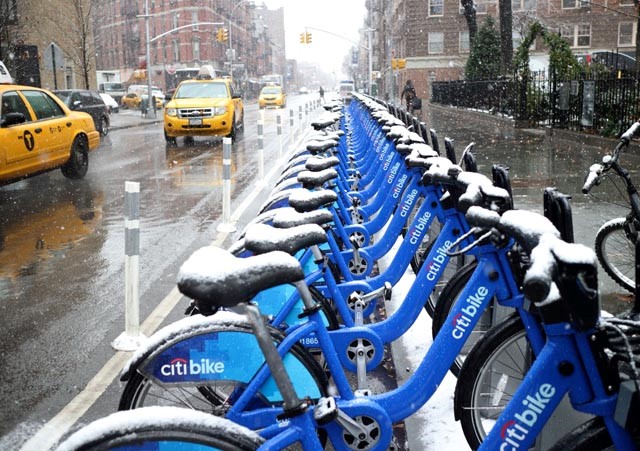
Now that the NYC Bike-share program is under severe pressure from a weak balance sheet, it is being subjected to a measure of overdue analysis, to seek to improve, maybe even save it. The Mayor has invited Alta, the operator, to explore creative means to continue this program and pay its costs. In 2011, I was one of the 6 bidders for this contract. I partnered with Deutsche Bahn, the German Railway Company, who have maintained the sophisticated “Call-a-Bike “ system for over a decade. Their orientation is transport rather than advertising, so they are not concerned about earning income from sprawling, sometimes very intrusive, banks of “docking stations”, really huge 3-D billboards. They instead have developed a means for bikes to be found and provided to renters through GPS, so they can be sensibly dispersed throughout convenient and appropriate spaces.

In contrast, the European billboard company JC DeCaux, set the pattern which is deployed here, popularized their version of the phenomenon and demonstrated that it could be done profitably. Their contract in Paris called for them to be given thousands of billboard faces in exchange for the right to put up conspicuous implantations in the most popular and congested sidewalks in the city. Ironically, it was announced, the same week that the distress of the bike-share program has gone public, that DeCaux has purchased the Spanish company who currently holds a 20 year long NYC contract, to build and maintain the 3,000 bus shelters, 300 newsstands and other street furniture here. Nobody would be surprised if they were exploring taking over the part, or all, of the NYC bike system too.

The current business model made it possible to attract a $40 million investment by Citibank here, which has resulted in an advertising and PR bonanza for them. The positive exposure that they have gotten from this, all over the world, is invaluable. They can portray themselves as active environmentalists and responsible members of the business community, at the same moment that they are settling immense cases regarding the fleecing of consumers, mortgage holders, etc. Regardless, they don’t want to put up any more loot for the foundering system and the operators are scrambling for additional funds. Every other form of transportation, from cars to trains, is provided with government funding to various degrees. Half the cost of your subway ride and a huge percentage of road building and maintenance costs is borne by the public through government grants and expenditures. Not bikes though. They must be 100% self-supporting to even exist. Does that seem fair?

We need to attract more attention to the potential of human-scale and human-powered transportation to meet our needs. Until we are able to further develop the designs of these vehicles it will be difficult for the average person to visualize this change. Finding ways to encourage this activity, which are also within the range of available financial resources, is important. Here is one plan, to use the upcoming 50th and 75th anniversaries of the New York World’s Fairs in 1939 and 1964 to capture the energy needed to launch a web-based celebration of human creativity, ingenuity and inventiveness. We can use all the help you can muster, so get in touch. Check out SharingUmbrellas.org. Meanwhile, here is a summary of our initial 2011 proposal, to organize and operate the NYC Bike Share program. The first element declares our willingness to go along with their requirements and proposed architecture. In contrast though, we saw this program as an ideal platform, from which to launch the next generation of high-tech, electric-assisted, weather-protected, cool, beautiful and exciting machines, the first step, rather than the last step, in the process

Plan B
Our bid will consist of two elements. The first, which we refer to as Plan B, will provide or exceed all of the stated requirements of the current New York City Department of Transportation Request for Proposals:

10,000 identical, durable, bikes equipped with GPS and other electronics
10,000 “docks” capable of securing them throughout Midtown and Lower Manhattan
600 kiosks to enable users to access the system
Suitable locations to place the equipment
Relevant experience
The ability to mount a test

Our improvements over the requirements of Plan B

Bikes: Don’t have to be the standard design because locating device can be put on different vehicles
Kiosks: All there but not needed everywhere. Re-configured by local artists to fit into the community.
Docking stations: 25,000 stanchions can go anywhere. No congestion created.
Ads: Primarily for suppliers is optimal. Minimized at least. Local where possible.
Scope: Citywide used by commuters overnight and visitors and residents by day.
Coverage: As many vehicles as needed, 50,000 or more as indicated in the City Planning Comm. study
Diversity: Of design, with common identifiers, and user groups, like kids and the transport-challenged
Participants: Local businesses, community groups, enthusiasts, artists, entrepreneurs, families

Plan A
We feel that this program has the potential to provide an important new tool for improving this community’s physical health and economic welfare. This enterprise intends to work with local businesses and community groups throughout the city, and in nearby suburbs, to maximize bike availability for everyone and minimize the time it takes to accomplish this. We will also support the designer/maker community’s efforts to creatively explore the potential of slow-moving, human-scale and muscle-powered transportation, to rapidly evolve.

NYC Bike Stores
We have already gained the support of the two largest bike store chains and a number of independents in the NYC area, in establishing a program that would enable stores to cooperate in the development of this program. They derive significant income from rentals and it is possible that this encouragement of cycling may actually do some harm to their survival. Competition from the internet and mass-market retailers, as well as current economic conditions, have put great pressure on this business already.

Group Riding
The participation in this program of one of the major providers of social networking tools will enable us to organize programs to offer the additional safety as well as other benefits of using this activity as a new and very powerful form of live and in-person, direct social-networking.

Bike Manufacturers
Trade show aspect: As a supplement to the 10,000 Plan B bikes, we intend to deploy a large number of others, of the greatest possible variety of cost and type, for the use of travelers. We will invite a good many manufacturers, whose products are known to be of good quality, to provide from 10 to 100 of their bikes for this program. We will make sure that they are provided with adequate and appropriate security in a variety of forms. Some will have GPS devices, some electronic locks, others less expensive but adequate security devices. Each manufacturer will be required to make an arrangement with one or more local bike shops to maintain their equipment while it is in use in this program.

Manufacturers will be paid an agreed-upon amount over the course of the three years of their equipment’s use in the program. If there are any significant equipment problems, any product will immediately be removed from the system. Surviving this environment intact will be a badge of honor and sign of quality. Potential purchasers of the bikes will be able, through the GPS system, to track the location at any time of every bike. This becomes the ultimate bike durability testing ground and year-round bike show.

Local Entrepreneurs
Designer builders: We are missing many features on the current design of bikes, which goes back to the 19th century. Back then they had many features not available today, like the famous side-by-side sociables and we have never had weather-protected or aerodynamic models in popular use. If the work of making these newly evolved vehicles takes place in this city and they are able to be put quickly in wide use, we will see the rapid birth of several new industries. They can provide well-paying jobs to skilled makers, both creators and fabricators of green transportation devices that can be exported throughout the world.

Connections to Transit
We have had conversations with a number of people from the transportation agencies, the MTA, the Port Authority, NJ Transit etc. We have been encouraged on all sides and promised cooperation in the siting of facilities and other matters concerning these efforts. The Director of real estate for the MTA, Jeffrey Rosen, felt that there were numerous ways in which the agency stood ready to be as helpful as possible.

Input from the Community
We have contacted every Community Board in the city and asked them for lists of locations in which they thought would benefit most from a program such as this. The density outside Manhattan is only a third as great in some areas and the usefulness of this program is most evident in the areas with the greatest population and pedestrian traffic. Regardless, this equipment will be welcome all over the city, especially in those neighborhoods with sufficient activity to justify its placement.

Our intention is to make fleets of vehicles available to social service centers on a fixed schedule, so that they may arrange mass bike rides of their members, for excursions, as recreation and for healthy exercise. We will do this on a non-profit basis. This will expand on the social networking potential which bikes encourage.

Connections to Local Businesses
Aside from bike stores, who are to be included in this program to the greatest degree possible, we will also seek the cooperation of other businesses, especially those in the vicinity of sizable emplacements which are open very long hours. While the central system is totally automated, many locations around the city support business that keep long hours, add to the security of the system by their very presence, and who could sell memberships, or provide other key services to the system

Kids
Education: There are bike groups in the city, like the 5Boro Bike Club, who have developed programs for helping young people develop safe and sensible behavior while involved with bikes. Plan B, a totally-automated system, ordinarily does not permit the participation of children under 18 years of age. As long as proper conditions are provided, insurance is available for this type of activity and our system intends to maintain a fleet of at least several hundred kid-friendly bikes, that would be provided to registered legal organizations that have collected proper waivers from parents and made other needed arrangements, so that children may spend time on a bike getting some healthy exercise.

Work
There are a number of programs in the city to help young people gain competence in the repair and maintenance of bicycles. Recycle-a-bicycle is the best known but Time’s Up and other organizations all provide opportunities to learn how to take care of bicycles, their own and, ultimately, others’. Some would like to employed by this program to earn some income and advance their knowledge in this field. Others could be on trikes, ferrying bikes around to needed locations from those that are overloaded.

The Creative Element
Decoration: Some find the uniformity of equipment in a program such as this to be reassuring and comforting. Others find the bland uniformity and repetitive commercial messages boring at best. We would like to encourage creative design in the way bikes to look. While some common design elements are helpful for those trying to find or identify the equipment, it is otherwise unlike the existing bike culture, where the individuality of bikes is a source of pleasure to many. Giving artists a chance to put their mark on this art-aware city benefits, everyone.

Design: The standard “Safety” bike was perfected in the 19th century and has been getting only marginally better for 120 years. It is time to move ahead on a number of important functional, experiential and aesthetic matters. Among them are:

Weather protection. There is a type of human-powered vehicle called Velomobiles. Strong but light coverings provide riders with a comfortable journey even in poor weather. Utility. There are already bicycles made for deliveries, three-wheelers, some with freight-carrying boxes, etc.

Transformation. Through the use of advanced design techniques, bikes can be collapsed and folded, fitted with trailers and otherwise made more suitable in dense urban environments.

The Transportation-Challenged
Access: The ADA appears to require than accommodation must be made for a variety of communities within this program. How to do that exactly is yet to be determined but discussions are taking place with informed and caring members of this community.
Innovative design: There need to be many more vehicles that permit those of varying abilities to ride together in a social environment.

Trikes aid that needing added stability, who comprise a very large group.
“TAB” (Temporarily able-bodied) co-usage: Many vehicles made primarily for the transportation-challenged can well be used by everybody. It would be a good idea for those who are still totally mobile to experience the kinds of vehicles made for those who are not.

Times Article Viewed: 6470

Empathy and a Nickle’s Worth of Change

Mar 23, 2014. Times Article Viewed: 5779

When you’re down to your last ten dollars, do you buy food, medicine or gas for the car?

I want to propose a simple way to begin to change society for the better. It costs just a nickel, but first, let me set the stage.

We need water, air, and the occasional snack, to survive. Clothing and a roof over your head may not be quite as essential, depending upon local climate and social customs of course, but are still pretty important. If you are a person of deep faith, you have the conviction that all of this will arrive, in good time, due to the grace of the Almighty. All that is required of you is patience and fortitude and the ability to suffer the pain which comes from realizing that there is still something missing from this picture. It can even feel as if all of this seemingly undeserved and unnecessary distress was put there on purpose, to put your faith to the test, since it feels otherwise to be so purposeless and random.

If you are more modern in your ideas, you might consider it the job of the government to make sure that you can fulfill these basic, human needs. Some would put companionship in the “absolutely needed” column too, but, aside from our sentimental preferences, we have a demonstrated ability to exist, even prosper, without any nearby two-legged accomplices, for quite some time. Got to have drinkable water and breathable air no matter what though. So why are our supplies of both under attack and in jeopardy? Are we completely out of our minds? Do we think that playing Russian Roulette with our essentials makes the game more interesting, raises the stakes and creates excitement out of the mundane? Is it possible that what we have always taken for granted, as belonging to us, is being completely commodified, and that everything has, or will soon have, a price tag, even the air we breathe?

Meanwhile, if so much has been reduced to numbers, pushed so far into the abstract that we can hardly recognize its connection to our reality, how do we push back and reassert the need to recognize, acknowledge, even celebrate that linkage? Since passivity is the ocean that we swim through to reach our life rafts of activity, it is no wonder that there is so little coordination amongst us in this continuous, ongoing process. Each person is too involved in staying afloat, paddling towards their destinations and making sure that there is plenty of oxygen in the immediate vicinity, to worry much about anybody else, except their own blood and kin.

So, if a problem arises which requires the coordinated effort of these various arbitrarily-distanced souls, there is no mechanism for enabling that to take place. The institutions we formerly relied upon, as narrow-focused as they were, religion, proximity and the rest, are moribund. Sports teams serve as place setters for real community and symbols replace actuality. You root for the home team, maybe win a few and probably lose the rest. Then a Katrina happens and we are all brought back down, for a little while, kicking and screaming, to raw reality. Then the Dream Machine kicks in again and we are glued into our easy chairs, back on the program, braced for the next wave.

The ultimate injury suffered here cannot be quantified and in most cases does not even have a name. It is embodied in a concept which we named “empathy”. It is the ability to share someone else’s pleasure or pain, accomplishment or loss. It is natural to us, as is the mechanism which permits us to shut it off and become absorbed in ourselves. If you listen to popular music, the most common word in songs is always “you” and close behind that “love”. The focus is constantly directed to the other, because that is where your affirmation lies, with your lover or your child. The ability to care more for them than for yourself is the path we have been given to escape the tyranny of our own bodies and selves, to displace our attentions and affections on another. Since the other primary drive programmed into us by our natures and our conditioning is to focus on ourselves and to relegate others to bit parts and extras, this is the exposure of our centers to the light, the closest we may ever come to a revelatory experience.

When we can provide all who are alive, and all that is alive, with the grace afforded by these flashes of unselfishness and unification with what is outside of ourselves, this can be a long sea voyage to the land where change lives. Without mechanisms to sustain you on your way, it becomes very difficult to hold your course though, so we need to become designers and builders, to re-form the institutions and methods that we have contrived, or which, in most cases, been imposed on us over time. Since so much of this existing framework was constructed with only minimal feedback from the consumers of all of this society-building, there is obviously a lot of slack to take up.

When the equipment provided to us to help in our encounter with raw nature has been in the manner of weapons, to force nature back into a predictable and beneficial state, for the sake of distributing ever bigger prizes to the populace, there is no reckoning of the long-term effects of so much manipulation of our resources. This is a giant experiment, which many reckon has gone off the tracks, literally, when it comes to trains and figuratively when it comes to everything else. Take the food supply. Here is one thought about how to help put it back on the tracks.

A Nickle’s Worth of Change

Pickers and gatherers of produce, People getting their hands dirty, by pulling roots and breaking stems, filling baskets and boxes, are making about a penny a pound for their work, give or take. When the final products of their efforts are passed along to the consumer, the price will be measured in dollars a pound.

If retailers were willing to mark prices in increments of 5 cents (not a common figure currently) this could be used to signify that they are passing this much down the line, to these hard-working men, women and children, an additional 5 cents per pound for their hard labors. Consumers can make certain this way that those employed to supply them with their needed nutrients are being compensated in a more reasonable way than is common today.

How are foreigners and migrants going to be able to keep track of and report what they are due? Rewarding cooperating growers with better sales will help and a well-monitored program of verification and tracking of funds. Of course, a mechanism must be implemented, to make certain that these funds are not diverted before they reach their intended recipients. For these reasons, one cent of the five will need to be used to devise and operate an efficient and honest process to make certain that everything works as well as humanly possible.

Any funds not needed to administer this program are to be used to enable other populations who are accustomed to receive a minuscule portion of the profits generated through their sweat-fueled efforts, apparel workers, etc., to accomplish this same purpose. Perhaps clothing prices will include a 25 cent additional payment to the gatherers of the raw materials, along with those who sew or dye the cloth, with $.25 prices reflecting retailers’ participation.

Will employers simply lower wages by the amount of these “bonuses”? Unfortunately, some will try to, so effective means must be employed, and constantly improved and updated, to thwart humanity’s worst impulses and habits or nothing will change. Great public shame must be heaped on criminals who rob the poor to help themselves and they must know that they will be identified, blackballed and ejected from civilized commerce.

The details needed to make this a reality must be gleaned from a number of conferences, by telecommunications and in person, and the participation of all those to be affected by these measures, workers, growers, retailers, distributors, and consumers of food. Time is of the essence since this has already taken far too long to implement. These actions must be carried out in harmony with not in place of other attempts to improve the working conditions of all farm laborers.

Times Article Viewed: 5779

New York’s De Facto Ban and Real Ones

Mar 15, 2014. Times Article Viewed: 2003

There is no better way to counteract global warming, change bad societal habits, and to respond to the negative effects of oversized, petroleum-fueled transportation modes and their threat to our economic and atmospheric survival, than to rapidly expand the use of every kind of bike and trike, especially electric-assisted ones and including pedicabs and cargo bikes. Current Federal Environmental laws, the Clean Air Act etc., require that we encourage cycling in every possible way already. Because many traffic laws, involving potentially dangerous behavior by cars and trucks, like sudden turns and excessive speed, are virtually never enforced though, these streets resemble stop and go highways, not pathways. This hazardous environment keeps most people from even considering cycles as a means of transportation, providing an ongoing, illegal, de facto ban on this activity, for them and their families.

Since our city streets have been largely turned into highways, are laws and regulations to limit cycling here calculated to reinforce that identity? It is not just a problem within urban spaces, it also affects the routes into cities, including the bridges and tunnels, many of which prohibit non-motorized vehicles. Marked highways and many other high-speed roads also do not permit any kind of bicycles to be on them, (not that it would be much fun with big trucks running 85 mph), and even “Neighborhood Electric Vehicles” are severely restricted. Is this legal? Couldn’t we use emergency lanes for slow-speed travel? Is it time to overturn the historically lower-class status of the smaller and slower? Is this an undeclared class war, where one side gets the ammunition and the other side gets 20% off discount coupons? Where is the Geneva Convention when we need it?

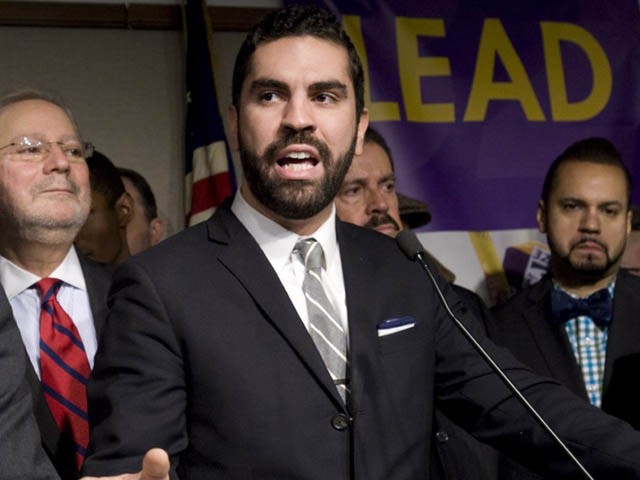
Fortunately, a Resolution was introduced this week in the NY City Council by Council Member Rafael Espinal [pictured above], which asks the Council to urge the State Legislature to pass their bills, legalizing electric bikes, throughout the State. This will amend the State Vehicle and Traffic laws, to allow electric-assist vehicles to be used. It is clear that for the sake of our future and because we have a moral duty to not do injury to our fellow human beings, we must hurry to expand the role of quiet, non-polluting, least expensive transportation, as the preferred means to provide for our basic human needs. Yet, those who benefit from the poisonous, bloated, unsustainable status quo will not permit this needed change to take place, if they can corrupt the political process enough to prevent it. Here is the press release:

“MARCH 11, 2014 (Brooklyn, NY)- Council Member Rafael L. Espinal, Jr., of Brooklyn today introduced a resolution in support of State legislation that would legalize the use of electric-assisted bicycles in New York. The State bill, introduced by Senator Martin Malavé Dilan and Assembly Member David F. Gantt, would amend the State Vehicle and Traffic law to include electric-assisted bicycles in the definition of bicycles and thus permit their use. “Many people would benefit from the State legalizing the use of electric-assisted bicycles. From people who make food deliveries for a living to commercial cyclists, to people who have health problems, all will benefit from e-bikes,” stated Council Member Espinal.

Council Member Espinal doesn’t understand why New York State has lagged behind and not implemented the Federal standards established in 2002 that set the parameters for electric-assisted bicycles. “It just doesn’t make sense for the State to maintain the status quo. The use of electric-assisted bicycles can have positive effects on New York’s economy and environment. It is a mode of clean transportation.” Others echoed the same sentiment. State Senator Martin Malavé Dilan indicated that it is the right time to move this legislation. “More and more New Yorkers are turning to electric-assisted bicycles as a cost-effective and environmentally responsible alternative mode of transportation. Uses for e-bikes range from the daily commute to local delivery route, but their practicality could also benefit the elderly and disabled. I can’t think of a State and City more suited for the electric bike than New York. The time has come to embrace them,” said Senator Dilan.

The Coalition Urging Responsible Biking, also known as CURB, applauded the introduction of the Council resolution and believes that it is a vital step towards getting the State bill passed. “Electric-assist bicycles are an important new, slow, safe, healthful and economical mode of transportation. We applaud Council Member Espinal’s efforts to make certain that they are available to our citizens, especially the older population, those for whom riding ordinary bicycles is a challenge, and those with long commutes and long workdays,” stated Steve Stollman, a spokesperson for CURB.

No date has been set yet for a hearing on the Council resolution but Council Member Espinal hopes that a vote can take place before Albany ends this year’s legislative session in June.”

The Yellow Taxi industry lobby is one of the most active and well-funded elements of the local Autopoly, which is composed of a variety of large interests. Their influence is legendary. This has never been a fair fight. The history of the current system begins in the 1930’s when GM and Standard Oil used over 400 secret holding companies to destroy this country’s rail infrastructure, from trolleys to interurban rail to rail freight. The way to demolish cycling as a potential rival as urban transport was easy: just design roadways to serve cars and make sure they are as fast-moving, un-policed and potentially dangerous, as they are.

Events over the last few years have given cycling a much higher profile though, and it is already a staple of TV commercials, for cars especially, as symbols of health, self-sufficiency and balance. Meanwhile, the lingering effects of a transit strike some time ago and the arrival of $4 a gallon gas, have had their impacts, along with rapidly escalating awareness of health issues and both personal and societal costs. So. in spite of the most oppressive conditions imaginable, hundreds of thousands have gotten on their bikes in this city in recent years. Bike-share has been a huge help of course, and sidewise, even given a boost to vehicle and ride-share for cars and other similar phenomena. Given proper encouragement, the number of various kinds of cycles, personal, passenger, freight, on the roads in these five boroughs could easily multiply every year, indefinitely, until human-scale transportation became the dominant mode of travel. Shouldn’t that be our goal?

Groningen, a modern industrial city in the Netherlands, has created a system where 50% of all movement is done with bikes. In China, for decades, up to 90% of the transportation in many major cities was through human-powered vehicles of all kinds. India and China are now both following our lead in wastefulness and their recent embrace of cars and motor scooters is adding incredible amounts to the total of pollutants being generated. We must remove the onus from those willing to consume only their rightful portion of space and other resources, and who are now demanding proper protection, from those determined to use many times their share of everything, often recklessly and invariably with an undeserved sense of entitlement.

Multiple-person propulsion is a beneficial evolution that can be encouraged and improved by augmenting it with lightweight electric systems. While tandems are in some use, they are pretty rare, and virtually nothing exists that permits a number of people to ride the same machine at the same time. In the 19th Century, “Sociables”, trikes for a gentleman to give his lady a pleasant excursion, while demonstrating his manly strength and care, were very popular. Potential heavy use of newer designs, useful for everyone but especially by the disabled community, as well as those who are simply having a harder time than previously getting around, justifies a heavy investment in these possibilities. There are already a few examples of machines that accommodate a person in a wheelchair and a second person using a conventional bike as well. This is just one configuration. We could be on the verge of a number of advances in the design of mass transit/multiple user vehicles and even in our definitions of these devices. Especially important are machines that are as useful, to the “Temporarily Able-bodied”, as they are to those with moderate to severe difficulties.

There can be a whole new class of vehicles, which enable us to remain vertical even though the strength of our limbs has begun to fade, but has not disappeared. We can foment conveyances that allow us to continue to travel, in a similar manner to the one we always have, perched on ledges, straight up, instead of crunched down into a wheelchair. We can design systems that will allow us to continue to use our own arms and legs to propel us while we are provided with some electric-assistance as well. These slow-moving vehicles can permit us to get the exercise that we need, in amounts that we determine for ourselves, and remain able to carry on with our lives without being put into the category of “disabled”.

Instead, there is an army of people who seldom wander into the outer world, who are virtually trapped within their living spaces, because there is no way yet for them to simply move about the way they once did, nearly as easily as then. In practice, most of the time, given the proper device, on our largely level land, a user would be relying principally on their own power, thereby gaining some strength and improving overall vitality. At other times, when a little boost is needed, it is provided. Arms and legs being used remain usable. The opposite, sadly, is also true.

In the late 19th century, when bikes were the biggest craze in the country, innumerable devices were built and in use which helped to expand the reach of the field. The use of heavy materials like iron and the lack of modern improvements like aluminum tubing, hi-tech lubricants, and gearing, skinny pneumatic tires, and hydraulic brakes, limited the effectiveness of many of these machines. In many cases, the principles on which they were based were sound though. Multi-person and multi-modal systems are optimal for the sake of our health and our wealth. It is time to re-build the transportation system and replace it with one that works. Pedicabs are one of the first paving stones on the path to sanity on our streets, and we need to look to the future while we also go back to Square One, to find more answers. Porter’s “Wheels and Wheeling” was a complete survey of the many forms of human-powered vehicles of the time, and contain innumerable very interesting ideas, that can now be re-examined for their relevance to this time, 125 years later.

Battery research is finally taking off. Nickel Metal-Hydride and Lithium-Ion are already here and capacitors and fast-charge options are coming on board. The potential of sugar batteries and other exotic ideas to break through and create new industries and possibilities is undeniable and Germany, Japan, and other countries, including this one, are encouraging these developments with funding and other incentives. When we are able to apply these improvements to ultra-light, human-scale vehicles, their utility is expanded maximally, because the weight of batteries ceases to be a serious drag on the potential of the vehicle to meet all of our needs. The weight problem, unfortunately, held back small, electric motor-assisted devices from progressing for many decades, because the law of diminishing returns clocked in early, and the weight of the batteries themselves became an unsustainable burden. Not any more.

Attempts to limit the spread of human-scale and self-propelled transportation, by auto-ad addicted tabloids, TV stations and others, is going to fail. This is in spite of the formidable combined power of parking lots, car companies, the oil industry, insurance interests etc. etc. because the ice shelf is breaking off in huge chunks and even though this is the coldest winter in memory, it was only a year ago, when it was 72 degrees in January, and nobody was buying parkas. People are finally getting really scared. It has taken a huge accumulation of this undeniable, visible evidence, to crack the solid wall of reassuring propaganda put out by the guilty industries. After decades of soothing lies, the fuzzy term “Global Warming” has been replaced by the much less comforting “Extreme Weather” and the deniers and doubters are scurrying for cover.

We have to figure out who are friends are and are not, especially among the public officials who are guiding this process. Some politicians are willing to assassinate the future of cycling here and the radical upgrades to our archaic, and urban-unfriendly transportation system, that they provide. They need to be called out on this, educated, and compelled to explain and change their actions. There are few remedies for what ails us, that are capable of delivering the pleasures that easy-cycling provides. Correcting the problems in our agricultural and medical systems, for instance, is going to involve a lot of pain and radical readjustments. Removing the distortions that have plagued our transportation options over the past century is, by comparison, a walk in the park, or maybe a nice slow ride through one.

The good news is that if we are successful, in our attempts to radically reform our mobility systems, we will have learned enough to consider taking on the even-tougher issues. And we will have a much better chance of dealing with them successfully, once we have developed the networks capable of resolving our transportation conundrum. Dislodging archaic, deeply-dug-in elements of our existing systems, that benefit practically nobody, but have seemingly always been there, is going to generate lots of opposition. Inertia is a powerful force.

Also, we have become so accustomed to taking the path of least resistance, that is, doing nothing, that any approach which fully engages the life-force, will perforce, involve some difficult re-programming. Regardless, we need to re-learn how gratifying it is to overcome, to struggle and to persevere. Just think about how much more satisfying it is to earn something, rather than just being given it. Maybe, in some ways, we should pity the rich. They already have everything, so there are some great pleasures here, that they are unlikely to ever be able to experience, except vicariously. What a pity.

Times Article Viewed: 2003

Legalize the Future……Please

Mar 09, 2014.

What is taken for granted in most forms of transportation, weather protection, the potential for multiple riders, access to creature comforts and the ability to carry freight, is absent from virtually any current versions of human-powered and other minimum-impact vehicles? Tiny, 1HP electric-assist motors enable a very significant upgrade in the potential for rider satisfaction delivered by human-scale transport. If deployed artfully, these safe, comfortable and attractive little (ideally, shared) devices, can change our mobility paradigm and steer us back onto a sustainable path.

Currently, too many discussions of electric bikes, in this part of the world especially, focus entirely on the behavior of some restaurant deliverers who use these machines to help make it possible to get hot food to impatient customers, while it is still hot. The city has a host of enforcement mechanisms available to influence the various practices of highly-regulated businesses like restaurants. They have already instituted a bunch of regulations, putting big numbers and the names of the restaurants on deliverers backs for instance, and complaints against these hard-working, mostly immigrants, have plummeted. Regardless, the rapid pace of food delivery has nothing to do with our need to expand our transportation options in urban environments, clean up the air and rid our streets of oversized, overpowered and dangerous machines. Tabloid headlines ignore their importance in helping to improve the health and freedom of movement of numerous populations, including the elderly and the out-of-shape. Conflating these issues demolishes our ability to understand them and enjoy the benefits of this new technology. 

There is a very active effort, at the moment, to encourage the current electric bicycle-riding food deliverers to modify their behavior in order to lessen the criticism coming from pedestrians, magnified by the tabloids, but real nevertheless. At the same time, the City and State are being asked to fully legalize this important new form of transportation. A group, Coalition Urging Responsible Biking, CURB, is also carrying on a campaign to improve the most upsetting habits of some deliverers, to discourage riding on sidewalks,  crowding pedestrians and riding in an overly-aggressive manner. (You may go to www.NYCURB.org if you care to endorse this effort). Posters are being made and distributed and bikes are being modified into a pedal-activated mode, putting them more into line with the current NYC law, which permits this modality but bans throttle-activated models, which are really more like mopeds. Pedal-activated electric-assist bikes are bikes.   

The recent bill in the NYS Senate will limit speeds to 20 MPH, as the Federal law requires, so the alleged 25-30 MPH models, if there are any, will need to be retired. The State can require approved vehicles, with less than the1 HP motors that are allowed, to have proper brakes, etc. too, maybe even to have to identify labels, permanently affixed to legal models and end the confusion over this issue.  

The city is concerned about enforcement, but the regulation of food delivers’ habits, and bicycle messengers’ before them, has been an ongoing concern for decades, long before bikes became modestly-electrified. The new, stricter regulations, improved education and peer pressure, along with closer relations with the restaurant industry, will do much to correct current problems. Meanwhile, there is no question that nobody should be riding bikes on sidewalks, no matter what. Also, biking so aggressively that it actually threatens pedestrians’ health and safety, should be treated seriously. Of course, in fairness, such a campaign to alter behaviors must include far more dangerous vehicles, from motorcycles to huge trucks too. The targeting of cyclists, riding the least dangerous vehicle, while ignoring potentially fatal maneuvers by far more hazardous vehicles, in the same space, obviously makes no sense.  

Amazon and eBay have just announced same-day delivery in NYC and some other cities, soon to be many more no doubt. We know that it will be impossible for an army of vans to further clog up NYC streets with pairs of deliverers heaving packages, of everything under the Sun, everywhere, at once. The brick and mortar universe has no choice but to join the party and seriously improve their own delivery services, in order to keep up with the online onslaught. This new tsunami of traffic can only be accomplished by a giant flotilla of cyclists, many of them soon wheeling new, creatively-designed evolutions of current models. Some of these vehicles will need to be helped along by electric-assist motors. We are leaving the ICE Age. The Internal Combustion Engine and its tendency to inflate the size and weight of our conveyances to historic heights, has reached, maybe even gone well beyond, its limits and is, as a sheet of ice, slowly receding. Happily, in its place, is a bunch of fauna and other earthly delights, especially in the form of some room to get around more easily, smoothly, quickly and safely. 

The best examples of this activity currently are pedicabs. Made very popular in South Asia and the Far East, they are only a tourist-gimmick here, not serious transportation, as they have been in some countries for a century. Without an electric-assist motor, carrying three passengers, as is the habit here, in places like Central Park, filled with long hills, makes this job incredibly difficult. The only issue is the fear of some, that an electric-assist motor would turn these colorful trikes into dangerous, deadly projectiles. Fortunately, the industry has already, informally, agreed to a very safe 10 MPH speed limit, to erase such fears from the picture, so there is no reason not to begin to use this needed and highly-appropriate technology today. One benefit is that It will create a huge number of new, good, green jobs, especially for women, who are largely precluded from the profession, due to the brute strength now needed to perform the task. Creative design is an important factor here too, as a tiny motor makes possible improved weather and collision-protection and the provision of a little heat and other amenities.

The standard design of “Safety” bicycles is about 120 years old. It has turned out to be a very durable configuration, but it has not advanced in many ways until the efficiency of the lithium-ion battery freed it from the tyranny of very heavy lead-acid versions. 90+% of the populace does not ride a bike, even once, in a given year. The primary reason, aside from dangerous highway-like roads, is that we have evolved a value system that renders physical effort, unless in a gym or athletic event, unpopular. We are accustomed to easing and the effort of working up a sweat pushing pedals is not a pleasant prospect for most. Yet, we know that everybody needs a certain amount of physical activity, sometimes called exercise, to maintain good health and vitality. Finding a way to accomplish that, in a pleasant way, while also fulfilling another universal need, to get from one place to another, is a terrific discovery.  

Electric-assist bikes bring freedom of choice, give you license to determine how much effort you want to expend, at that moment, into your personal transportation. We are accustomed to either/or situations. Once you have made your choice, you are either going to be responsible for your own motive power, or you are going to relinquish it to a motor. Ebikes that are truly pedal-able cycles, that work very well even without any motor assist, were very rare until quite recently, but are now widely available. What this means is that the user is able, from moment to moment, to evaluate their situation and determine how much energy they themselves want to provide and how much they prefer to gain from the motor. 

This decision is made by you, not the machine. This arrangement puts the human species, its needs and potential contributions, first. It takes the decision-making power away from the machine and it gives it back to the person operating it. This is revolutionary. It is paradoxical too. Because you give your energy to something, you are empowered. While some cyclists may prefer a purer form of muscle-powered biking, the other 90+% of the population in this State is currently being denied legal access to those devices that would best enable them to get some healthy exercise and have an easy, un-sweaty journey, at the same time. We are also being denied the opportunity to recover our will, our capacity to choose.

This is nuts. And it’s just not fair. It is a form of bullying, a system that allows resources according to what you already have. It rewards aggression instead of accomplishment and produces a flood of white noise that drowns out the music. The difference between being carried along and moving is profound. Combining the two is a new experience for most of us and more closely resembles the natural matrix within which we all find ourselves. It suggests the next step, where we are players of music instead of just listeners, designers and sewers of clothing instead of just wearers, makers of something besides supper. We’re getting closer to the moment when we find ourselves, as a survival mechanism, becoming Socratic skeptics, who have run out of patience with the pat answers and transparent myths that compel us to be true believers, when, what that really means, is shutting down your mind. Waking up our bodies, teaching ourselves to merge human energy with mechanical forces and harmonizing them could be one sure step towards re-booting and re-balancing our entire system. So what are we waiting for? 

Getting Somewhere Slowly

Mar 02, 2014

25 years ago we put on a show at the Municipal Art Society in NYC called “Going Nowhere Fast”. It covered a full range of transportation modalities and identified the problems and possibilities inherent in them, from Rail Freight to Solar Cars. It was a largely dismal survey of the state of our services, some history and some opining as to the future. During the months that it was up there, we held panels and attracted some attention to the issue, but an honest assessment of the results would conclude that it wasn’t going to make much of a difference. I’m glad we did it but its title was far more prescient than I would have wished. The same show could go up again, (and I still have all of the original 6′ tall panels,) it would be very hard to find anything that was not as true today as it was then.

The direction that we are headed has been established for at least the 75 years, since the GM FUTURAMA dominated the 1939 NY World’s Fair. Now better known as the title of a freaky but funny TV cartoon show about robots and intelligent crustaceons, this pre-war giant, 3D, moving panorama, was a full-immersion spectacle. It was calculated to sell the maximum number of cars, which, ironically, at that moment were becoming impossible to buy, since every plant was soon fully engaged in war materiel production. The picture that is painted of the world to be, was not far off in many respects too, even if the automated roadway that it promised for 1960, is only now coming into focus. The suburbs, stretching out forever, the little houses and their little yards, once the nasty war was out of the way, became the shape of our suburban universe, from Long Island to Catalina Island.

At the same moment, the MAS exhibit was being prepared, what the NY Times’ energy maven, Matthew Wald, accompanying us, referred to us as a “ragtag” crew of vehicle designers and builders, was making its way slowly from Washington DC to NYC. This caravan, that we labeled LightWheels, over a week’s time, stayed in college dorms and other available venues and made its way across the landscape in short bursts, setting up, in each location, for a local show and tell, and press event. Since we had the beautiful Stanford University Solar Racer as our glamorous centerpiece we attracted positive attention and lots of stories about the technologies that could change the direction of our transportation systems and put us on a more sustainable path. Electric bikes and handmade Solar vehicles converted electric cars and utility vehicles all demonstrated the possibility of non-highway-centered, or petroleum-fueled and human-scale transportation options. We even gave people a chance to try them out.

It was certainly not as impressive as the 10-day Tour de Sol events taking place in Switzerland throughout the 80’s, with hundreds of vehicles and thousands of spectators. We probably did give some impetus to those who decided to try to reproduce the European event here, the Northeast Solar Energy Association. They spent years doing an Americanized version of the Swiss event, found some corporate sponsorship, mostly from car companies, and eventually banned human-powered vehicles entirely, thus forsaking the central rationale of the original event. Our demonstrations in DC were difficult to arrange and greeted with considerable indifference but we persevered nevertheless. In the days before Lithium-Ion batteries, the burden of dragging so much lead around in order to advance the technology of personal transportation was really too much to bear, and hard to justify, and electric vehicle acceptance stalled for decades partly over this lack. There were those like Jim Warden of MIT, who worked around these limitations in the 80s and bragged of vehicles with hundreds of miles of range and other remarkable accomplishments, but even hard information about advances was so badly covered, that it made little difference. Bravo Bill Moore.

One of those who we expected to be supportive of us in DC, for all of its irony, was Jay Rockefeller, Senator from West Virginia, scion of the great Rockefeller dynasty. When I called his office I expected a rousing welcome and invitation to visit, along with the sponsorship of a reception on the steps of the Capitol. Instead, I was given a short lesson in economics and a friendly rebuff. It was explained to me that Mr. Rockefeller was, indeed, a strong proponent of electric cars. The reason for this was his understanding that these nice, big, heavy cars would consume a large quantity of electricity which would end up being generated by the burning of coal, which was mined in his state and he was strongly in favor of this. But, since I had explained to her that we had a double purpose, to promote the virtues of electric-powered mobility and the benefits to be garnered by the scaling down of our needs, to emphasize the virtues of human-scale applications of this technology in electric bikes and other minimal configurations, her interest disappeared. She was, at least, honest enough to explain to me that this was not going to require the massive consumption of coal, which was the primary interest of the Senator, and therefore he would not be interested in being helpful to us.

There is a similar disinterest in this subject evidenced by the major media. There are no bike ads or electric-vehicle commercials on TV. The biggest individual advertisers may be mobile phone companies, but overall, the Automobile industry is the biggest factor in all paid media. The bicycle industry has always suffered from an inferiority complex when it comes to heavy-duty promotion. The only exception to this in modern times is the popularity which the Tour de France had occupied, since an American became the biggest winner in the race in history. TV coverage improved and the beautiful French countryside is very photogenic, the non-stop picnic by the side of the road pleasant-looking and engaging. Of course we now know that this was not the pure athletic spectacle that we had been led to believe it was, but rather a wild, cross-country drug-fest. Cycling, an activity considered so healthy that it decorates an amazing percentage of prescription drug ads, is a victim of the same over the top, insanely competitive and out-of-proportion tendencies, rampant in every other aspect of our lives.

As transportation, cycling is in its infancy. Denmark may be the leader of the pack, but once upon a time it was Vietnam that was reknowned for the ubiquity of its bicycles. There is no doubt that this was a feature of a society with meager access to resources, a poor country where the population could not afford anything but a bicycle to get around on. It can be romanticized as a portrayal of a place with unusual balance in its habits, or one which is close to the ground and essential, rather than caught up in Western materialism. Regardless, increased prosperity has brought with it a flood of scooters and motorbikes with plenty of automobiles thrown in for good measure. Bikes are for those with no choice.

Mechanization is surely one element of the process which enables populations to begin to enjoy the comforts and pleasures that come with a consumer society. It is not a sign of cultural decline when peasants can educate their children, get their goods to market and do less back-breaking work, although factory environments can surely be life-deadening. It is, nevertheless, the slippery slope that we call “advanced” and “developed”. Those of meager means, the vast majority of all of those who are alive now, here and around the world, are constantly being reminded of the wonderfulness of all of the goods that will be their ticket to a better way of life.

Whether it is a pack of cigarettes or a new TV, the game is on, the girls in the ads are very pretty, and we will be judged by our success at climbing this ladder into status and prosperity. It is a seduction, plain and simple and more sleaze, tease and wheeze than the promised Stairway to Heaven, but at least it suggests that there is a way forward and maybe even a way out. Climbing over the bodies of your neighbors to gain elevation has its hazards though, and unless dizziness is your goal, whatever you do, don’t look back and don’t look down.

Make Bike Not Car

Feb 23, 2014.

It appears to me that we are turning into a world of activists, that we are reversing decades of minimum involvement by the masses in the determination of their destinies. It is happening on different continents and the response of established governments is not exactly the same, although the resistance to change is the most common response, and violence is often the result. In this country, ever since the under-reported and failed anti-war protest of ten years ago, it has been a sad period for political activism, aside from the Tea Party version. Curiously, the original, colonial Tea Party, was a bit of blame-the-victim, racist, black-bag op terrorism, with a spoonful of patriotism, and so is the current one for many of its most passionate adherents. The difference is that back then, we were rising up against protected monopolies and giant corporations, whereas the current version is largely funded by these megaliths.

We can do better, much better. If we need a theme song, how about the Automat’s egalitarian and inclusive “Let’s have another cup of coffee”?  We can organize friendly people in all the coffee shops, and let the people who have trouble with including everybody, have tea shops. We can have Starbucks and the corner diner and the morning breakfast table and they can have the crumpets. We can have meetings morning noon and night, all over town, to figure out how to take back this puppy from the beast. Confused and frightened people, looking for help are being told, ”Sharing is Socialism”. So elevators and trains must be hotbeds of Marxism, and water mains and sidewalks a sinister, devious plot, to tie us together and make us dependent.

So what is the needed response to the Tea Party? COCOA, Coffee Conversation Action maybe?  It’s not a Party exactly, (even though a little fun is always a welcome relief from the tedium), or a means to anoint the already too self-important with additional titles and privileges. Rather it’s a minimal mechanism for building an energetic, ongoing, constantly-evolving plan to maximize the chances that our species can have a healthy future on this rock. It is also an action agenda, without hysterical, lying demagogues, and without non-stop, one-dimensional self-interest masquerading itself as the common good and crushing our humanity in its path. We had sound-outs and teach-ins, but we need a continuously-refreshed framework that frees us with the truth instead of confining us in lies, open for business wherever and whenever sippers meet.

That’s the Coffee Conversation Action Agenda, COCOA2. Namely: Move over a little so there’s room for everybody and when it’s freezing out there, who doesn’t need something hot to drink to help take off the edge? No matter how cold the facts get out here, friend, in the coming days, please remember what your Mom told you about what you had to do if you wanted to get into Heaven, and make mine hot Cocoa thank you, not hate-filled Cuckoo.

The ’60s are portrayed as “Sex, Drugs and Rock and Roll”. This is not inaccurate as much as it is incomplete. I would add “Exploring, Questioning and Demanding Proof”. Faced by the prospect of being drafted into a war that seemed totally unjustified, which was being sold as a Modern Crusade, against both Militant Buddhism and Atheistic Communism, members of my g-g-g-generation needed to process, and act upon, each of these three oxymorons, of stupendous contradictory magnitude, simultaneously. Fortunately, we baby boomers had the help of psychedelics and other multi-dimensional lubrication or the stresses created could easily have sent the entire of us down the Rabbit Hole for good. Of course, we had Gracie Slick as our travel agent and Vietnam vet, Country Joe and the Fish, winding us up with the “I feel like I’m fixin’ to die rag”, so the luckiest among us never got lost in the maze or fooled by the cover story.

We expected that the realizations being experienced by nearly everyone, the appreciation of the importance of Civil rights and even more subtle questions like gender-equality and Women’s rights, would inevitably lead to more honest and equitable society. All forms of music were being listened to and combined within a single song or album as East met West and everybody shook their behinds in what felt like your own special way. Many will argue that the ideals revered in the ’60s, tolerance, peace, free expression and love of your fellow-creature, obscured the more serious issues like survival and crime, but the dramatic increase in political participation and activism was a sign of health and vitality in a largely self-satisfied society.

The sixties gave us a whole population unwilling to accept its prerogatives and privileges at the expense of their fellow-creature, who questioned every single verity and turned a lot of them into cartoons that gave them the status and perspective needed to understand them.

Human Energy and Our Love of Waste

Feb 16, 2014

Oddly, when charts are made, measuring the use of energy and its production, the most important form of it, human-power, is ordinarily excluded entirely. Fueled by calories, most available from rooftops, yards, fields, and window-boxes, truly locally-grown foodstuffs, we require only muscle-power, with a little help from our fiery neighboring star, to prosper. We’ve pummeled her with abuse and continue to, but Mother Earth still pushes forth new life unceasingly, regardless. As for us, the machines, people, give us water and something to chew on and we are amazingly productive devices. It is not just salty sweat being manufactured either, it is also brilliant labor-saving insights that are being generated. Think about how hard life would be without N.Tesla’s AC current, his induction motors and electric starter in your car. It is our good fortune that homo sapiens have been gifted with an infinitude of skills and constructive inspirations spread, albeit somewhat unevenly but still universally, amongst us. How lucky can a species be?

Were we, as a whole, to develop the means to have easy and free access to this rich pool of resources, we would certainly find ourselves on the critical path to our most fulfilling destinies. By unleashing this phenomenal storehouse of wealth, composed of the sum of the vast knowledge gained by all of us, through our jobs, our experiences, and adventures, we thereby enter the Age of Abundance and leave the Age of Scarcity behind. Unfortunately, we have spent centuries, weighed down by an incomplete picture of biology, weather and such, searching for better answers to our questions, rationing our goods, providing them only to those with the means. This is our history.

Now that we are able to produce a virtually infinite amount of anything, it is only through the systematic waste of resources, especially the human ones, that it has been possible to maintain the myth of scarcity within an obscuring cloud of overabundance, for the last several decades. While the armed conflict has been the most effective way to destroy the value of both the material world as well as the living one, a century of overconsumption has left its mark on every activity. Meantime, those with factories want them to run continuously, so the first task becomes convincing everybody both that they need this thing, beyond reason, and the last, that they should not share it with anybody else. Planned obsolescence and raging fashionability will do the rest. The Waste-God must be served or the wheels of commerce grind to a halt and we are done for, or so the market says or curses if you will.

While bike-sharing and other attempts to get a grip on this suicidal drive are gaining serious traction, this good news for almost all of us is anything but that, to those whose activities provide them with huge profits from the generation of waste. The military establishment, for instance, will fight like mad to preserve their benefits for themselves. They are able and willing to do this in spite of the damage it wreaks on their fellow-creatures, and sometimes even on themselves, but they can not stop their destructive ways, because they have no way to sustain their current lifestyles without these profits. They are addicted to the ability to have their way, to superimpose their view of reality and their bankrupt value system on a pacified public. They are supported by those who pretend that the numbers tell the story and can never focus down closely enough on what is on the ground, to include it in their world-view.

One feature of our profound misuse of resources is in the prison system. A famous wag once claimed that if you steal a loaf of bread, they will put you in jail whereas if you steal a railroad, they make you a US Senator. A friend of mine was featured on CNN this morning, being granted bail for the crime of being a heroin addict and being accused, falsely it turns out, of supplying Philip Seymour Hoffman with his fatal overdose. This fellow, Robert Aaron, is renowned within the city’s musical community as one of the most accomplished and talented musicians around. He is also one of the nicest and most modest and generous people you might have the pleasure to meet. He is the polar opposite of the stereotype of a junkie, the useless slouch, dangerous and untrustworthy person. He works constantly, sometimes for very small pay, often to help aspiring artists to establish their presence. He plays in scores of styles and on a dozen instruments. Wyclef Jean, who he arranged for and played with for a decade, Mick Jagger, David Bowie and hundreds of other musicians, have improved their offerings due to his attentions. Now he is facing prison and our loss of access to his gifts, because of his current need for his, admittedly often self-destructive, medicine. The system is ready to relegate this fine, non-violent, talented person to a bare cell, where he can no longer help anyone to realize themselves, or to enlighten us. A total waste. (Contributions to his bail fund are welcome.)

Meanwhile, prisons have become an “industry”, with profit-centers and ROI charts. The society with the highest rates of incarceration is also the one which has the greatest propensity to reduce everything to numbers, to de-humanize and disguise what amounts to institutional torture. Sure, those who harm others must be held accountable in order to reduce this kind of activity, but is punishing and causing pain to people a way to improve them or is it just a form of rough vengeance, a page torn from the stone age?

We do the same thing to older folks, who have slowed down or whose skills are less needed because of onrushing automation or outsourcing. Couldn’t schools make room to allow those with a lifetime of learning, to be enabled to pass that valuable information down to the next generation? At the end of the 19th century, with industrialization taking full hold, innumerable hand-crafts were rendered obsolete and its skilled practitioners put out of work. Wood and metal workers with centuries of development contributing to their production of useful and beautiful products were rendered irrelevant, because there was a machine that could do it almost as good, or even sometimes a little better, at a rate thousands of times faster than their hands could match. An army of illustrators, fine artists, could no longer afford to fill their brushes and pens with India ink after the technology of taking and printing photographs took hold. Their loss? No, ours.

With clothing, imagine the work needed to handpick raw material, process it into yarn or thread, weave it into the fabric and make it into a garment, compared with our mechanized version of mass production, engineered by giant machines. Delivering a complex and finished piece of clothing, made by handwork only, is still the rule in some parts of the world but only the very poor or very rich have access to this system. The ability of machines to be so productive has been a mighty boon to our assumptions about what we are due and we have become used to having it all. A closet and dresser filled with garments that once would have taken a regal sweatshop to provide us with, could, until quite recently, only have belonged to a member of a noble family but instead, these former luxury items were bought for a pittance from a huge chain store. We are drowning in products but we have lost our self-identity as producers.

Likewise our food. If you had been a member of the royal family of a 19th-century empire, the presence of fresh fruit in the colder months or any foods out of season would have indicated a truly elite status. In fact, the range of ordinary products available to the masses, from soft cushioned toilet paper to a shelf of 100 exotic spices from around the world, were not easily acquired by even the most privileged members of any society in former times. Yet, we take them all for granted, without half a thought. The technologies that made it possible to live like a KIng, on a pauper’s ransom, have accustomed us to a level of comfort and ease that were unimaginable heretofore. One consequence of this is our unsupportable assumption that we should be able to have unlimited access to everything. Along with this sense of entitlement has come a lack of concern about the origins or consequences of this condition. One of the seemingly inevitable results of overabundance is a lack of understanding of or responsibility for the downside of this equation.

When it comes to transportation, the most egregious examples of imbalanced activity are to be found here. A stretch Hummer is a potent symbol for all that is wrong with this picture. It is instructive that the origin of this abomination is to be found on the field of battle. It is a weapon in the form of an automobile. We can combine its purposes as a life-protecting device into one of a life-destroying one and these identities merge and blend into one another seamlessly. It is wonderful to feel impervious in a dangerous world but our vulnerability is always with us, no matter what.

We spend a lot of energy projecting strength, and swagger with a coating of suave will always be a crowd-pleaser. Displaying this on the outside is often a cover for a lack of inner confidence and durability on the inside though. The cure for elitist, top-down definitions of our value and nature, is much more bottom-up, creative and life-affirming phenomena. Block parties without the tube socks. The stakes keep getting higher and the time to repair the breach shorter. I keep thinking that this is something about the importance of music, and its main components, like harmony, tone and pace, style and rhythm. Meanwhile, if we do have to sing for our supper, I think we should at least be able to pick the tune, and choose the main course, and be treated like guests, not servants.

You can hear some of my songs, free, on http://www.SteveStollman.com/ produced and with musical accompaniment by Robert Aaron, on all wind & string instruments and keyboards.

No Comment

Jan 26, 2014.

I’m not sure what Disqus is, but I know it eats comments. One of the pleasures of writing pieces like this is the responses that it can provoke. Sadly, often nothing is said in response to the 2000 or so, of what I am willing to admit are sometimes intentionally-provocative words, that get thrown down on these pages every week. This, in spite of a thousand or more visits. The length of those visits is unknown and they may be mostly quick hellos rather than deep conversations, still, it has been the case, some weeks, that a half dozen or more visitors have decided, after they have finished reading, to make their feelings known at the bottom of the page. Sometimes these have been very complimentary and friendly and other times not. This is normal, to be expected, and include plenty of disagreements or differences of opinion. Truth be known, regardless, I wish every one of you would say something, even if it was minimal, give an opinion, state a fact, but…

For some reason, Disqus, the mechanism employed to capture and display comments on EVWorld, likes to show them when it feels like it and otherwise keeps them secret. Odd but true. Since this is my 20th contribution in a row to this blog, which has become a regular feature of my life for a bit, I will admit that I miss the occasional barbs and bouquets. I wonder if they were taken out to a lonely field, like in an episode of the Sopranos or Boardwalk Empire, and dispatched in the tall grass, or given a more dignified end, perhaps in a restful archive by the sea, or slowly floating cloud. I have seen them come back to life a few times too, only to disappear once again, an agonizing flashback to what might have been and actually was, but is no more.

I had a job once, which may have been my best one ever, being the head waiter, really doorman, at the Village Vanguard, a jazz music club in Greenwich Village for the past 500 or so years. As this was a place that many luminaries made it a point to record at, it had a heady bill on, almost continuously. At this time it was a couple of famous musical giants, bassist Charles Mingus and saxophonist Coleman Hawkins, each with their own groups. Since both of these fellows could be described as Demi-Gods of their craft, some of the greatest artists of our time in any field, I wish I had spent more time listening to their mutterings and exclamations, but I do remember one. Mingus was notorious for his displeasure at the bad, which is to say inattentive, the behavior of his audience. This was a club, with drinks and a small amount of food, no hushed concert hall, but the sounds made there, at times, were as amazing, transporting and important, as any made anywhere.

Regardless of the fact that this was a basement joint, in a raucous neighborhood, Mingus would simply stop the music, if there was too much noise and too little appreciation that this was the finest music on the planet being performed before them. In one such episode, after he stormed off the stage, I remember “The Hawk”, as he was popularly known, nattily dressed, standing ramrod straight but not very tall, approaching the great bass player and telling him, “You have to play them quiet Charles”, in a sympathetic but chiding voice. The point is, if I expect more people to make more comments about my writing, I’m going to have to “Play them noisy”, more openly daring them, that is you, to join the picture and establish a presence.

I notice that a few weeks ago, Popular Science decided to abandon their comment function altogether. Too many little spats and petty problems probably, which took up space and discouraged others with more substantial points to make, from even participating. Who wants to get lost among the slings and arrows filling the air, aimed at nobody in particular? I’m sure their legal department was pelted with controversies over libel and patent infringement and other matters which soaked up time and bled expenses. It is a sad day though when scientific and technical inquiry can not be matters for lively discussion and widely varying points of view. Fortunately, there are still many many thousands, maybe millions, of online forums on every imaginable subject to help promote healthy controversy and fact dissemination. Generating directories, that rate them according to their relevance and popularity, needs to be a priority, and that process is, thankfully, well underway.

Sure, there is plenty that is of little weight or value in the mix, but also a lot of important information, that is now having a much easier time finding its way to the public. In balance, the flood of new information is a boon to honest inquiry, even if it is also hard to sift through and the major outlet for loony stuff too. The filters that have always been there, to separate the wheat from the chaff (and too often, to serve the chaff and call it wheat), claim a high degree of reliability for their product. It used to be that if you read it in the paper it was true. The TV had the same power, to grant, to their presentations, an aura of certainty and finality. It was rare that they actually deserved such confidence, but there wasn’t much competition. It is clear, in many minds, that the opposite is now the case.

We are having to be much more discerning, to question the quality of our sources, to come to rely on certain ones because of their proven track records. We have been lied to and misled too often, and by experts, to simply accept what we are told without a high degree of skepticism. Our gratitude must go out to the Bill Moore’s of this world, who devote such a substantial portion of their life on this planet, to trying to figure out what matters and what is true, because it is beyond the ability of each of us to do this for ourselves. I opined in one of my previous pieces about the way in which the commercial media serves the interests of its advertisers rather than its consumers. The movement away from that integrity-sapping formula, is what is needed, and demonstrated by EVWorld and many other worthwhile and truth-seeking web sources.

The Underground Press of the 60s and 70s forced the aboveground press to pay more attention to differing viewpoints. I was proud to be its distributor for a time here in NYC. Unfortunately, the shrinking of the printed press has left us with somewhat fewer of them as potential sources, even while the world of apps and blogs has multiplied the total of potential resources, all reachable free, easily and electronically, by a factor of infinity. The increase of Localism is partly a realization that common conditions, even those prevalent on a broad scale, can often best be affected by the collection of individuals, in physical reach of one another. This has been most conspicuous when it comes to food issues, especially in areas where there is local production of some kind. The addition of community gardens, roofs and other projects in urban spaces is growing rapidly too. Interest in the origins of what ends up on your table is surging and CSAs and variations on them are spreading every day. The connections between the most mundane daily concerns and the big questions, the ones that supposedly matter most, become more apparent every day.

The Chicago SEED, the Atlanta Great Speckled Bird, the L.A Free Press and all the rest of the Undergrounds were totally independent and self-reliant operations. The late ’60s generated much interest in the ways that governments functioned or didn’t, on account of the war primarily but for many other reasons too …