COCOA  COffee  COnversation  Action

The original colonial Tea Party was a bit of blame-the-victim, racist, black-bag op terrorism, with a spoonful of patriotism, and so is the current one for many of its most passionate adherents. The difference is that back then, we were rising up against protected monopolies and giant corporations, whereas the current version is largely funded by these megaliths.

We can do better, much better. If we need a theme song, how about the Automat’s egalitarian and inclusive “Let’s have another cup of coffee”?  We can organize friendly people in all the coffee shops and let the people who have trouble with including everybody have tea shops. We can have Starbucks and the corner diner and the morning breakfast table and they can have the crumpets. We can have meetings morning noon and night, all over town, to figure out how to take back this puppy from the beast. Confused and frightened people, looking for help are being told, ”Sharing is Socialism”. So elevators and trains must be hotbeds of Marxism, and water mains and sidewalks a sinister, devious plot, to tie us together and make us dependent.

So what is COCOA, Coffee Conversation Action?  It’s not a Party exactly, (even though a little fun is always a welcome relief from the tedium), or a means to anoint the already too self-important with additional titles and privileges. Rather it’s a minimal mechanism for building an energetic, ongoing, constantly-evolving plan to maximize the chances that our species can have a healthy future on this rock. It is also an action agenda, without hysterical, lying demagogues, and without non-stop, one-dimensional self-interest masquerading itself as the common good and crushing our humanity in its path. We had sound-outs and teach-ins, but we need a continuously-refreshed framework that frees us with the truth instead of confining us in lies, open for business wherever and whenever sippers meet.

That’s the Coffee Conversation Action Agenda, COCOA2. Namely: Move over a little so there’s room for everybody and when it’s freezing out there, who doesn’t need something hot to drink to help take off the edge? No matter how cold the facts get out here, friend, in the coming days, please remember what your Mom told you about what you had to do if you wanted to get into Heaven, and make mine hot Cocoa thank you, not hate-filled Cuckoo.

NUTRITION, HEALTH, AND TRANSPORTATION

THE BIG  QUESTION;  IF YOU ARE DOWN TO YOUR LAST TEN DOLLARS, DO YOU GET FOOD, YOUR MEDICINE OR GAS FOR THE CAR?

We need water, air, and the occasional snack, to survive. Clothing and a roof over your head may not be quite as essential, depending upon local climate and social customs of course, but are still pretty important. If you are a person of deep faith, you have the conviction that all of this will arrive, in good time, due to the grace of the Almighty. All that is required of you is patience and fortitude and the ability to suffer the pain which comes from realizing that there is still something missing from this picture. It can even feel as if all of this seemingly undeserved and unnecessary distress was put there on purpose, to put your faith to the test, since it feels otherwise to be so purposeless and random.

If you are more modern in your ideas, you might consider it the job of the government to make sure that you can fulfill these basic, human needs. Some would put companionship in the “absolutely needed” column too, but, aside from our sentimental preferences, we have a demonstrated ability to exist, even prosper, without any nearby two-legged accomplices, for quite some time. Got to have drinkable water and breathable air no matter what though. So why are our supplies of both under attack and in jeopardy? Are we completely out of our minds? Do we think that playing Russian Roulette with our essentials makes the game more interesting, raises the stakes and creates excitement out of the mundane? Is it possible that what we have always taken for granted, as belonging to us, is being completely commodified, and that everything has, or will soon have, a price tag, even the air we breathe?

Meanwhile, if so much has been reduced to numbers, pushed so far into the abstract that we can hardly recognize its connection to our reality, how do we push back and reassert the need to recognize, acknowledge, even celebrate that linkage? Since passivity is the ocean that we swim through to reach our life rafts of activity, it is no wonder that there is so little coordination amongst us in this continuous, ongoing process. Each person is too involved in staying afloat, paddling towards their destinations and making sure that there is plenty of oxygen in the immediate vicinity, to worry much about anybody else, except their own blood and kin.

So, if a problem arises which requires the coordinated effort of these various arbitrarily-distanced souls, there is no mechanism for enabling that to take place. The institutions we formerly relied upon, as narrow-focused as they were, religion, proximity and the rest, are moribund. Sports teams serve as place setters for real community and symbols replace actuality. You root for the home team, maybe win a few and probably lose the rest. Then a Karina happens and we are all brought back down, for a little while, kicking and screaming, to reality. Then the Dream Machine kicks in again and we are glued into our easy chairs, back on the program, waiting for the next wave to break.

The ultimate injury suffered here can not be quantified and in most cases does not even have a name. It is embodied in a concept which we named “empathy”. It is the ability to share someone else’s pleasure or pain, accomplishment or loss. It is natural to us, as is the mechanism which permits us to shut it off and become absorbed in ourselves. If you listen to popular music, the most common word in songs is always “you” and close behind that “love”. The focus is constantly directed to the other, because that is where your affirmation lies, with your lover or your child. The ability to care more for them than for yourself is the path we have been given to escape the tyranny of our own bodies and selves, to displace our attentions and affections on another. Since the other primary drive programmed into us by our natures and our conditioning is to focus on ourselves and to relegate others to bit parts and extras, this is the exposure of our centers to the light, the closest we may ever come to a revelatory experience.

When we can provide all who are alive, and all that is alive, with the grace afforded by these flashes of unselfishness, and unification with what is outside of ourselves, this can be a long sea voyage to the land where change lives. Without mechanisms to sustain you on your way, it becomes very difficult to hold your course though, so we need to become designers and builders, to re-form the institutions and methods that we have contrived, or which, in most cases, been imposed on us over time. Since so much of this existing framework was contrived with only minimal feedback from the consumers of all of this society-building, there is a lot of slack to take up.

When the equipment provided to us to help in our encounter with raw nature has been in the manner of weapons, to force nature back into a predictable and beneficial state, for the sake of distributing better prizes to the populace, there is no reckoning of the long-term effects of so much manipulation of our resources. This is a giant experiment gone off the tracks. Literally, when it comes to trains and figuratively when it comes to everything else. Take the food supply. Here is one thought about how to help put it back on the tracks.

Hybrid Muscle/Electric-Powered Vehicles are the future

PUCK magazine, in downtown New York City, gave political satire its most powerful boost. Its momentum has propelled it 150 years into the present day in the form of Comedy Central and millions of youtube videos. The impatience of these cartoonists with corrupt politicians, greedy accumulators and the webs they jointly constructed to rid us of our fortunes and futures, put them in the role of wise surrogate parents, preparing us for the real-world conditions that we were going to have to face in the post Civil War economy and society of the United States, in a difficult and fast-changing environment. PUCK U. printed 80,000 gaudy diplomas a week and awarded them to anybody with a thin dime and a little time, to laugh at power and privilege and its alleged prerogatives.

In the print world, it revolutionized its impact with full color. This took the movie industry another half-century to do and the Electronic version still another half-century. Mobilizing amazing humor, courage, and wit, it is a MAD magazine, Vanity Fair and the New Yorker today, and most lately CHARLIE HEBDO. If we did not have the benefit of the perspective that the revelations of absurdity provide, we could not survive the strange occurrences that surround us daily. Without the ability to capture and highlight the obvious, and often unavoidable contradictions, that arise out of the self-serving testimonials, of all of the one-dimensional purveyors of this ideology, or that web of mystical beliefs, how can we sort through them and figure out where we stand within them?

Our teachers are Socratic and skeptical and need to be since there are so many contrary notions competing for your fervid loyalty and so little proof that anyone is any better than all the rest. Many of us sift through the lot of them and pick and choose elements that appear to hold together, the way you would in a supermarket, looking for ripe ideas, squeezing them to ratify their readiness to be consumed. You do this at the same time as you are computing the value of venturing down the paths currently on sale, seduced by their sometimes ridiculously low prices, or put off by the high tariffs. We’re careful shoppers but we’re also captives of our habits and histories, and not that interested in what the person next to us is doing. That is until the walls start shaking and the small stuff starts mattering a whole lot less.

If you are going to hold up to ridicule those who have the means to harm you, the rich and powerful for instance, you must accept the possibility that they will take offense and try to do something to lessen your ability to do them damage. They may buy your publication and find a new editor or withdraw their advertising from it or start their own. When PUCK magazine began to exert its influence, a group of those with opposing views, mostly defenders of the status quo, formed JUDGE, a practically identical journal in style. They pirated some of the PUCK’s best cartoonists by offering them higher remuneration and relied upon the code of the illustrator, which is to give the client what they ask for, to deliver them of a counterbalance to their rival’s popular messages. Fortunately, the public appreciated the quality of the original and remained loyal to it, and it enjoyed a longer and much more robust influence than its copycat’s.

The co-option of anything is still one of the most insidious and dangerous effects that economic competition can produce. It is easy for the most powerful truths to be diluted down to punchlines in a situation comedy, with a laugh track primed to hold up to vigorous ridicule, any serious deviation from “acceptable” behavior. We are constantly being conditioned to enforce stereotypes on all individuals and commentaries according to categories that we hardly knew existed. There is even, inevitably, a character who is charged with challenging convention who must be portrayed as too complex to really understand, or secretly conflicted about his, or her, identity or worth. Our attitudes are manipulated the way a piece of french bread dough is, pulled and pounded and shaped until it fits the popular mode and then baked into its permanent shape. Unfortunately, a lot is lost in the process. Think of the difference between a perfect baguette, still hot out of the oven, and its fluffy replica, sealed in a plastic bag and devoid of taste, crust or character and you have the model of the actual in all of its glory and a world of sad phoniness.

It is true that creativity is not easy to find. We are, by and large, copiers and adaptors. Nothing wrong with that but the accompanying self-congratulations and inevitable egoism which is associated with calling oneself an “artist” or a creative person in general, too often barely conceals an army of sycophants copying somebody else’s homework not tortured souls giving birth to difficult notions. Repeating the mistakes of the past, endlessly, by dressing them up in new costumes and disguises, preserves a sense of freshness on that which is perched on top of a mess of out-of-date rottenness.

The common bicycle broadcasts a powerful and important message, just by its existence. If “lighter is better”, a principle that has invaded and conquered the information and communication universes lately and lain them to waste, is applied to transportation, the age of the “bike” is upon us. The Internal Combustion Engine, ICE Age, is already over and what TESLA doesn’t turn into yesterday’s news, the “Shareable” and “Wearable”, pared down to its minimal expression, will. The opposite effect is happening in many parts of Asia like Vietnam and South Asia like India, where heavier motorcycles (some admittedly electric powered) are replacing bikes, as symbols of higher status.

Being carried along, without conspicuous effort, can feel almost magical. Preserving the element which can be defined as “self-propelled” or “muscle-moved” is essential though, for any vehicle that wants to call itself a “bike”, or it just becomes another kind of motor transport, and we certainly have enough of them already. We may be lazy by nature but there is no doubt that this is the way we are being aggressively nurtured. Self-drive cars? Will robots shave you too and brush your teeth? Can you manage a fork and knife at the same time so that your food can be broken down into bite-sized pieces or will that need to be done for you too, like you were still two years old? If you are too weak and rendered unably, it is understandable. Otherwise, it is not.

At the same time as we are miniaturizing the personal equipment that we depend upon for many tasks, the systems that maintain these devices are growing larger and more consolidated. This is a good thing in many respects because the economies of scale provided by this massive adoption of personal communication devices have brought the costs down considerably. Meanwhile, there is the ever-present danger that this consolidation will result in huge monopolies that will manipulate the charges and raise them into the upper atmosphere while thwarting better technology and ignoring risks to the environment or insults to human dignity. The beneficial effects of competition can evaporate on overheated trading floors. There is also the matter of tacit conspiracies in various industries, among the few large companies that invariably control each one, to maintain a certain level of charges for all of their sakes. This is not just an attack of paranoia either though these kinds of tacit arrangements can not always be proven very easily, no matter what the facts clearly reveal.

The recent victory for “Net Neutrality” gives hope that concerted action by millions of stake-holders can influence public policy after all and restrain the influence of the largest factors. This is not the way that these things usually are decided though and it is not easy to keep your constituency constantly on the alert and ready to send in all those emails and sometimes it just doesn’t work, no matter how much effort is put into the struggle. If you do care what is going to happen next, you are already used to the hills and valleys that make up expectations and accomplishments, so you are also used to that rocking motion while you’re rolling. Eventually, we are going to fully remember how exciting the creative process can be, when you are not so frightened to use it that it is locked in an access-proof vault, in a part of your mind that only comes into being in your dream-life.

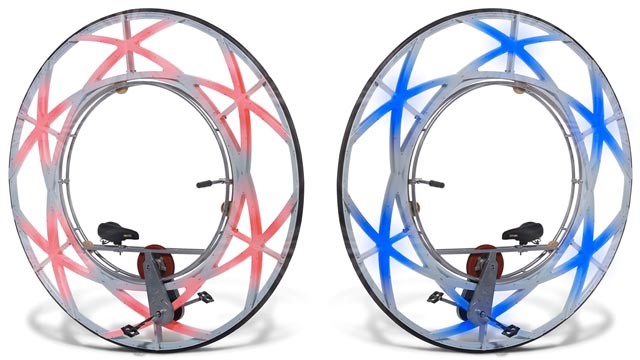
Please visit www.LightWheels.com for some examples of what I think are the missing links in our current transportation systems. My intention is to build them. If you want to help, let me know. Also please consider making a comment about them, sweet or sour, in the space provided below, to help spice up this bubbling stew of words.

High 5

Pickers and gatherers of produce, People getting their hands dirty, by pulling roots and breaking stems, filling baskets and boxes, are making about a penny a pound for their work, give or take. When the final products of their efforts are passed along to the consumer, the price will be measured in dollars a pound.

If retailers were willing to mark prices in increments of 5 cents (not a common figure currently) this could be used to signify that they are passing this much down the line, to these hard-working men, women and children, an additional 5 cents per pound for their hard labors. Consumers can make certain this way that those employed to supply them with their needed nutrients are being compensated in a more reasonable way than is common today.

How are foreigners and migrants going to be able to keep track of and report what they are due? Rewarding cooperating growers with better sales will help and a well-monitored program of verification and tracking of funds. Of course, a mechanism must be implemented, to make certain that these funds are not diverted before they reach their intended recipients. For these reasons, one cent of the five will need to be used to devise and operate an efficient and honest process to make certain that everything works as well as humanly possible.

Any funds not needed to administer this program are to be used to enable other populations who are accustomed to receive a minuscule portion of the profits generated through their sweat-fueled efforts, apparel workers, etc., to accomplish this same purpose. Perhaps clothing prices will include a 25 cent additional payment to the gatherers of the raw materials, along with those who sew or dye the cloth, with $.25 prices reflecting retailers’ participation.

Will employers simply lower wages by the amount of these “bonuses”? Unfortunately, some will try to, so effective means must be employed, and constantly improved and updated, to thwart humanity’s worst impulses and habits or nothing will change. Great public shame must be heaped on criminals who rob the poor to help themselves and they must know that they will be identified, blackballed and ejected from civilized commerce.

The details needed to make this a reality must be gleaned from a number of conferences, by telecommunications and in person, and the participation of all those to be affected by these measures, workers, growers, retailers, distributors, and consumers of food. Time is of the essence since this has already taken far too long to implement. These actions must be carried out in harmony with not in place of other attempts to improve the working conditions of all farm laborers.

Evolving Bikes into Future Trikes

While there is almost no image more elegant or romantic than a person simply riding a bike, we are constantly being enticed into embracing something grand, a car, a nice big house, which is intended to inflate our sense of well-being. Seldom on display is the ragged couple, exhaustedly dragging themselves into that home, in that car, the lines of worry deeply etched into their foreheads, trying to figure out how they are going to make the next payment on these behemoths or finance a needed repair. Of course, the second home, or second car, has now entered the picture and how can the Jones’ ever keep up, when it is only a matter of time before the next generations appear and begin to assert their right to all that the earth provides, without limit? The Merry-Go-Round keeps spinning faster and faster and even historic floods and droughts are not enough to slow it down enough to get on or off, without the aid of an accompanying power failure.

Now that the school year is in full gear it may be instructive to project oneself back into the time when each of us was enrolled in one of these august institutions. Fitted with a book-bag, (now a backpack), we were dropped off, or made our own way, into a crowded classroom filled with kids just like ourselves, wondering if we would be able to do what was expected of us and meanwhile get along with the others. Another big issue was behavior. If the teacher was temporarily absent we spent the time ribbing each other over something trivial, an article of clothing or a new haircut or misspoken word and the wisecracks and teasing went on until the teacher appeared. Often, for at least some of us, that was not enough to stop the errant activity, but soon order was restored and the sound of chalk on slate brought us back into line. Some kids kept it up, as often as not, and had to be shushed or berated to sit down and behave themselves. Restlessness prevailed regardless since the young are naturally energetic and spontaneous until they have been tamed and disciplined into orderly automatons. Slowly, the pressure to conform and fit in is applied and few escape its gravity.

Most of us could not wait until the time between classes when we could have a few minutes to whoop it up and get to the next classroom. This varied from grade to grade and kid to kid and the rules of the school about talking and being restrained in our behavior, but the time gaps between sitting there, and being told not to move around too much and keep quiet and not disturb the class, were precious. Even more important, in the midst of all those calls for self-control, were lunch periods and recesses, where you could move about more freely and express yourself more completely, where you could, in effect, be yourself. Since we are all different and especially when it comes to how we regard and relate to others, this was a unique experience for each of us and could be troubling if you didn’t think you fit in quite right or had problems that few recognized or related to very well. Peer-pressure starts early and has a powerful effect on all of us, although much more on some than others. Going along and doing well is the most important thing for many, while the opposite is true for a significant number of others and these patterns can continue for a lifetime, for quite a few.

There are some factors that affect everybody in that class though. You must become comfortable in a seated position, facing forward and being as passive as possible. Sure, you need to answer a question if the teacher has one, although not too eagerly or often or the other kids will think you are a nerd or kiss-ass. Acting or speaking out of turn will earn you a reprimand and really outrageous behavior on a trip to the Principal’s office. If you do it often enough you will get some pills to take and will be regarded henceforth as a troubled child, in need of extreme discipline or worse. Order is what matters and going along with the program. There are too many bodies to manage and not enough time to master the essential skills, reading, math, and comprehension, so there is no time or patience for being too spontaneous or expressive. This is a giant Viking ship and all of the oars must be pulled in unison or the voyage will be delayed or misdirected. We are being trained to be little conformists, to find our rightful places and fit in so that needed jobs can get done and good order preserved. Ergonomically disadvantageous sitting down becomes more natural than standing or lying down. Or running.

Consequently, for many, sports becomes an important release. There is the ability to get physical at a time when the body is growing and vigorous activity provides an outlet for the energy that we possess in abundance and is always looking for a channel to express itself. There can be tension too, (do you make the team, are you good enough, is your team a winner?), but the participation alone is gratifying and healthy if it doesn’t get too competitive. The bad news is that recess is in a recession, takes away valuable time from studying for the standardized tests that teachers and principals are judged on, requires resources that are in short supply and is being eliminated along with the music and art programs, that experience shows do so much to motivate and improve attitudes. We are in a death spiral when it comes to providing a really well-rounded education, along with the memorization and drills. The impact on our mental health and ability to truly understand who we are and where we want to go in this life are being short-circuited and demolished, by one-dimensional measurements and lack of depth in these venues.

Why is it so difficult for this society to get the point about what matters the most and how to reach it? Mostly it comes from a lack of understanding of the nature of society and how it functions. A cab driver from Haiti last week, a hard-working fellow enjoying the music on his radio, commented about the life here and the lack of connections among people. His country, one of the poorest on the planet, with deprivation as common as sunshine, is a wonderful one to him he said because everybody regards each other as family. What is good for you is good for me. Here, we are all in a race, sometimes described as one between rodents, and what benefits your neighbor may mean that it is costing you. The media embraces this message and amplifies it until it is deafening. If your own kid is doing great, that is what matters. If your city’s team is winning you should be happy. If your country’s economy is improving, who cares if the other guy is in trouble. What is missing from the picture is the way in which your economy is dependent upon the other’s, that their problem is soon yours. If the educational system is producing mostly losers, unsuitable for more than the merest tasks and rewards, how long will it be before this malaise undermines your own kid’s fortunes? This lack of connectedness is fatal to the big picture’s health, and so-called recessions elsewhere can easily turn into depressions here.

One way in which this process has evolved has to do with the wealth which is now in the hands of different races. We are now aware, following the economic disaster recently barely averted and still poised to swallow us all in its potential aftershocks, that the material holdings of those called “White” people, conventionally those descended from Europeans, is 20 times that of those we call “Blacks” or African-Americans. Latinos are only slightly better off. Is it any wonder that vast swaths of our population regard themselves as persecuted and unfairly treated? Certainly, it does denote a shocking disparity and distance from the egalitarian ideals that we are all taught to embrace and respect, as part of the American ideal. Furthermore, does it come as a big surprise that the average person, of any race or nationality, living from week to week and enveloped in insecurity, feel immersed in worry?

Our habitual wasting of the material resources that have been provided to us, (whether or not we deserve them), is nothing compared with the waste of human resources that we perpetually witness every day all around us. It is so considerable that it barely scratches our consciousness. Nowhere is this more obvious than in transportation. Whereas one horsepower is enough to get us where we are going, we expect to have 200-300 to get the job done, without a second thought about all of the resources needed to feed that mighty herd. 80% of the time, only one-sixth of the seating capacity of the vehicle is in use. I can remember many long hours standing by the side of a windy or rainy highway, wondering why nobody would consider sharing that empty space with a needy, non-threatening looking civilian, with his thumb hanging fruitlessly in mid-air. This machine sits idle 90% of the time and that is alright we compute since it is there when we want it, with nary a thought about who might really need it at that moment. It is giving us a wide variety of maladies, from heart disease to diabetes, kidney malfunctions, and bad backs, but we think it is an unalloyed blessing. We are deluded and living in a fantasy world constructed from TV commercials and smug assumptions of our superiority and dangerous fantasies in regard to the permanence of these conditions.

Lately, I have spent a lot of time making models of tricycles with a variety of features that are missing from our conventional forms of mobility. I wonder why, since we ordinarily avail ourselves of a variety of postures during a given day, from prone to standing, sitting, leaning, maybe even crouching, we have been conditioned from an early age to sit, the most unhealthy of them all, according to medical authorities, almost all of the time. Your car, your desk, your dinner table, and train or bus, all demand that you assume this position and stay there. The conveyances that I am currently construing, permit the assumption of the widest number of different body positions that are possible. In school, past kindergarten, as I have just asserted, sitting is the only permitted way to position ourselves. We are not even given the choice between a tall stool and a conventional chair. We may not crouch or stretch out on the floor lest we get “dirty” or encourage undisciplined behavior. It is either follow the rules or get out. Instead of listening to our bodies, which crave some difference in attitude and position, we are commanded to obey, and we do. It is claimed that there is an inner logic to this, that we are too young and stupid to understand, but really it is just for the convenience of our managers, who want to encourage “responsible” predictable behavior and who must enforce their commands without fail.

The second variable element is the source of the motive power, conventionally either a motor or leg power. To these choices, I would like to add arm power as well. The “Rowcycle” is one already well-developed example of this. To these, I would add the choice of an electric-assist motor as well. The combination of the three, arm, leg and motor, is superior to any one of them by themselves but is virtually unavailable in any vehicles with the exception of some recumbent and disabled vehicles that use two or more of them in tandem. Why not all three? Because it has not been the rule up to now and we are creatures of habit and captives of the conventions that have been most popular. Some of it is technological since the advent of lithium-ion batteries has now made practical the inclusion of electric-assist motors on primarily human-powered vehicles easy and economical. Mostly it is the difficulty of popularizing any radical variations on what we have been accustomed to. There is no retail marketplace that is available to sell and display and offer free test rides of these variations on the usual, so they are virtually invisible. The internet will change that somewhat but the pace needs to pick up much faster and that will require more ambitious and energetic ways to get the word out.

In addition to needed changes in available postures and power generation, there is the matter of rolling resistance and road condition. (Ignoring for the moment such heavyweight considerations as self-image and convention). Two wheels have many advantages over three, most of them based upon the greater efficiency of a single-track vehicle over one with three tracks like a tricycle. These advantages disappear when the need to minimize the weight of the vehicle is reduced due to the addition of the electric-assist motors. Lessening rolling resistance demands high-pressure tires, and the increased bumps and shakes produce by the triple-track vehicle makes the ability to steer around them of a single-track machine vastly superior. But if you can use bigger and softer tires, which are much better at absorbing these imperfections of the roadway, that advantage inefficiency is reduced greatly and more than made up for, by the increased stability and utility of a three-wheeled device. Since we have just begun to enjoy these electric-assist motor benefits, the advanced design of these three-wheelers is in an infant stage. Creative designers are just beginning to evolve the formerly slickly-aerodynamicVelomobiles of yesterday, into the comfortable and safe and reasonably-efficient, rather than maximally-efficient, conveyances of tomorrow.

Weather protection is an essential feature of any up-to-date vehicle. Rain, hot sun, wind, airborne grit and dust, cold, all discourage riding out in the open all of the time. In order to become the ordinary means of transport, a vehicle must be able to protect the rider against the worst effects of these annoying elements. Nobody expects a car, or bus, or train, to expose the rider to a host of unhealthful and disturbing elements but bike riders bundle up and assume that this is part of life and unavoidable. This reduces the number of users of human-powered vehicles tremendously except in the most forgiving climates. Putting an umbrella above a bike is to invite a gust of wind to carry you into oncoming traffic, a dreadful thought. Assuming a lower position, (while providing visual signals of the presence of the rider, flags, LEDS floating above, streamers and the like), offers great advantages, through a lower center of gravity, aside from greater comfort at times. Additionally, Three wheels and an electrical-assist motor and its batteries, add weight down low, where it contributes the most to safety, and guard against the negative effects of the increased surface area that weather enclosure requires. We have some wonderful weather-resistant and very lightweight materials available today that allow for tight, transparent enclosures to be made that can be easily stored when not needed, so this improvement in the usability of the vehicle can be deployed only when necessary. No industrial-scale vehicle can offer this kind of variability to the rider. Tiny battery-powered also relatively easy to provide and wind-screens are easy to deploy on stable tricycles.

The bike is essentially a single-person device. There are tandems but they are rare and require good coordination between riders. With appropriate designs, we can have side by side or tandem-style multi-person human-powered vehicles that, because they are on a stable three-wheel platform, do not require anything special from the riders. One could even be severely-disabled and it would be of no consequence. Even three or more people could ride on a single vehicle with no problem. We have sen this so seldom that we don’t consider it even possible, but it is not really a problem, just very unusual. The multi-person ”Sociables” of the 19th century laid the groundwork for this development but have, sadly, subsequently disappeared. We can bring them back and build on that tradition, expand the common bicycle into the multi-person vehicle it always had the potential to be.

All of these improvements in the safety, utility, enjoyment, practicality, and range of features available for muscle-powered, electric-assisted vehicles, primarily (hopefully shared) futuristic tricycles, are ready to be deployed today. They will change the expectations that we have for the most appropriate use of materials and resources that we, in any event, need to cultivate for our own benefit and survival. There is a full century of slack to take up in the opportunity for innovation in the field of human-scale transportation. This will involve no sacrifice of comfort or other pleasures, in fact, will enhance our existence in numerous ways, help us to be healthier and more vigorous in closer touch with our surroundings and each other. It is the reason I am devoting my energies to the development of these possibilities, and suggest that you do too.

In Pursuit of the Perfect All-Weather LEV

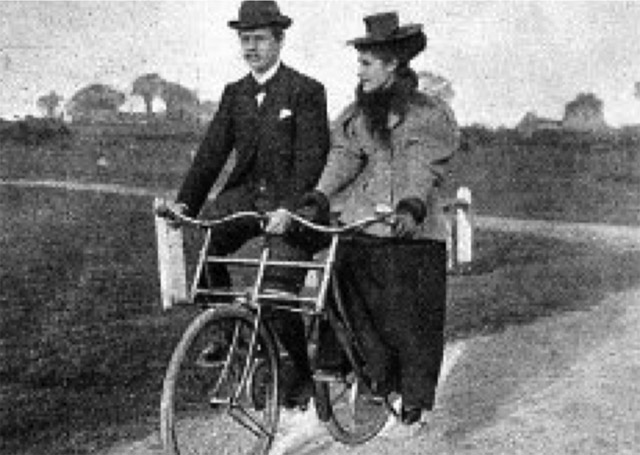
Late 19th-century ‘Socialable’ bicycles put riders side-by-side, unlike tandem bicycles. Modern examples are still being custom-made.

Oct 19, 2014

Times Article Viewed: 49086

Bicycles are great, but they have their shortcomings,

especially as the weather turns wet and cold. What’s needed to make them viable year-round are creative solutions that meld form and function into the perfect Light Electric Vehicle.

While there is almost no image more elegant or romantic than a person simply riding a bike, we are constantly entangled in innumerable schemes to wed us to something grand, a car, a nice big house, which is intended to inflate our sense of self and give us a greater sense of well-being. Seldom displayed is the ragged couple dragging themselves into that home, in that car, the lines of worry etched deeply into their foreheads, trying to figure out how they are going to make the next payment on these behemoths or finance a needed repair. Of course, the second home, or second car, has now entered the picture and how can the Jones’ ever keep up when it is only a matter of time before the next generations appear and begin to assert their right to all that the earth provides without limit? The Merry-Go-Round keeps spinning faster and faster and even historic floods and droughts are not enough to slow it down enough to get on or off without accompanying power failure.

Also see EV World’s interview with William Mulyadi on the Virtue enclosed tricycle featured at the 2014 Interbike show in Las Vegas.

Now that the school year is in full gear it may be instructive to project oneself back into the time when each of us was enrolled in one of these august institutions. Fitted with a bookbag, (now a backpack), we were dropped off, or made our own way, into a crowded classroom filled with kids just like ourselves, wondering if we would be able to do what was expected of us and meanwhile get along with the others. Another big issue was behavior. If the teacher was temporarily absent we spent the time ribbing each other over something trivial, an article of clothing or a new haircut or misspoken word and the wisecracks and teasing went on until the teacher appeared. Often, for at least some of us, that was not enough to stop the errant activity, but soon order was restored and the sound of chalk on slate brought us back into line. Some kids kept it up, as often as not, and had to be shushed or berated to sit down and behave themselves. Restlessness prevailed regardless since kids are naturally energetic and spontaneous until they have been tamed and disciplined into orderly automatons. Slowly, the pressure to conform and fit in is applied and few escape its gravity.

Most of us could not wait until the time between classes when we could have a few minutes to whoop it up and get to the next classroom. This varied from grade to grade and kid to kid and the rules of the school about talking and being restrained in our behavior, but the time gaps between sitting there, and being told not to move around too much and keep quiet and not disturb the class, were precious. Even more important, in the midst of all those calls for self-control, were lunch periods and recesses, where you could move about more freely and express yourself more completely, where you could, in effect, be yourself. Since we are all different and especially when it comes to how we regard and relate to others, this was a unique experience for each of us and could be troubling if you didn’t think you fit in quite right or had problems that few recognized or related to very well. Peer pressure starts early and has a powerful effect on all of us, although much more on some than others. Going along and doing well is the most important thing for many, while the opposite is true for a significant number of others and these patterns can continue for a lifetime for quite a few.

There are some factors that affect everybody in that class though. You must become comfortable in a seated position, facing forward and being as passive as possible. Sure, you need to answer a question if the teacher has one, although not too eagerly or often or the other kids will think you are a nerd or kiss-ass. Acting or speaking out of turn will earn you a reprimand and really outrageous behavior a trip to the Principal’s office. If you do it often enough you will get some pills to take and will be regarded henceforth as a troubled child in need of extreme discipline or worse. Order is what matters and going along with the program. There are too many bodies and not enough time to master the essential skills, reading, math, and comprehension, so there is no time or patience for being too spontaneous or expressive. This is a giant Viking ship and all of the oars must be pulled in unison or the voyage will be delayed or misdirected. We are being trained to be little conformists, to find our rightful places, and to fit in so that needed jobs can get done and good order preserved. Ergonomically awkward sitting down becomes more natural than standing or lying down. Or running.

Consequently, for many, sports becomes an important release. There is the ability to get physical at a time when the body is growing and vigorous activity provides an outlet for the energy that we possess in abundance and is always looking for a channel to express itself. There can be tension too, do you make the team, are you good enough, is your team a winner, but the participation alone is gratifying and healthy if it doesn’t get too competitive. The bad news is that recess is in a recession, takes away valuable time from studying for the standardized tests that teachers and principals are judged on, requires resources that are in short supply, and is being eliminated along with the music and art programs that experience shows do so much to motivate and improve attitudes. We are in a death spiral when it comes to providing a really well-rounded education along with memorization and drills. The impact on our mental health and ability to truly understand who we are and where we want to go in this life is being short-circuited and demolished by one-dimensional measurements and a lack of depth in these venues.

Why is it so difficult for this society to get the point about what matters the most and how to reach it? Mostly it comes from a lack of understanding of the nature of society and how it functions. A cab driver from Haiti last week, a hard-working fellow enjoying the music on his radio, commented about the life here and the lack of connections among people. His country, one of the poorest on the planet, with deprivation as common as sunshine, is a wonderful one to him he said because everybody regards each other as family. What is good for you is good for me. Here, we are all in a race, sometimes described as one between rodents, and what benefits your neighbor may mean that it is costing you. The media embraces this message and amplifies it until it is deafening. If your own kid is doing great, that is what matters. If your city’s team is winning you should be happy. If your country’s economy is improving, who cares if the other guy is in trouble. What is missing from the picture is the way in which your economy is dependent upon the others, that their problem is soon yours. If the educational system is producing mostly losers, unsuitable for more than the merest tasks and rewards, how long will it be before this malaise undermines your own kid’s fortunes? This lack of connectedness is fatal to the big picture’s health and so-called recessions elsewhere can easily turn into depressions here.

One way in which this process has evolved has to do with the wealth which is now in the hands of different races. We are now aware, following the economic disaster recently barely averted and still poised to swallow us all in its potential aftershocks, that the material holdings of those called “White” people, conventionally those descended from Europeans, is 20 times that of those we call “Blacks” or African-Americans. Latinos are only slightly better off. Is it any wonder that vast swaths of our population regard themselves as persecuted and unfairly treated? Certainly, it does denote a shocking disparity and distance from the egalitarian ideals that we are all taught to embrace and respect as part of the American ideal. Furthermore, does it come as a big surprise that the average person, of any race or nationality, living from week to week and enveloped in insecurity, feel immersed in worry?

Our habitual wasting of the material resources that have been provided to us, (whether or not we deserve them), is nothing compared with the waste of human resources that we perpetually witness every day all around us. It is so considerable that it barely scratches our consciousness. Nowhere is this more obvious than in transportation. Whereas one horsepower is enough to get us where we are going, we expect to have 200-300 to get the job done, without a second thought about all of the resources needed to feed that mighty herd. 80% of the time, only one-sixth of the seating capacity of the vehicle is in use. I can remember many long hours standing by the side of a windy or rainy highway wondering why nobody would consider sharing that empty space with a needy, non-threatening-looking civilian with his thumb hanging fruitlessly in mid-air. This machine sits idle 90% of the time and that is alright we compute since it is there when we want it, with nary a thought about who might really need it at that moment. It is giving us a wide variety of maladies, from heart disease to diabetes, kidney malfunctions, and bad backs, but we think it is an unalloyed blessing. We are deluded and living in a fantasy world constructed from TV commercials and smug assumptions of our superiority and dangerous fantasies in regard to the permanence of these conditions.

Lately, I have spent a lot of time making models of tricycles with a variety of features that are missing from our conventional forms of mobility. I wonder why, since we ordinarily avail ourselves of a variety of postures during a given day, from prone to standing, sitting, leaning, maybe even crouching, yet we have been conditioned to sit, the most unhealthy of them all according to medical authorities, almost all of the time. Your car, your desk, your dinner table, and train or bus, all demand that you assume this position and stay there. The conveyances that I am currently construing, permit the widest number of different body positions that are possible. When we get to school, past kindergarten, sitting is the only permitted way to position ourselves. We are not even given the choice between a tall stool and a conventional chair. We may not crouch or stretch out on the floor lest we get “dirty” or encourage undisciplined behavior. It is either follow the rules or get out. Instead of listening to our bodies, which crave some difference in attitude, we are commanded to obey, and we do. There is claimed to be an inner logic to this that we are too young and stupid to understand but really it is just for the convenience of the managers, who want to encourage “responsible” predictable behavior and will enforce their commands without fail.

The second element is the source of the motive power, conventionally either a motor or leg power. To these choices, I would like to add arm power as well. The “Rowcycle” is one example of this and I would add the choice of an electric-assist motor as well. The combination of the three, arm, leg, and motor, is superior to any one of them by themselves but is virtually unavailable in any vehicles with the exception of some recumbent and disabled vehicles that use two or more of them in tandem. Why not all three? Because it has not been the rule up to now and we are creatures of habit and captives of the conventions that have been most popular up to now. Some of it is technological since the advent of lithium-ion batteries has now made practical the inclusion of electric-assist motors on primarily human-powered vehicles easy and economical. Mostly it is the difficulty of popularizing any severe variations on what we have been accustomed to. There is no retail marketplace that is available to sell and display and offer free test rides of these variations on the usual, so they are virtually invisible. The internet will change that somewhat but the pace needs to pick up much faster and that will require more ambitious and energetic ways to get the word out.

Two wheels have many advantages over three, most of them based upon the increased efficiency of a single-track vehicle over one with three tracks like a tricycle. These advantages disappear when the need to minimize the weight of the vehicle is reduced due to the addition of the electric-assist motors. Lessening rolling resistance demands high-pressure tires and the increased bumps and shakes produces by the triple-track vehicle make the single-track one vastly superior. But if you can use bigger and softer tires, which are much better at absorbing these imperfections of the roadway, that advantage is more than made up for by the increased stability and utility of a three-wheeled device. Since we have just begun to enjoy these electric-assist motor benefits, the advanced design of these three-wheelers is in the infant stage. Creative designers are just beginning to evolve the slickly-aerodynamicVelomobiles of yesterday, into the comfortable and safe, and reasonably efficient, rather than maximally-efficient conveyances of tomorrow.

Weather protection is an essential feature of any up-to-date vehicle. Rain, hot sun, wind, airborne grit and dust, cold, all discourage riding out in the open all of the time. In order to become the ordinary means of transport, a vehicle must be able to protect the rider against the worst effects of these annoying elements. Nobody expects a car or bus or train to expose the rider to a host of unhealthful and disturbing elements but bike riders assume that this is part of life and unavoidable. Putting an umbrella above a bike is to invite a gust of wind to carry you into oncoming traffic, a dreadful thought. Assuming a lower position, while providing visual signals of the presence of the rider, flags, LEDS floating above, streamers, and the like, offer great advantages through a lower center of gravity. Three wheels and an electrical-assist motor and its batteries add weight down low where it contributes the most to safety, and guard against the negative effects of the increased surface area that weather enclosure requires. We have some wonderful weather-resistant and very lightweight materials available today that allow for tight, transparent enclosures to be made that can be easily displaced when not needed, so this improvement in the usability of the vehicle can be deployed only when necessary. No industrial-scale vehicle can offer this kind of variability to the rider. Tiny battery-powered heaters embedded in clothing and body-heat itself can be quite efficient and the rush of air past the body is a form of air-conditioning that has always been there. Shade to block the sun when needed is relatively easy to provide and windscreens are easy to deploy on stable tricycles.

The bike is essentially a single-person device. There are tandems but they are rare and require good coordination between riders. We can have side-by-side or tandem-style multi-person human-powered vehicles that, because they are on a stable three-wheel platform, do not require anything special from the riders. One could even be severely disabled and it would be of no consequence. Even three or more people could ride in a single-vehicle with no problem. We have not seen this very often so we don’t consider it possible but it is not really a problem, just very unusual so we are unaccustomed to the possibility. The multi-person ”Sociables” of the 19th century laid the groundwork for this but have, sadly, subsequently disappeared. We can bring them back and build on that tradition, expanding the common bicycle into the vehicle it was meant to be.

All of these improvements in the safety, utility, practicality, and range of features available for muscle-powered, electric-assisted vehicles, primarily futuristic tricycles, are ready to be developed today. They will change the expectations that we have for the most appropriate use of materials and resources that we need to cultivate for our own benefit and survival. It will involve no sacrifice of comfort or other pleasures, in fact, it will enhance our existence, help us to be healthier and more vigorous. It is the reason I am devoting my energies to the development of these possibilities and suggest that you do too.

E-Bike Share: Perfect Wave of the Future

Jun 08, 2014. Times Article Viewed: 8317

Instead of spending hard-earned income on an asset that sits 23 hours out of the day and takes constant ‘care and feeding’ in the form of toxic, polluting fuel, just to move 170 pounds of human, how about something 1/50th the weight that does the same job, only better?

Ebikes weigh 60 pounds. Cars weigh 3000. That is a factor of 50. A car is driven about 10,000-15,000 miles a year, at typical speeds of about 30-60 miles per hour. This computes out to about an hour a day, about 1/25th of the time. Cars provide comfort and speed. We can make human-scale vehicles that allow for changes in body position and provide other advantages that make them far superior to industrial-scale vehicles in a variety of ways. We need to create and deploy automobiles’ replacements.

We can evolve electric bicycles while developing a system, for them to be handed from person to person, during the 20 hours that we are active each day, as an alternative means of travel. When you multiply the excess weight of cars, by the wasted time that they sit unused, multiply 50 by 25, and you arrive at 1250 pounds/hours expended. By this calculation, the person who is using the car is wasting 1230 units out of the 1250 units used, in order to accomplish the same task, to provide mobility for a person, every day.

Neo (Keanu Reeves) awakes in the movie ‘The Matrix’, finding he has been asleep all his life and dreaming in a computer-generated world

If I was a fan of conspiracies, which I sometimes am, I would say that we are so rich that, in order to maintain the same social system, a way had to be found to keep us poor, or at least deeply in debt. This methodology, inserting us back into a padded mechanical womb, has the added benefit of rendering us dreamily unconscious so that we are incapable of offering any defense against this savage assault on our well-being. We are required to be regimented from birth, in order for us to be deprived of our natural tendency to cooperate and instead be set against one another, continuously, in unnatural formations, called classes, races, sexes, or social orientations. We want to find and establish the ways that we are not the same as everyone else, as a way to assert our individuality and specialness. Being tied up in that quest takes a lot of energy. What is left over is seldom enough to achieve lift-off?

We find that our self-esteem, to some serious extent, is being measured by our capacity to generate waste. Being concerned about issues such as this, can put you in the category of somebody who may not be able to pay their bills promptly, or is suffering from some other debilitating stress. You have to project an attitude of ease and comfort or you could be on the skids. This attitude of nonchalance, whether on the receiving or the delivering end, includes the ability to totally disregard the needs and concerns of others, to be a virtual monarch in your own dimension, living high and acting like a big baby.

To foster this addiction to competition and loss of empathy, we are constantly being reminded of the pecking orders that surround us. Superstars in their bling rule. If you are in a certain profession, it is understood that you will behave in a certain way. Businessmen and women wear cleanly-pressed garments and speak in measured tones. The food servers are usually extra-friendly and smile even when it is not called for, as a way to lessen the chances that they will displease you and be called out for their behavior. Kids play their games and choose their friends and soon begin to treat others differently, depending upon a host of signals that are unspoken but ironclad. If you hang out with this one, that one doesn’t want to know you and vice versa. The popular kids know it and begin to use the value of their friendships as bargaining chips and so the game begins.

Part of this is biological and has to do with choosing mates and improving the species, but a lot is learning where you belong and adjusting to the realities. That one is faster. That one is smarter. That one is prettier. Here is where I fit. Here is what I have to do to get along. Good educators know that you can break down these classifications and the limitations that they impose on our ability to appreciate the unique contributions that each of our fellow creatures may be able to make to our common lives. It takes skilled workers to help kids to do this though, and paying professionals to do this is too expensive for most school systems.

Bullying is just an extreme form of the tiny slights and little signals that define our relationships to each other and to the world. If you look around at all the subjects which interest you the most, sports, music, business, etc. it is clear that there are only a tiny number of big winners and a huge army of wannabes, and you soon get the message. The realization that this is the nature of our society or at least its dominant trend, puts some into a frenzy of determination to be the winner, sometimes at any cost, while many others collapse into despair, full of the realization that they can never reach the pinnacle. The frustration that ensues can take many forms, but anger and hostility are one. Unfortunately, there has never been a good system for identifying anti-social individuals at a young age and helping them to modify their behavior. These days, it is easier to give everybody the anti-ADD behavior-modification pills and disregard the underlying problems.

We are constantly receiving messages and sending them, what we like, what we accept, what drives us crazy. When they are not received and responded to we get bent out of shape and behavior becomes more extreme. Identifying issues becomes difficult or impossible as, often, those with the same view of the world become friends and cliques grow based on a wide variety of factors, including insensitivity to the pain of others. Mall rats watch their parents’ consumption patterns and start copying them early. The owner/manager class is anxious to pass down the skills and habits needed, to preserve position and status, to their offspring. Often these lessons are ignored or actively opposed by the next generation and the materialism and shallowness rejected. Just as often, they are absorbed and used to give a further advantage to the advantaged.

How we respond to this situation defines our personality, and we are a product of our perceptions and actions, and they also determine how others see us. All the jockeying for status takes a lot of energy. Extreme rejection by your young peers can be destructive and permanently damaging but it is also a way for your fellows to let you know that you had better change your ways, that you are not fitting in. This can be a good thing, for instance, if an overweight kid decides they are tired of being made fun of and are ready to put the work in to get themselves into better shape. Someone can be tired of being called stupid and start studying more. Usually, the result is the opposite though. We are cowards and conformists and peer pressure does more to intimidate us than to teach us. Our sense of the possibility of a common future or a commonplace is destroyed over time, by the realization that people live in every kind of condition, from horrible to exalted, and that this is not only considered alright by many, but it is also seemingly becoming more so every day.

The remedy for the angst associated with understanding your place in the world is to foment a system in which the inessential differences between us do not prevent everybody from getting a modicum of what is needed to survive and prosper. The essence of that enterprise is shared access to needed resources, like transport for instance. NYC is blessed with an underground railroad that carries the majority of people around without clogging up the streets. Most other communities are reliant upon various forms of surface transport and face endless lines of barely moving, smoke-spewing motorcars every day.

In addition, in NYC, there is now a shared bike program that is enjoying great success. It is proving to be safe and convenient and attracting use from every sector of society. It is still not being deployed everywhere around the city where it is needed, and the economics are still being tweaked to get it to work better, but no fatalities after a year and widespread joy at its installation, have made it possible to consider expansions and variations on the theme. If it is better to be able to use something than to own it, what implications does that have on everything else? If your status is a product of what you do, not what you have, what does that do to the current model of Paradise?

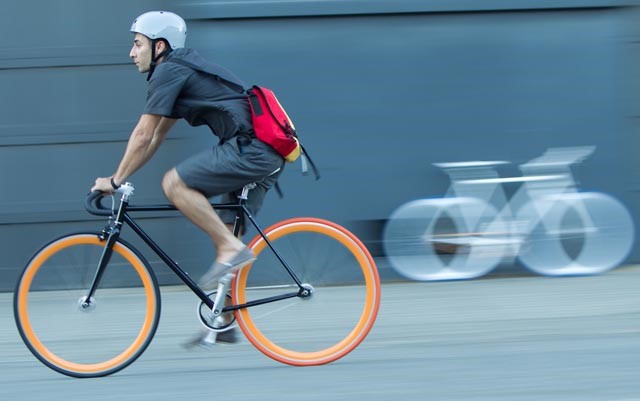
Only .8% of us commute by bike. It is too much hard work early in the morning unless you are a very fitness-conscious person. The troupe is tiny, but growing to be sure, especially in big cities, where distances are modest and a lot of young folks are moving into the workplace. The fashion now is “fixies”, incredible machines of under 20 pounds, that can be hauled upstairs with aplomb and use coaster brakes (mistakenly described as “no brakes”) so they are as trim as many of their riders. Like messengers before them, they connote style and are streetwise fashion leaders. Clunky electric-assist bikes are considered to be a sign that you are not at the height of physical condition and therefore a few notches down on the ladder to perfection, for the cool, Brooklyn crowd. Pride of ownership is a big deal at this time with this crew too. The notion of sharing their prize possession is anathema. There is nothing inherently wrong with bonding with your ride, I suppose, although it is a little kinky.

The current bike culture is the enemy of the future bike culture. It is still very trendy and fashion-conscious. Whether you ride a classic clunker or a $10,000 carbon-fiber masterpiece, defines, to some extent, who you are and how you are. Being a rebel on wheels was a great image for decades, a symbol of those who rejected the central tenet of the consumer society. Now, you are riding a big, heavy shared-bike, with ugly advertising on it, but it doesn’t matter because it is only a 15-minute ride and much easier and more fun than the subway. It doesn’t matter how you look, it matters that you can go nearly door to door in minutes and without mussy hair from wearing a helmet. The barriers to riding are breaking down. Older people are getting over the fact that is has been decades since they rode and doing it.

Even on the smooth and level roads of the city, it still takes effort to move the machine. That discourages a lot of people, accustomed to our no-sweat lifestyle. There are moments when you want to minimize that effort because you are tired, or feeling lazy, or loaded down with gear. Voila, the electric-assisted bike. Transportation for the other 99.2% of people who are not accustomed to making muscle-powered transport their mode. I don’t think that even 1% of the public has ever been on an electric bike. They are being used by a bunch of food delivery people and a handful of older folks. Everybody has seen them in motion but almost nobody has ridden one.

That’s a shame because once that has happened, a million free rides later, the public is going to turn into a loud cheering section, demanding their availability. The only way to accomplish this task expeditiously, aside from the manufacturers unleashing a host of free rides at block parties, etc., is to deploy shared-e-bike schemes. They are already underway in San Francisco and Berlin and many other places and will soon be everywhere. The slack is ready to be taken up. By connecting to existing businesses, the huge expense of automated kiosks can be avoided by giving local establishments first dibs on handling the action in their neck of the woods. Instead of putting existing bike stores out of business, as was reported in Bloomberg News this week, this program can be used to infuse new traffic into neighborhood businesses, who will welcome it and the income it can bring.

It has to be made possible for the machines to be taken home at night by commuters, who are only charged a reasonable fee for the privilege. They need to be made so rugged that they can hold up under constant use, and have their components replaced on a regular schedule along with other kinds of maintenance. They will need to be electric-assist and require pedaling to move, not just throttles so that they are not in conflict with existing bicyclists, some of whom are already displeased at this prospect. There can be an infinitude of designs and we can shake out the best producers and shapes and configurations, through feedback from the users. The evolution of these devices from the crude imitations of standard bikes that we have now, into the fully-functional, safe and comfortable transport of the future, has to come from the bottom up. This pertains to the weight and impact of these transporters as well as the hand-crafted, constantly-changing nature of the devices.

Many of these new vehicles need to be trikes rather than bikes. Even though two wheels have the advantage of less rolling resistance and overall weight, lean steering and easy storage, trikes bring stability and a way to mount the weather protection, inflatable mostly, in place, along with copious storage. Multi-passenger vehicles, like virtually all existing cars, will become the rule rather than the rare exception for cycles. It will be possible for multiple persons to use their muscle-power to contribute to the movement of the vehicle too, both for fun and for energy efficiency, and side by side configurations will make the experience more social and comfortable.

Replacing the giant-esque automobile with something more suitable for dense and congested urban spaces is inevitable, and does not have to take forever. Sparking innovation is not easy, but in this case, everybody is familiar with the concepts; it is just the equipment that is temporarily not yet available. That situation will change dramatically when a few designs are being produced more widely, like the ELF, which proves the viability and popularity of these ideas. Programs like www.SharingUmbrellas.org will help encourage more creative activity. Full legalization will advance. Peace will find away, and so will we. Or I’m a monkey’s uncle.

Times Article Viewed: 8317

A Glimmer of Hope for E-Bikes in the Empire State

Jun 02, 2014. Times Article Viewed: 6804

What a difference a year and a new city administration can make. There is no opposition now as, in the waning weeks of the current session of New York State’s legislature, there’s a chance that bills legalizing electric-assist bicycles may come to a vote… 13 years after the idea was first proposed.

It now appears that the New York State Senate will move the bill legalizing electric bikes forward. This welcome move comes at the very end of the session and leaves just enough time to pass it and reconcile it with another bill that is ready to pass the Assembly. That bill contains two restrictions which will put painful limitations on use: persons under 16 may not ride as passengers and helmets are required for adults. Since you can ride a kid on a Harley-Davidson or a Schwinn, why are e-bikes singled out as especially hazardous? I’m not sure that this restriction exists anywhere else in the country or even the world. I think it may be motivated by a sincere desire to protect the vulnerable from harm, but by doing it this way, it prevents electric-assist transportation from evolving into its fullest expression, as family-friendly vehicles, at least in this state. It is hard to blame someone for not seeing that minimal vehicles can provide for weather protection and passenger capacity if you have never seen one, or even a picture of one. It is not in your experience and it is not in your imagination, so it doesn’t exist.

Bike groups, from the NY State Bicycle Coalition to the city’s Transportation Alternatives, including all of the major national organizations, are consistent in their recommendations that individuals use bike helmets. They are also all, however, strongly against making this a requirement under the law. The fact is that the number of riders is reduced tremendously by this requirement, and research shows that this makes it much more dangerous for the resulting riders. There is safety in numbers after all. Also, importantly, car drivers get closer to helmeted bikers and cyclists tend to be more adventurous and less risk-averse since they feel protected by their headgear. Adults can decide if they want a plastic bowl on their head, or even a full-tilt jet fighter pilot helmet, with an outside air supply, but almost everybody agrees, let it be a personal decision, not the law. It is perfectly understandable that a public official would be inclined to want to protect his constituents from harm when possible and helmets are a bit of safety gear. This is a counter-intuitive situation however and requires study and independent thought. Regular bikes go 30 MPH and faster and these electric-assist models go only 20 MPH max. They should be considered more dangerous? It doesn’t make a lot of sense.

The two legislatures will need to work out these questions over the next couple of weeks, in a conference committee context. They may well do this now, 13 years after it was first introduced in the Assembly, especially since the NYC legislature is ready to pass a resolution urging them to do this. Last year, this was not the case. Even though these same bills passed the transportation committees in both houses, unanimously, a call from the Mayor was enough to kill them. He didn’t want it to look like he favored the riding habits of restaurant deliverers. This year, there’s a new Mayor and City Council, and Rafael Espinal and Ydanis Rodriguez, chairs of their committees in the NYC Council, are working to help provide us with access to this important new form of healthy, high-tech transportation. What a difference a year can make. It is still not decided but there is a good chance that this can actually happen.

When I tried to describe the current situation to somebody this week they were incredulous. How could electric bikes be illegal and stretch Hummers fine and dandy? Is this legal jumble the primary reason that millions of these handy devices are sold in Europe every year and mere tens of thousands here? The Federal law from 2002 says clearly that their law supersedes State laws that are more restrictive, but over 30 States regulate these machines the way that they feel like it anyway, with some defining them as mopeds and others as motorized vehicles. The companies who are selling these products are not of the magnitude needed to engineer a massive public relations and public information campaign to put their products on the map. Laws that restrict the use of your legal product can be challenged but it is a costly campaign. The issue has not been pushed yet by the environmental movement or health groups, except in all of their ads, which feel almost naked without a bike in the picture.

Imagine a world in which the telephone land-line companies had been able to stop the spread of cellphones, what we now like to call smartphones. We would have been left in a world of only dumb phones, with no other features besides fixed-location voice communication, and we’d still be spending $2 a minute for long-distance, plenty more if an operator is involved. Now it is a penny and the operator is a robot who always sounds like it is happy to hear your voice. We are in that place now when it comes to transportation technology. If you thought AT&T was hard to budge, just think how difficult it has been to do anything about industrial-scale transportation and its well-heeled and well-mobilized adherents. The resistance to change is a natural phenomenon Those who are in control are willing to use any means, natural or unnatural, to maintain their hold on the situation. Making roads too dangerous for pedestrians, and small vehicles have been a major weapon used against human-scale travel for a century. Lax enforcement of traffic offenses, the forgiveness offered to drivers who end up being an instrument of death, are others. A recent news story featured a dapper fellow with a Ferrari, who had just gotten his 15th DUI, and was ready to get back on the road.

The spectacle of the privileged pumping poison gas into their vicinity, while they semi-reclined in air-conditioned splendor within their cocoons, also serves to discourage the unadorned and unprotected, from disturbing the status quo. The chemical stew in which we are being marinated, in our close urban quarters, on a nice hot day with no wind, is being concocted out of an unknown combination of substances, with letters and numbers for names. It is not dope in the sense that we would begin to shudder and shake if we left the city for the piney woods and found ourselves outside of its fumes for a period of time, but we really don’t know how it operates and what it is doing to us. It is not a matter for conspiracy theories, it is a subject for serious scientific research, much of which is neglected because its conclusions could require changes that those in power do not want to have to deal with if they don’t have to. What happens to populations that are surrounded by different mixtures of these chemicals over time? Do they become more passive and accepting of these substances? Is this the physical manifestation of what we call a self-fulfilling prophecy?

The problem with epidemiological studies is their cost, the time they take and the need to establish control groups, in order to isolate causative factors and relevant comparisons between different populations. They are the most reliable evidence of a phenomenon, the kind that can not be ignored. In contrast, anecdotal information, which merely relates the experiences of a particular group and issue being studied, can be fragmentary and therefore not entirely convincing. Does this mean that we should ignore what is before our eyes? Do we need to study whether oil trains can be derailed, if there are reports of it every week? We know that living in the vicinity of a big highway, especially one that suffers from congestion, is going to send your asthma rates through the roof. Your kids are going to have trouble concentrating in school and local streets are a powerful magnet for those avoiding the traffic on the big road, so playing on the street becomes a version of Russian Roulette.

Sure, it used to be worse when all those dirty factories were working away, and no environmental laws even existed or were enforced in any serious way. We have much to be thankful for and not everything is just going downhill. We can’t use that progress as an excuse to not look hard at what is in front of us though. We have no larger responsibility then to be the protectors and preservers of what deserves to be there. We don’t yet have the most effective means to collect our influences and focus them, and we are deeply distrustful of all movements and organizations and rightly so. Some wish that an alien would alight, give us a reason to recalibrate and recalculate. That is just waiting for the messiah in a secular guise. We don’t need a planetary awakening to know that there is work to do here.

Politics is always a contest, who is right, who is wrong. When we are all wrong, or all right, that should be enough. If we did nothing but exhaust those issues about which we, practically all agree, we could get them out of the way and move on the more fractious and difficult ones. Ralph Nader, our National Conscience, has begun to search out areas of agreement among those of ostensibly different, even contrary, views, and use those overlaps to help advance worthwhile causes. That sounds about right. We are never going to agree about everything and trying, causes a lot of conflicts. If we can not agree to agree on those matters that we do agree on we are, clinically speaking, nuts.

This does not mean that those who continue to dissent should be treated like yesterday’s french fries. It is just that we need to prioritize. If we can’t even get down the list, past the things that nobody in their right mind would disagree about, the need to make sure that everybody has access to drinkable water for instance, where can we go, what hope is there left? We are doomed if we allow ourselves the indulgence of endless conflict when the urgent business at hand goes neglected. It is easy for the emotional element of this to overcome the reasonable and lead us into an invisible cul de sac. We throw all of our energy into our own dilemmas so there is nothing left over for anybody else. We have been offered one last chance to prove, for all time, that we are not simply addicted to the chase and therefore fatally bored with the prize. This may or not be true but, in the final analysis, it doesn’t matter. The problem is that nobody likes a sore winner.

Times Article Viewed: 6804

All Charged-Up and Nowhere to Go

May 25, 2014. Times Article Viewed: 5726

Both the NY City and NY State legislatures are preparing to vote in the next month on legalizing electric-assist bikes. Would giving politicians and their staffs’ test rides, where they are, be a better strategy than putting on a mini-event, at a fancy resort in NJ, 90 minutes away from the city?

OK, I admit it. I hate the New York Post. I used to love it. There were writers like Murray Kempton, who fashioned poetry out of the muck, and dazzled us with the hard evidence of his enduring love affair with words, and our humanity, and inspired us with his justifiable suspicion of everything else. He was only associated with two material objects in this universe, aside from his typewriter and pencil, and they were a pipe and a bike. He was a minimalist to the core, although his sentences sometimes led through long and dimly lit caverns. He told the truth, never pretended to know anything that he didn’t and showed you how to find enough irony in a situation, to keep you from having to shed real tears about it.

Rupert Murdoch, the current owner, spends a fortune each year to provide himself with an editorial sidearm and the political leverage which comes with it. Now, this former illustrious rag, is a nail-studded, poisoned club, to be swung at its “enemies”, in angry drunken lunges, devoid of reason, truth or compassion. They get almost everything wrong if it has a political dimension. One of the problems with this modern-day version of William Randolph Hearst and his “You supply the photographs and I’ll supply the war” mentality, is their fealty to their advertisers. One day’s worth of ads in a shrinking world of tabloid newspaper advertising is the old reliable, in his case 29 pages long, car ad section. Counseling any reduction in the consumption of anything, is halfway between treason and heresy. Since he also owns the Wall Street Journal, this article of faith has been elevated to the level of Prime Principle.

One consequence of this arrangement is that this classic tabloid, America’s oldest newspaper, the NY Post, is in an unrelenting war against anything having to do with human-powered transportation. Economical bikes are the enemies of the people and those who ride them are barely human. Before bike-share was established they had regular screaming headlines, claiming that this was going to result in something resembling a battlefield, the streets littered with the bodies of both cyclists and their victims. Ambulances would need to cruise the streets constantly, to pick up the bodies and get them out of the way of legitimate vehicles. After 7 million rides and zero casualties, they are in trouble. Pedicab drivers from other countries are their new devils and restaurant deliverers a constant target. Only 1% of us commute by bike, so pandering to the other 99% comes naturally to them. (This is in spite of their ordinary sympathy for the wealthiest 1% when their interests are threatened) They can even do it self-righteously, with phony allegiance to principles that don’t even exist.

We owe a debt of gratitude to one of the richest men in this country, Michael Bloomberg, also the master of a media empire, who could, due to his wealth, resist the automobile industry’s stranglehold on the political system. He pushed for congestion pricing because he knew it would cut down on traffic considerably and improve the air outside at least as much as his smoking bans did indoors. He couldn’t get past the outer boroughs addiction to easy passage for their beloved cars, but he decided to do the next best thing and put in lots of bike lanes and even a bunch of bus lanes. Unfortunately, he had a City Council that was totally beholden to the usual suspects and unable to do much more than step aside and let it happen. The new Council is much more activist though and totally behind the current Mayor’s Zero Vision plan, to slow speed limits and rein in dangerous misbehavior by those tooling around in multi-ton machines, texting and talking their brains out.

Last week we were treated locally to an event put on by the titans of the bike industry in this country, INTERBIKE, who puts on the yearly show out west and Bicycle Retailers Magazine, BRAIN, and Outdoor Retailer. They assembled a small handful of electric bike manufacturers, a tiny fraction of the industry, and provided them with an opportunity to give rides to journalists at a fancy resort in New Jersey, a 90 minutes car ride away from New York City, the city with the lowest rate of car ownership in the country. This recognition, by the largest factors in the bike business, of both e-bikes, and the East Coast of the United States, is very welcome, albeit long overdue.

When I first became involved in this issue, the “Bike Show” was one floor, and a mere fragment of, the “Toy Show” here in New York City and obviously strongly tilted towards the young. A few major manufacturers dominated the industry and the most original element of any given show was likely to be based on snazzy paint jobs. Now that Las Vegas, one of the least bike-friendly places on the planet earth, is the home of the yearly INTERBIKE show, our side of town has become almost incidental to the process.

This is all in spite of the density of population on the East Coast and therefore the relevance of slower means of travel, like bikes, to the transportation systems. Besides bikes are not often considered transportation. They are for sport, for exercise and pleasure. They are marketed to young people primarily, although somewhat less than in the past, and there is a real dichotomy in their demographics. They go largely to the upper and upper-middle classes and the lower classes, delivery workers, etc. They are either the only affordable, or at least most economical, way to travel, or just another recreational option, a way to get out into the country.

In Scandinavia and the Netherlands, 25%-50% of trips are made by bikes, not 1%, and we all have the same arms, legs, hearts, etc. We also have the same need to keep those limbs functional and in that regard, we in the US are also way behind, in health, vitality, life span, etc. Breathing the by-products of hydrocarbon incineration, daily, at close range, is clearly not a good idea, whether you are in Beijing or NYC.

Is this a plot by doctors to make us unhealthy? Not really, but many are concerned, that they do far too little, to exert their influence on the political process, especially when it comes to policies that either damage or improve our health profile. They should be riding and promoting bikes like mad. What activity could be more supportive of good health?

It is notable that the 5-Boro Bike Tour, which had its big ride and accompanying Expo only a few weeks ago, had 85 exhibitors rather than the tiny handful in New Jersey. In the afternoon, bike store owners were invited to ride some of the bikes on display around the grounds of the golf club and residential development surrounding it. While there were surely benefits to this demonstration and exhibit, I could not help wondering where everybody was? Wouldn’t it have made more sense to have this affair in NYC itself, on some piece of private property, like it was in NJ, which also currently bans electric bikes from its roads? Since the NY City Council and State Legislature are going to be voting on this issue, within the next month, could invitations have been provided to all of its members and their staff, to have what will probably be their first ride on these devices? We know that the level of positive responses from those who have actually ridden one of these machines is stupendous.

The US Open attracts over 10,000 journalists to its event. The NYC press core alone is huge. As rare as such an event has recently been, maybe it suggests a stronger East Coast presence on behalf of the industry in the future. A great many journalists and store owners from Philadelphia, Boston, Washington DC and Europe might find their way to a great demonstration event, with a chance to try a wide variety of machines. The public too is hungry to see what the fuss is about and could be a part of such an undertaking. Being in NYC puts you in the middle of the media industry, from magazines to web companies, Google, etc. etc. The interest in this subject, if you measure it by the number of stories written about it and mentions it, is immense. It is an anomaly, that there is a subject, about which almost everybody knows only a little tiny bit, especially regarding the legality, and what they think they know is usually wrong. The industry needs, but can’t afford apparently a huge public information campaign. When it includes a multitude of free rides at County and State Fairs and block parties, and a scattering of celebs, the breakthrough will come in a big rush.

The missing piece has been, as is so often the case when it comes to worthy causes, the financial one. The cost of machines has been a few thousand dollars, significant for bike stores but not enterprises like car showrooms and TV stations, where multiple $10,000 bills are expected. The profit margins are a bit better than ordinary bikes, but the volume, at today’s low level of awareness, is still very small. In New York State electric bikes have not been approved by the Department of Motor Vehicles, so they are technically not permitted. Some argue that the Federal law grants them rights to the road, but there have been problems for some users, especially restaurant deliverers, whose ignominy is magnified by their need to get there as quickly as possible. Regardless, stores are nervous about renting them, which would provide the key step in giving the public a chance to find out if they work for them, all due to the liability risk that accompanies a product in legal limbo.

The problem with determining its relevance is that 99+% of people have never been on an electric-assist bike. They have no idea how pleasurable and empowering it is to realize that you have the ability to decide when and how much handy power you want, in moving along. Even car drivers do not get to make this choice. Since our health ultimately depends heavily on how well we are able to keep ourselves limber and use our faculties, this is not a small matter. It is an immense advantage that human-scale transport has over industrial-scale solutions. Cars kill and not just when they hit you. They are slowly killing you while you are sitting there when you could be standing, pedaling or even cranking. The key question is: who makes the choice, you or the machine? Are you controlling it, or is it controlling you? Is the answer $60,000 multi-ton robots or $6000 shared devices, measured in tens of pounds?

If you are in heavy industry, there is no question, this beneficial adaption would be a catastrophe. If you are insuring things or loaning the money to purchase them, this will not please you at all. If you are tired of wasting time in traffic and ready to get closer to the ground and in closer touch with nature and what is around you, this will be a positive development. Whether it is a wheel or a shoe, transport is bottom-up. When we begin to direct its development from down here on the ground, rather than in the boardrooms of the petroleum and automobile industries, much can change. I am afraid that there are decisions being made on behalf of the bicycle and e-bike industries, that are also not fully appreciative of the immense potential here, both for themselves and for others as well.

We are in the initial stages of a new “Movement” as it applies to movement and it is being propelled via a new “Medium”, Hybrid Human-Electric power. The question “How do I get there?” turns out to have so many answers, applications and varieties that it qualifies as a creative “Medium”, like Dance or Sculpture, not just a mechanism. Unlike those classic arts, its history is one of suppression rather than expression, its prospects held down by its own “leaden” identity. It is now an opportunity, to open up the issue of expedited movement, to artists and other creative makers. Sure, it is a functional exercise, mostly engineering, on one level, but it is also the key element in the re-design of our streets and public spaces and our relationship to them re-conceptualized. We are talking about what is beautiful, unusual, unique and fantastic, something that changes how you view the world.

There is work that needs to be done here, to forge links between the health, environmental and other public interests involved with this issue. One person who is already part of this coalition is Tim Blumenthal, the President of Bikes for People, who was the main speaker at the NJ Charged-Up event. His organization has been known for their pro-bike activities, and happily, he and his group are completely supportive of electric bikes. This has both symbolic importance and practical benefits as well, as better information begins to circulate. There have been times historically when this was not so when the strength and endurance needed to take part in cycling was considered essential to its nature and identity and motors were considered “cheating”, a sign of weakness, or an unwillingness to suffer the pain that athletes must endure. That self-limiting attitude, fortunately, is in the past now.

This more recent acceptance of diversity within the cycling community is a vital step on the path to legality and legitimacy. The League of American Bicyclists (a 120-year-old organization originally known as the “League of American Wheelman”) has also taken the same enlightened position. Their support will be essential in the struggle across the country to craft rules that will enable us to accept the blessings that bikes, with helper motors, can provide great swaths of our population. The complete acceptance of the many forms of cycling and its evolution into a fully functional and refreshingly diverse, healthy and vibrant element of our transportation system is now possible. It is clear, that if we would legalize the future, we would immeasurably improve the likelihood that we will have one.

Times Article Viewed: 5726

A Serious Conversation with Myself

May 11, 2014. Times Article Viewed: 5762

Sometimes I blog to get things off my chest and maybe, get you to think a bit differently about a topic near and dear to me. Sometimes, I just do it to clear my head. This time I’m hoping you’ll introduce yourself and join the conversation.

“There used to be a little grey cloud that followed me around and rained worry on me all the time, about the environment and things like that.”

“Sounds like a drag. Is it still a problem?”

“Not really. I took care of it.”

“What did you do?”

“It was easy, I just moved into that cloud. Now it’s somebody else’s problem.”

“Don’t you mean me?”

“That could be. There’s plenty of room up here if you want to join me though.”

“But if everybody moves up there, who is going to take care of everything down here?”

“It’s probably too late to do anything about anything anyway, so it makes no sense to worry about it.”

“Aren’t you afraid that it could all just fall apart, trap your grandkids in a deluge or avalanche of grief?”

“Yeah, I’d probably have to really increase my dosage, of whatever it is that they’ve been giving me.”

“Does it concern you that you may be witnessing the total breakdown of the world you were gifted with at birth?”

“If I cared about anything, I suppose that is something that I might care about, but honestly I don’t.”

“Maybe there is some secret technology breakthrough that will solve all of these crises, a reason to hope?”

“More inanimate devices seem unlikely to re-connect us to the life-force, which has been in open retreat.”

“What happened to the concept that your whole life is devoted to enhancing the prospects of your heirs?”

“It was discarded as archaic, selfish and unrealistic, as they are unworthy, undeserving, and unappreciative.”

“Don’t you worry that your kids will abandon you in your dotage, ignore you and forget you exist?”

“They’ve been practicing that day and night since they were little tykes, have got it down pretty good.”

“So you don’t care if there is a habitable planet left when you are carried off onto your next adventure?”

“I doubt if a piece of rock has many feelings for me and the sentiment is just about the same over here.”

“What about all the plants and animals, and all that fervent praying for everlasting life, etc. etc. etc.?”

“Well it’s nice to look at all that stuff and music in church is sometimes cool but none of that really matters.”

“You mean that was all an act, a charade, a Big Lie, just a way to get what you wanted on the cheap?”

“I guess you could say so, but I was just doing the same thing everybody else was doing, no big deal.”

“But don’t you see that not paying attention turned your chicken coop into a fast food joint for the foxes?”

“You vegetarian-types think it’s all about the “Big Picture” but you forget it can be pretty rough down here.”

“Does anybody think that emptying out the oceans of anything alive, down to the plankton, is survivable?”

“More hysteria, whipped up by professional environmentalists who depend upon these wild exaggerations.”

“What about the fishermen, whose empty boats and long faces speak loudly about their changing daily lives?”

“They can get jobs as truck drivers or plumbers, tell stories about how great things used to be sometimes.”

”But if this isn’t just one cog in the wheel, is it possible that it could be a crucial one, that we can’t do without?”

“Look, maybe our species is like a restless teenager, tired of the routine, looking for some risky behavior.”

“Sure, but don’t you hear all the time about a terrible accident, where one of these kids goes over the edge?”

“And girls have babies when they’re too young and maybe we expect too much of those who are in power.”

“Once you take on those responsibilities though, shouldn’t we expect a much higher order of behavior?”

“Only if we are delusional since they have demonstrated historically that they are just like us, only bigger.”

“So what about the guy who writes this blog, who thinks that we all have to make new kinds of bikes, jump to the human-scale, etc.”

“He’s just like all the rest, except worse, because he fosters the hope that there is actually a way out of this .”

“Well, we have our hands and brains so shouldn’t there be a way to use our ingenuity to crack this case?”

“Nobody beats the rap unless somebody gets to the judge, which is why politics actually matters.”

“So if it doesn’t help that he writes this thing, the proof is that nobody, at least hardly ever, comments on anything?”

“That’s how I would interpret this lack of response, either nobody is actually reading it, or nobody cares.”

“Then, does it even make sense to keep going on about this stuff, creative designs, World’s Fair blah, blah?”

“I’d suggest there be a pause, see if anybody noticed, to open up the discussion to everybody else and see.”

“Maybe that Disqus system doesn’t work just right and the comments get swallowed up and disappear?”

“I suppose, or very few people get through those 2000 words all the way to the end where the comments are.”

“Or do readers think that you said it all, and it really doesn’t require their commentary on your commentary?”

“There is really no way to know what they are thinking if they won’t say anything even when you ask them to.”

“So should I stop writing every week? I’d like to ask you to decide. Is there anybody there? Anybody care?”

Please create your own Commentary and begin a conversation. Help put the Common back in Commentary.

And identify yourself and let us know that you exist. Check-in. It makes this all worthwhile. Thank you.

Times Article Viewed: 5762

Some Thoughts On Slowing the Automobilization of the Planet

May 04, 2014. Times Article Viewed: 7600

Could it be that the curious devices depicted in the famed Hammacher Schlemmer catalogs point the way toward slowing, if not ending the rise of the automobile as the dominant machine force on the planet?

While a focus on the rewards of unbridled wealth, and the lurch towards hyper-consumerism, are two trends that I normally abhor, there is, regardless, much to be admired about the Hammacher Schlemmer catalogs and their cornucopia of treats and sometimes very practical devices and objects. Next month their cover will feature my friend Rob Cotter’s revolutionary “ELF”, the vehicle that has begun to change a million minds about the practical nature of hybrid human/electric powered vehicles, from its economics to its aesthetics. One of the ways that the world changes, is as a result of people voting with their wallets and generating buzz, and by earning profits and fueling entrepreneurism, inspiring more breakthrough projects.

As usual, this month the catalog features a variety of mobility devices. They range from the Worksman Trading Company’s genuine ice cream cart tricycle to a gizmo that projects laser lines on to the ground at night so you can make your own bike lane as you go along. Even stranger are two machines that are as odd as they are provocative and both use human power as their essential feature. One is an edition of the “Monocycle” that was featured in the closing ceremony of the Beijing Olympic games [pictured above], its slowly spinning rings of light providing a serene parade, symbols of balance and coordination based on our energies, the human element. This was a beautiful, almost magical display, with a strong statement to make about our capacities and abilities.

While traveling inside a giant glowing ring has its charms, I have long felt that we could stand to make our lightweight vehicles, in such a way that the passenger can travel very close to the ground, for the sake of minimizing wind resistance, improving safety by lowering of the center of gravity and the stability that this provides, while enhancing the comfort of the rider. This still allows for this person, or even the number of persons, to use pedals or hand cranks to propel the vehicle in an ergonomic, efficient and comfortable fashion. Of course, the problem that immediately comes to mind is that buses and trucks and tall SUVs, could squash you like a bug that way, plead that they hardly knew you were there, and drive away without so much as a summons.

The solution is lighting, contained within thin telescoping filaments, projecting 8 or 10 feet high, deployed when needed only, flashing unmistakable signals that there is a small, perhaps hard to see, vehicle alongside you. This can also be a means of developing the personality of these modes of travel, by focusing on the graceful aesthetics of gently moving objects and how much they can lend to the landscape, instead of being huge, endlessly repetitious examples of the same massive, personality-less, potentially-lethal objects. While you ride peacefully, nice and close to the ground, all that commotion up there can be fresh and surprising, intermittent instead of continuous, colorful and fun. Accompanying this eye candy with sound displays, musical and otherwise, (the sound of a flock of birds seems appropriate), adds another variation, and one that can contribute to the safety of nearby pedestrians too.

The catalog’s other featured vehicle is propelled by electric energy, which is being generated by the four passengers, through the use of rowing bars. The manufacturer claims that it can reach speeds of 60 MPH and costs $60,000. One of its most interesting aspects is the mechanism whereby their rowed energy is converted into electric energy stored in a battery, which is used to power the motor which actually propels it. It is described as “battery agnostic” meaning it can be “upgraded as future battery and motor technologies advance”. While it has the flavor of the wonderful Kinetic Sculptures from the 1980s, it is also a very serious lesson in the art of combining power-sources and having a good time. It is reminiscent of the wonderful tiny railroad-tracked vehicles, that were moved by the up and down exertions of the two operators. It is another version of Derk Thijs’ excellent Rowbike from the Netherlands, a proven winner for decades, which also cleverly employs cables to carry the power to the wheels.

Getting around is recently becoming much more of a subject of interest to the geek community. Communication has been conquered. One push of a button and you are in the Land of Infinite Apps. Information is ubiquitous. We speak now of “overloads” and the impossibility of turning it off. Both have been shrunken down into something that fits into the palm of your hand, soon to be an amulet around your wrist or neck. Minimalization has proven to be the key to accelerating our access to what had preciously existed as two trivial factors, that we barely knew existed, clunky black phones and their fat yellow paper directories.

Now it is time for Transportation’s close-up, to be followed by its right-sizing, which, if history is any guide, means it’s on the road to virtual disappearance. It is the next mountain ready to be turned into a molehill. This will be even more fun than taking on TV Networks and Ma Bell. This is the really big one, that fills the streets and empties out the bank accounts. There is no aspect of our lives riper for revolution than transport. This is the next step beyond Social Media to the Mobility Movement, the MoMo. Who’s riding with who and where has implications even beyond the Human Be-Ins that rocked the sixties with Peace and Love and all that other good stuff.

There will be, and already is, a monumental change in this arena. We are getting ready to subtract, from the personal monetary equation, its second-biggest factor, your domicile being the one that requires you to take on the greatest amount of debt. (Schooling, of course, is starting to rank up there with the top causes of “voluntary” serfdom). Cars take up an exaggerated amount of both real three dimensional-space and, if you live in the country especially, virtually control the ability to access essential services. With the advent of bike share and car share though, rideshare is on the horizon and nothing could be a greater threat to the hegemony of the current automobile paradigm than a sharing economy. This doesn’t just threaten the auto and oil companies, this is a potential attack on the entire mall culture and a return to local shopping, slower living and an ethic of greater cooperation on all relevant issues before us.

The “Autocracy” is also a huge element in electronic media, TV, cable, and satellite. You can not avoid the pitches for brands that go on constantly, much less the ads for car insurance and oil companies, injury lawyers and finance companies. Programs themselves feature cars as top prizes on game shows and the essential instrument of heroic cops speeding around to catch the bad guys. Traffic reports dot the news stories and horrifying accident pictures are reliable fodder. Aside from work-related associations, we have accustomed ourselves to ways of life that permit us to largely seal ourselves off, from all but family members or a few intimates, in any meaningful activities or exchanges. We treasure our privacy more than almost anything else, even though it does nothing for us but give us some seeming protection from others. Do we have so little to offer each other that we should want to remain at these distances and with these barriers in place? As the importance of what you drive becomes less important than what you have to say, (and recent surveys suggest that, in a radical departure from the past, young women are much more interested in guys with practical vehicles than flashy ones), many sacred “truths” are being questioned.

Granted, folks ignoring each other, is far better than the anti-social activities featured in the news stories about civil wars and bar fights, but does this constitute a society? We are happy to be safe and secure in our houses too, and nobody says that this is not important, but we don’t even imagine a world, in which the conditions that exist are not inevitable and unchangeable. TV reinforces the same stereotypical ideas and attitudes that prevail. If you tilt right you go to Fox, Lefties congregate on MSNBC. It’s almost like High School, with the jocks and the nerds in everlasting battle. So the jocks get the girls, but later on, the nerds will marry them because they have a better sense of humor and earning potential. The missing element here is the artists, who don’t buy any of it, who thrive on total social interaction and crave change instead of being frightened and alienated by it.

The many parents who testified at the Vision Zero hearing about the death of their children under the wheels of multi-ton vehicles were touching in their deep concern. The Chair, Councilman Ydanis Rodriguez, let them speak their piece and seemed genuinely moved by their stories of loss and despair. Nobody had to recruit them to speak. They are compelled to right this wrong, to bring us to our senses. Some responsible legislators are asserting a new reality, in which local streets are not allowed to be high-speed highways and cars not permitted to rudely nudge and intimidate pedestrians out of the way. I like bikes but shoes are the ultimate human-powered vehicles and NY’s Mayor DeBlasio is kicking an important program into gear, with his Vision of safe and friendly streets for pedestrians. He has the Police Department re-arranging its priorities and adding new programs to enforce traffic laws more stringently, especially involving the most dangerous infractions by motor vehicles. It’s not going to be enough but it is a start. Smaller and slower vehicles, along with better laws and enforcement, are the best paths we have to safer streets.

Linked here is a flier we prepared for the 75th Anniversary Celebration of the opening of the 1939 World’s Fair, and the Public Hearing on Vision Zero the same day. This Fair made one of the most persuasive arguments ever, for the total Automobilization of our planet. It is here, synchronistically encountering a bold proposal, to initiate severe and rarely, if ever, imposed restraints, upon oversized motorized vehicles’ domination of our urban roadways and spaces. This is a remarkable conjunction of events, possessing considerable historical irony. The additional coincidence, of the 50th Anniversary of the opening of the 1964 Fair, on the same day as “Earth Day” this year, further emphasizes the urgent need for new ways to move about, in smaller, slower, cleaner and safer vehicles, to reduce our consumption of space and all other resources, before we use them all up and run out of everything, including excuses.

Times Article Viewed: 7600